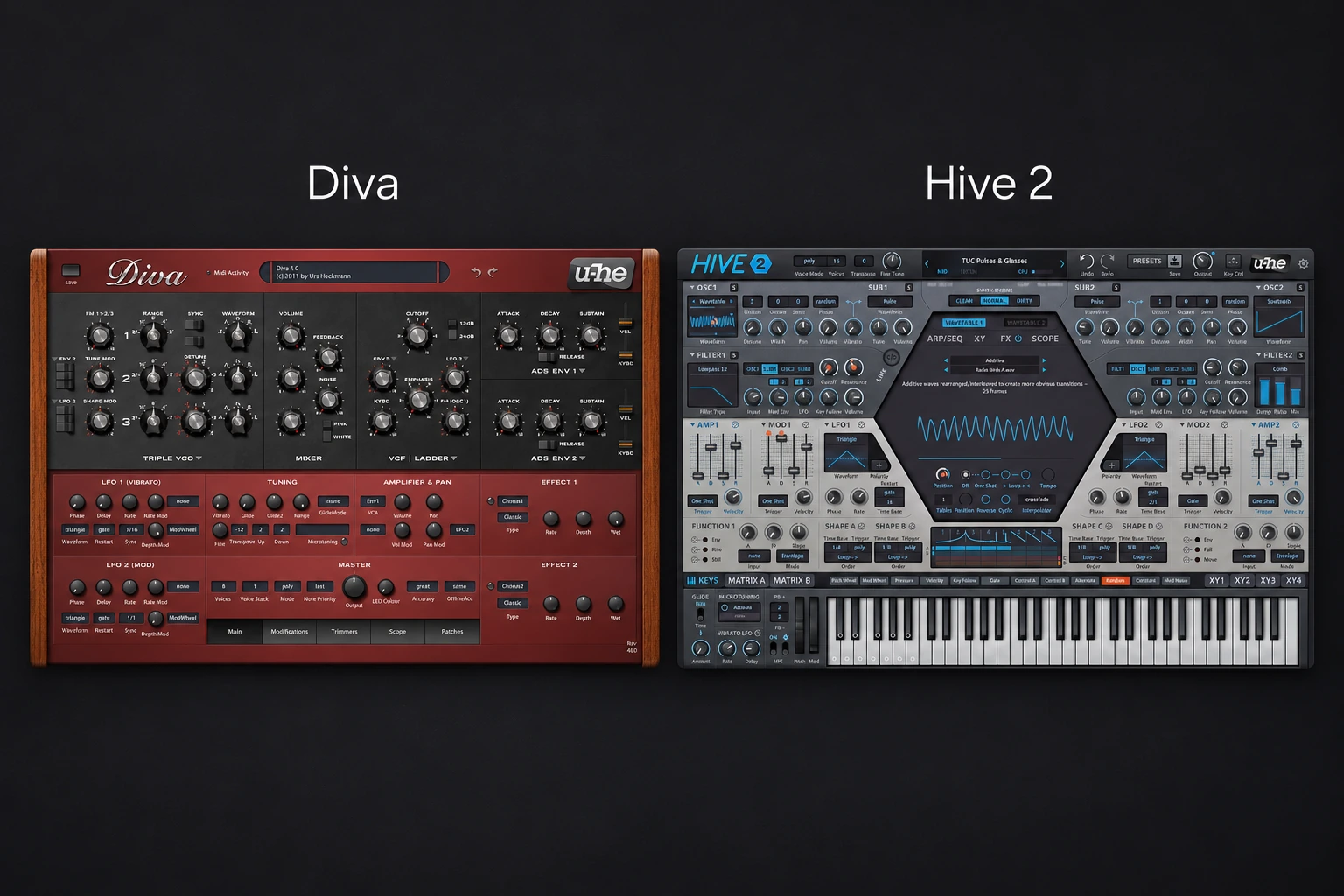

Choose Diva if you want to build sounds around modelled oscillator, filter and envelope components inspired by classic hardware. Choose Hive 2 if wavetable movement, flexible modulation and integrated sequencing are bigger priorities. Both can make basses, leads, pads and plucks. The useful difference is how you prefer to create and revise them.
Diva is often the synth we would shortlist for a particular filter-and-envelope response. Hive is the one we would investigate when the sound needs an evolving source or a detailed modulation pattern. Genre labels will not make that decision for you: either can belong in a contemporary electronic track.
Quick Comparison
| Buying question | Diva | Hive 2 |
|---|---|---|
| Core approach | Mix modelled oscillator, filter and envelope sections | Work within a consistent synth layout with standard waveforms and wavetables |
| Why shortlist it? | You enjoy shaping the response of a hardware-inspired instrument | You want varied sources, movement and pattern creation in one synth |
| Modulation direction | LFOs, envelopes and additional processing in the Modifications panel | Drag-and-drop routing, shape sequencing and function generators |
| Writing patterns | Arpeggiator | Arpeggiator, note sequencer and separate modulation-shape tools |
| Performance consideration | Check Accuracy, voice settings and project headroom | Designed for efficiency; still test your intended patches and voice counts |
Diva: choose the components, then shape the part
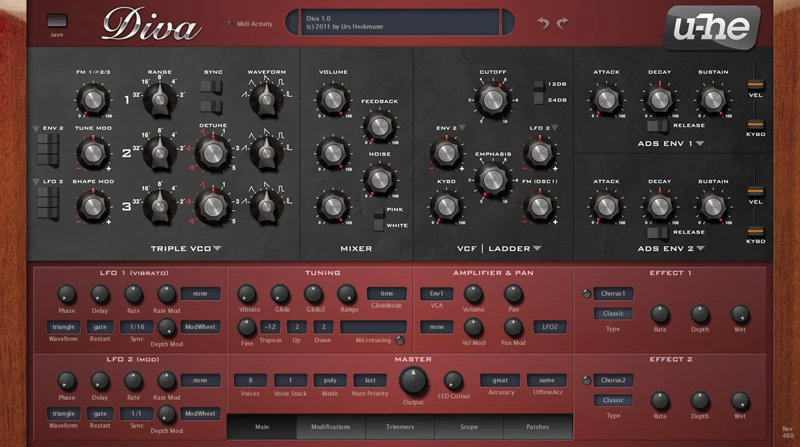
Diva lets you combine different oscillator, filter and envelope models. You are selecting from its available sections, so a patch can draw on more than one hardware-inspired design.
For a bass, begin with the oscillator balance, filter cutoff and envelope. Then change one component model and readjust the patch. The useful question is whether that response helps the notes sit in the song, rather than whether one model has a more famous inspiration.
The Trimmers and Modifications panels add voice variation and further ways to process modulation. You can explore detail beyond the main panel once the basic part works.
Diva also includes a Digital oscillator model. Its character is broader than a description based only on analogue waveforms would suggest. Our Diva review covers its component-based approach in more depth.
Hive 2: keep the layout and change the source
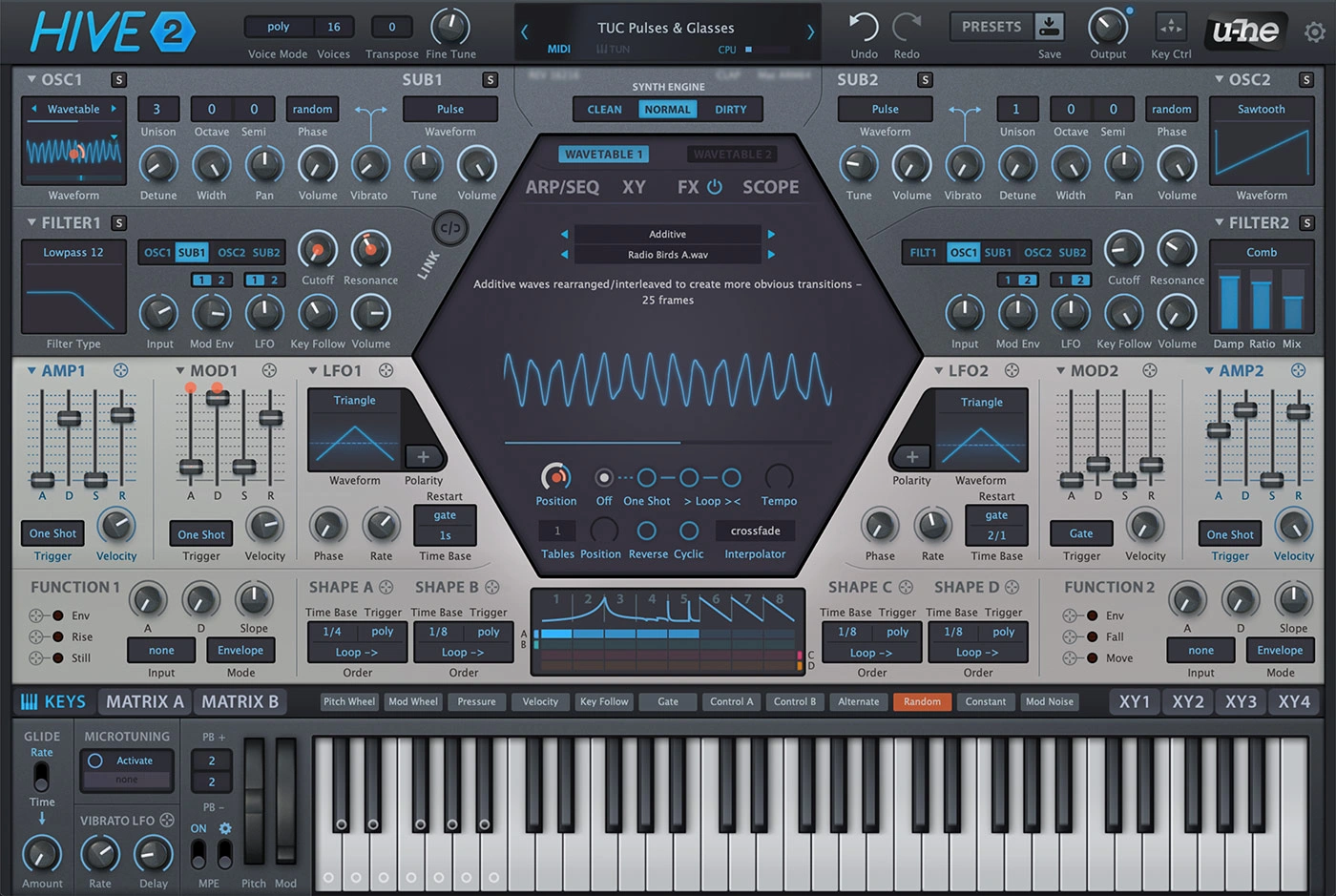
Hive 2 combines standard waveforms and wavetable options with filters, envelopes, modulation and effects in a consistent layout. Its Normal, Dirty and Clean engine characters provide another way to change the instrument's response.
Wavetables are a clear reason to investigate Hive. You can choose a source, find a useful position and modulate that position for tonal movement. Start with a slow, small change before making the whole range sweep repeatedly.
For a pluck or lead, first make the part work without extra movement. Then add enough change to keep repeated notes interesting. A sound that changes constantly can become harder to place beside a vocal.
Hive has deeper control than its streamlined presentation suggests. The Hive 2 review looks at its modulation, effects and broader buying value.
For bass and leads: compare the same musical job
We would try Diva first when the attraction is a particular oscillator-and-filter interaction. Build a simple bass or lead, then work on how the envelope opens the filter and how the note releases.
We would try Hive first when the idea depends on changing wavetable position or combining the source with a repeatable modulation pattern. Give that movement a purpose in the arrangement.
For a useful first comparison, use one saw oscillator, one unison voice and no effects in each synth. Play the same bass phrase and adjust the filter envelope to a similar length. Then add the feature you are considering buying: Diva’s alternative filter model or Hive’s wavetable movement. This separates the basic patch from the extra capability.
For bass, include the lowest and highest notes in the actual line. A patch that sounds convincing on one sustained note can become uneven when the part moves. Listen with the kick before adding more layers; our kick and 808 guide covers that balance.
Pads: choose the kind of movement you enjoy editing
Diva would be our first trial for a pad shaped mainly through oscillator balance, filtering, envelopes and restrained voice variation. Begin with the chord voicing and release so that the next chord arrives cleanly.
Hive would move ahead when evolving wavetable content or patterned modulation is central to the texture. Use one modulation source first, then add another only if it contributes something separate.
Both can create sounds with much more movement than the track needs. Compare the pad with the rest of the arrangement at a quiet level. If it competes with the lead, reduce its width, release or modulation depth before reaching for another plugin.
Hive's sequencing tools deserve a separate test
Hive includes an arpeggiator and note sequencer, plus a Shape Sequencer for modulation. Its function generators can provide additional envelopes, LFO-like movement, gates and related control functions.
To test Hive’s Shape Sequencer, hold one chord and send Shape A to filter cutoff at a shallow depth. Change that lane’s shape and timing while the MIDI stays fixed. This creates repeating parameter movement; it is a different job from the note sequencer generating pitches.
Diva also has an arpeggiator. The buying distinction is whether you want Hive's wider collection of sequencing and modulation tools often enough to make them part of your workflow.
If you already write every note and automation change in the DAW, give those extras less weight. A feature you rarely open should not decide the purchase.
CPU: test the project, not the reputation
u-he presents Hive as a CPU-friendly design. Diva's modelling can be demanding, and it provides Accuracy settings that trade processing cost against quality. That makes performance a useful part of this comparison, particularly for dense polyphonic arrangements.
Still, a preset comparison is not a controlled benchmark. Chord size, release, voice stacking, unison, wavetable settings and effects can change the load. Try the parts you intend to use in a busy section of your own project.
For Diva, audition lower Accuracy settings while writing if the session needs headroom, then check the intended offline-render setting. Test multicore behaviour in your DAW rather than switching it on across every instance automatically; u-he's manual explains that its benefit depends on the setup.
We have not measured a universal CPU ratio between these synths. Keep the result specific to your computer, host and patch.
Already own Serum, Pigments or another broad synth?
Start with what you want to add. If your current instrument already handles wavetable motion and detailed modulation comfortably, Hive needs a reason beyond covering those features again.
Diva may be a more contrasting workflow when you specifically want its modelled components and the decisions they encourage. That is a reason to try it, rather than proof that every digital synth collection needs an analogue-style instrument.
If you already own Diva or Hive, learn the less familiar parts before buying the other. A useful starting preset or a better understanding of modulation may solve the task you keep putting off.
For other comparisons, read Diva vs Serum 2 and Hive 2 vs Sylenth1. If the component-modelled approach is the attraction, Repro vs Diva narrows that decision further.
Price and value
Compare current U.S. license prices, including tax and any applicable account or bundle offer. A temporary discount should not decide which interface you want to work in for the next few years.
Conclusion
Diva is our first shortlist choice for producers who want its mix-and-match modelled components. Hive 2 is our first shortlist choice when wavetable sources, modulation and sequencing are the bigger attraction.
Neither choice locks you into a genre. Choose the sound-building process you enjoy and confirm that it runs comfortably in the projects you actually make.
Sources
This is editorial buying advice based on documented features, rather than a matched listening or CPU test. Sources checked 2 November 2026: u-he's Diva overview, Diva user guide, Hive 2 overview and Hive user guide.


