
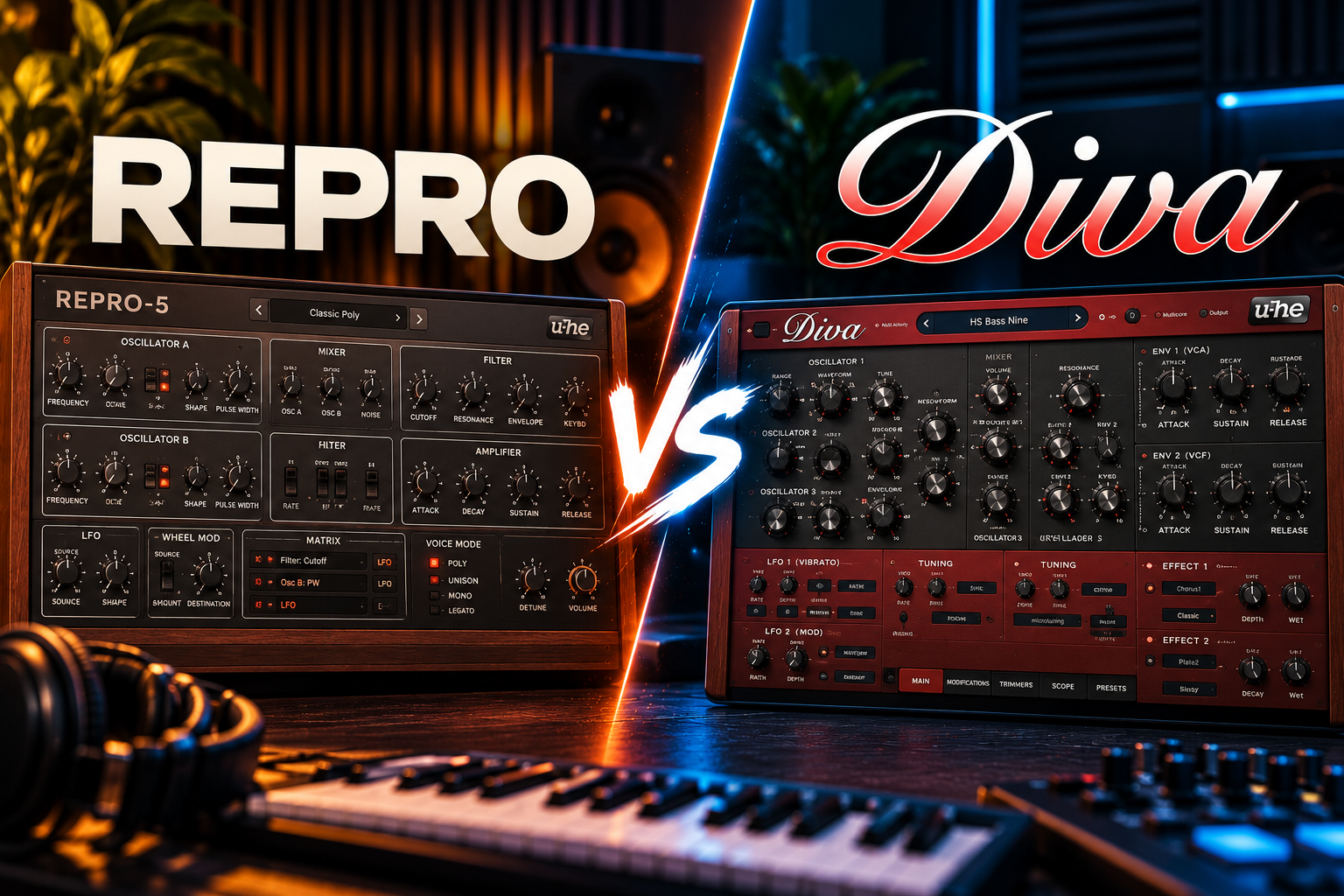

Repro and Diva are two of u-he's best-known analogue-style synths, but they are not trying to do the same thing. Repro gives you two tightly focused instruments inspired by specific vintage architectures. Diva is a broader modular-style analogue synth that lets you mix and match oscillator, filter and envelope models from different hardware traditions.
My short answer: choose Repro if you want a very specific, characterful vintage workflow that sounds great quickly. Choose Diva if you want a wider analogue palette and more freedom to combine different oscillator and filter types inside one instrument.
On October 6, 2026, Repro is $149 at Plugin Boutique and includes Repro-1 plus Repro-5. Diva is $179. That $30 difference is small enough that the architecture matters much more than the price.
| Decision | Repro | Diva |
|---|---|---|
| Best for | Focused vintage character, basses, leads, sequences, pads and classic polysynth sounds | Broader analogue sound design and hybrid vintage architectures |
| Price | $149 | $179 |
| What you get | Repro-1 + Repro-5 | One flexible synth with interchangeable modules |
| Oscillator concept | Fixed architecture per instrument | 5 oscillator models you can swap |
| Filter concept | Focused filters tied to the Repro architecture | 5 different classic-style filter models |
| Polyphony | Repro-1 mono; Repro-5 up to 8 voices | Up to 16 voices |
| Factory presets | 500+ Repro-1 + 950+ Repro-5 | 1,200+ |
| Sequencing | Repro-1 has a dedicated sequencer | Host-synced arpeggiator |
| MPE | Supported in current Repro release | Supported in Diva 1.4.8 |
| CPU use | Can be heavy | Can also be heavy, especially at higher quality |
| My pick for simplicity | Repro | — |
| My pick for analogue variety | — | Diva |
Repro vs Diva: the quick verdict
Repro is the easier synth to understand immediately. Repro-1 gives you a monophonic instrument for basses, leads and sequences. Repro-5 gives you a polyphonic instrument for chords, pads and unison sounds. The architecture is focused, so you spend more time shaping the sound and less time choosing the synth structure.
Diva is the better choice when you want more analogue variety in one plugin. u-he gives you five oscillator models, five filter models and three envelope models based on different classic hardware ideas. You can mix those modules instead of committing to one historical architecture.
The choice is therefore not “which one sounds more analogue?” Both are designed around detailed analogue modelling. The real question is whether you want focus or flexibility.
Why Repro is the better focused synth
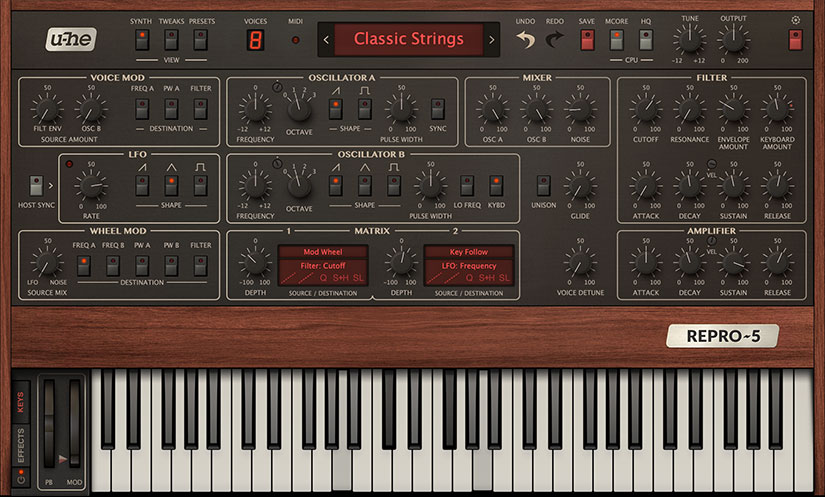
Repro's strength is that the architecture is deliberately narrow. You get two oscillators, a classic-style low-pass filter, envelopes, modulation and effects without needing to decide which historical oscillator and filter family to combine first.
Repro-1 adds a twin 32-step sequencer, making it especially good for basslines, repeating patterns and mono leads. Repro-5 adds polyphony, unison, voice panning and polyphonic distortion, making it much better for pads, chords and wider synth parts.
My take: Repro is what I would open when I already know I want a classic analogue-style sound and do not want to audition several architectures before making music.
Read our full u-he Repro review for the detailed Repro-1 vs Repro-5 breakdown.
Why Diva is the better all-round analogue synth
Diva is built around interchangeable hardware-inspired modules. u-he currently lists five oscillator models: Triple VCO, Dual VCO, DCO, Dual VCO Eco and Digital. It also includes five filter models: Ladder, Cascade, Multimode, Bite and Uhbie.
That is the core difference. You can pair an oscillator style inspired by one family of hardware with a filter inspired by another. Diva therefore behaves more like a collection of classic analogue building blocks than one strict emulation.
It also goes up to 16 voices, offers mono, duo and legato modes, supports per-voice detune and drift, and includes quality settings that let you trade CPU load against modelling detail.
My take: if I only wanted to buy one u-he analogue synth, Diva is the safer all-round choice because it covers more tonal ground.
Sound character: specific vs broad
Repro has a more identifiable personality. The oscillators, filter and component-level modelling are designed around a specific vintage family, so even relatively simple patches tend to share some sonic DNA.
Diva can move between several analogue flavours. A Ladder filter can give you one type of low-end and resonance behavior, while the Bite or Uhbie filters can push the same patch in a very different direction. Changing the oscillator model can be just as dramatic.
I would choose Repro when I wanted one strong character. I would choose Diva when I wanted to compare several classic flavours before committing.
Which is better for bass?
Repro-1 is excellent for bass because the mono architecture naturally keeps the line focused. The sequencer also makes it easy to design the rhythm and the tone together.
Diva is more flexible. You can choose between different oscillator and filter combinations, switch to mono or legato modes and use different quality settings depending on the project.
For a very specific gritty vintage bass, I would often reach for Repro first. For an all-purpose analogue bass synth, Diva wins because you have more architectures available.
Which is better for pads and chords?
Repro-5 can produce beautiful pads and chords, with up to eight voices, unison and per-voice panning. It is especially good when you want that specific warm vintage polysynth character.
Diva goes up to 16 voices and has more oscillator and filter combinations, so it can cover a wider range of pads, brass sounds, keys and polyphonic textures.
My pick for variety is Diva. My pick for a more specific classic polysynth sound is Repro-5.
Oscillators and filters: Diva wins on options
This is the clearest technical advantage for Diva. Five oscillator models and five filter models create many combinations before you even start using modulation.
u-he's Zero Delay Feedback filter design is a major part of Diva's identity, and the different filter models have noticeably different resonance and saturation behavior. The oscillator modules also vary significantly, from classic triple-VCO structures to DCO and Digital options.
Repro deliberately gives you fewer choices. That can feel restrictive on paper, but it also means you are less likely to spend ten minutes choosing the architecture before shaping the patch.
Modulation: neither is trying to be Serum
Neither Repro nor Diva is built around a giant modern drag-and-drop modulation system. Both are more traditional synths with modulation designed around their analogue-inspired architectures.
Diva gives you two LFOs, modulation processors and deeper Modifications controls such as invert, quantize, lag, multiply and add. Repro has a smaller modulation system but keeps the workflow closely tied to the original-style instruments.
If extreme modulation complexity is the goal, I would look elsewhere. If the goal is analogue-style movement that remains easy to understand, both work well.
Presets: Repro actually gives you more combined
u-he lists more than 500 factory presets for Repro-1 and more than 950 for Repro-5, giving the bundle more than 1,450 presets across the two instruments.
Diva includes more than 1,200 factory presets. It also has a huge third-party soundset ecosystem covering house, techno, synthwave, ambient, cinematic and melodic electronic styles.
I would not choose based on the raw number. Diva's presets span more architectures. Repro's presets are spread across two more focused instruments.
CPU: both can be demanding
Do not buy either synth expecting ultra-light CPU use. Detailed analogue modelling costs processing power.
u-he explicitly notes that Diva's authenticity comes with a relatively high CPU hit. Diva includes several quality settings plus a more CPU-friendly Dual VCO Eco model, so you can manage the load depending on the patch.
Repro can also be heavy, especially with Repro-5 polyphony and unison. Repro-1 includes a Sleepy mode that can reduce CPU use when the synth is idle.
My take: CPU should not decide the comparison unless your computer is already struggling. Test both demos inside a real project and freeze or bounce finished parts when needed.
Sequencing and arpeggiation
Repro-1 has the stronger built-in sequencing concept. Its two 32-step patterns can be chained for up to 64 steps, and the sequencer becomes part of the preset itself.
Diva includes a host-synced arpeggiator with swing and several progression options, but it is not the same kind of integrated pattern-building tool.
If sequences are central to your techno, synthwave or electronic workflow, Repro-1 has a real advantage here.
Price and value: $149 vs $179
| Purchase | Current price | What you are paying for |
|---|---|---|
| Repro | $149 | Two focused instruments: Repro-1 and Repro-5 |
| Diva | $179 | One broader instrument with mix-and-match analogue modules |
| Difference | $30 | Small enough that workflow matters more than price |
The price difference is only $30 at the current Plugin Boutique listings. That means I would not choose Repro just because it is cheaper.
Buy Repro because you want its specific character and focused workflow. Buy Diva because you want broader analogue coverage and the freedom to combine classic-style modules.
Demo: try both before deciding
Both u-he instruments use a similar demo system. The synth remains usable but introduces crackling at irregular intervals until you enter a license.
That is enough to compare them properly. Build the same three sounds in both: one bass, one lead and one pad. You will know very quickly whether you prefer Repro's fixed architecture or Diva's module choices.
Which one should you choose?
| Choose Repro if... | Choose Diva if... |
|---|---|
| You want a specific vintage synth character | You want a broader analogue palette |
| You like simple fixed architectures | You like mixing oscillator and filter models |
| You want Repro-1's integrated sequencer | You want up to 16 voices and more polyphonic flexibility |
| You want both a dedicated mono and poly synth in one purchase | You want one instrument that covers many analogue traditions |
| You prefer fewer decisions while designing patches | You enjoy choosing the architecture before shaping the sound |
| You already know you like the Repro / Prophet-style family | You want the safer all-round analogue purchase |
Does it make sense to own both?
Yes. There is overlap, but the workflows are different enough to justify both for someone who uses analogue synths heavily.
Diva can cover a much wider range of classic analogue ideas. Repro can still be faster when you specifically want the sound and behavior of its two focused instruments.
I would not buy both on day one. Start with Diva if you want maximum range, or Repro if you already know that its character is the one you want. Add the other when you can identify the gap it fills.
Final verdict: Repro or Diva?
For most producers buying one u-he analogue synth, I would choose Diva. The $30 price difference buys a much broader architecture: five oscillator models, five filter models, three envelope models and up to 16 voices.
I would choose Repro when I wanted focus rather than range. Repro-1 and Repro-5 are easier to treat as instruments with their own personality instead of a collection of interchangeable modules.
Neither is the “better sounding” synth in every situation. Diva is the better all-round analogue platform; Repro is the more specific character purchase.
For the deeper product breakdown, read our u-he Repro review.
Frequently asked questions
Is Diva better than Repro?
Diva is more flexible and covers more analogue architectures. Repro is more focused and gives you two specific instruments. Diva is the safer all-round buy; Repro is better when you specifically want its character.
Is Repro cheaper than Diva?
Yes. Plugin Boutique lists Repro at $149 and Diva at $179 when checked on October 6, 2026.
Does Repro include two synths?
Yes. One Repro license includes Repro-1 and Repro-5.
How many voices does Diva have?
Diva supports up to 16 voices and can also run in duophonic, monophonic and legato modes.
How many presets does Diva include?
u-he lists more than 1,200 factory presets for Diva.
Which is better for bass?
Repro-1 is excellent for focused mono basses and sequences. Diva offers more oscillator/filter combinations and is the more flexible all-purpose bass synth.
Which is better for pads?
Diva gives you more polyphonic and architectural variety. Repro-5 is excellent when you specifically want its vintage polysynth character.
Are Repro and Diva CPU heavy?
Both can be demanding because they use detailed analogue modelling. Diva offers quality settings and an Eco oscillator model, while Repro has its own CPU-saving behavior. Test them on your own system.
Research notes and official references
Prices and product details were checked on October 6, 2026. Recommendations are editorial judgments about workflow and value rather than claims that one synth is universally better.
Sources: u-he Repro, u-he Diva, Repro at Plugin Boutique and Diva at Plugin Boutique.
![[background image] image of recording equipment (for a musician & band)](https://cdn.prod.website-files.com/68efa70811edd8e5af30a90d/6acd43b8998701bbde84e11a_Best%20Export%20Settings%20for%20FL%20Studio.png)
![[background image] image of recording equipment (for a musician & band)](https://cdn.prod.website-files.com/68efa70811edd8e5af30a90d/6acd3f9347bd0dd62b202621_ShaperBox%203%20vs%20Infiltrator%202.png)
![[background image] image of recording equipment (for a musician & band)](https://cdn.prod.website-files.com/68efa70811edd8e5af30a90d/6acd3d99fa68785e0f58960e_Kontakt%208%20vs%20Decent%20Sampler.png)