
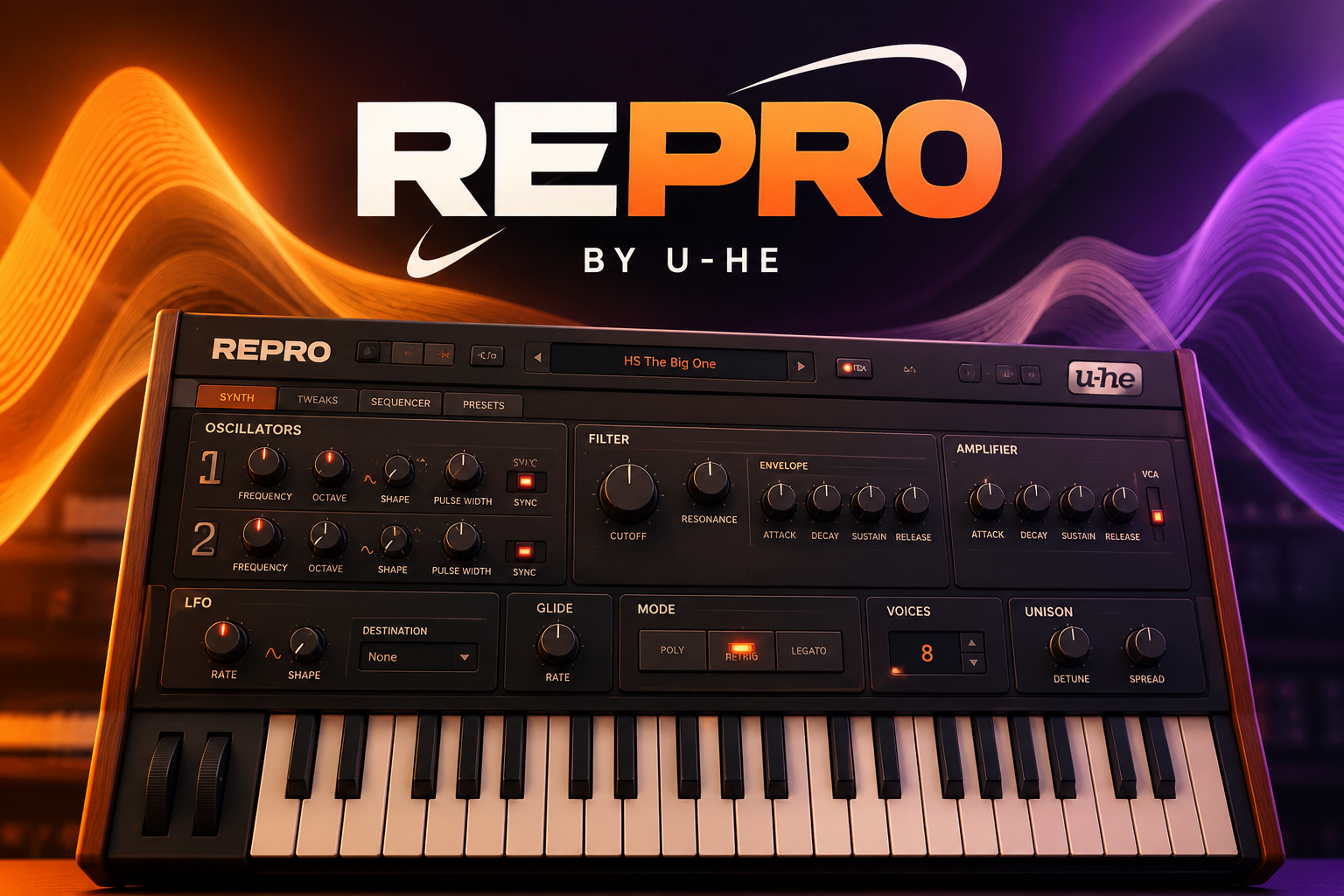

u-he Repro is one of the easiest vintage-style synth bundles to understand: one purchase gives you two different instruments. Repro-1 is a monophonic synth built for basses, leads, sequences and aggressive analogue-style sounds. Repro-5 turns the same general sonic idea into an eight-voice polysynth for chords, pads, unison leads and wider arrangements.
That combination is why Repro is more interesting than a simple “Prophet emulation” label suggests. You are not buying two skins for the same instrument. Repro-1 and Repro-5 overlap in character, but they solve different jobs inside a track.
My take: Repro makes the most sense for producers who specifically want convincing vintage analogue character without needing a huge modern modulation system. It is less attractive if you mainly value wavetable synthesis, endless routing or low CPU usage. The sound-first design is the point.
| u-he Repro at a glance | Details |
|---|---|
| Includes | Repro-1 and Repro-5 |
| Best for | Vintage basses, leads, sequences, pads, chords and analogue-style synth sounds |
| Price checked | $149 at Plugin Boutique on October 6, 2026 |
| Repro-1 | Monophonic, step sequencer, arpeggiator, 500+ factory presets |
| Repro-5 | Up to 8 voices, unison, polyphonic distortion, 950+ factory presets |
| Main downside | Heavier CPU use than many simpler virtual-analogue synths |
| Demo | Full demo with intermittent crackling until licensed |
u-he Repro review: the short verdict
I would shortlist Repro if the sound you want is classic, weighty and immediately musical. Repro-1 is especially good when a track needs one dominant mono part: a bass that holds the centre, a cutting lead or a repeating sequence. Repro-5 handles the opposite job, filling space with chords, pads and stacked unison sounds.
The bundle is deliberately narrower than a do-everything synth like Omnisphere. That can be a strength. The front panels make the core decisions obvious: oscillator shape, filter, envelopes, modulation and effects. You spend less time building a complex architecture and more time deciding whether the patch actually works in the song.
The trade-off is CPU. Component-level modelling is part of why Repro sounds convincing, but it is not the synth I would choose for dozens of simultaneous instances on a modest laptop. Freeze, bounce or use high-quality modes selectively if a project becomes heavy.
What is u-he Repro?
Repro is a software instrument bundle from u-he built around detailed analogue modelling. u-he describes the process as component-level modelling: instead of only approximating the broad response of an old synthesizer, the software models the behaviour and interaction of the original-style circuit components.
The result is two plug-ins in one product. Repro-1 is based on the idea of a classic early-1980s monophonic synth, while Repro-5 expands that family sound into the territory of a famous five-voice late-1970s polysynth. u-he avoids depending on the original brand names in the product itself, but the intended lineage is obvious to synth users.
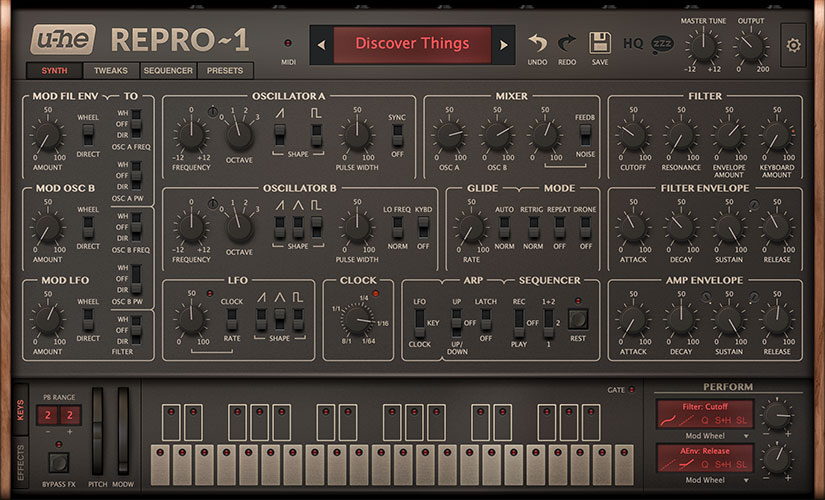
Both instruments share two oscillators, a resonant four-pole low-pass filter, envelopes, modulation and a set of high-quality effects. The important differences are voice architecture and workflow rather than basic sonic DNA.
Repro-1 vs Repro-5: which one should you use?
| Feature | Repro-1 | Repro-5 |
|---|---|---|
| Voices | Monophonic | Up to 8 voices |
| Best at | Bass, leads, sequences, arps, aggressive mono sounds | Pads, chords, keys, poly leads, unison stacks |
| Sequencer | Twin 32-step sequencer; up to 64 steps chained | No Repro-1-style step sequencer |
| Special processing | Wavefolder plus rearrangeable effects | Polyphonic distortion plus tape-style saturation/effects |
| Factory presets | 500+ | 950+ |
| My default use | One strong part that needs to lead the groove | A wider harmonic layer that fills the arrangement |
Repro-1 is the more characterful choice when monophony is useful rather than limiting. A bass line often benefits from only one note sounding at a time. The same applies to acid-like sequences, synth leads and arpeggiated parts that need a clear contour.
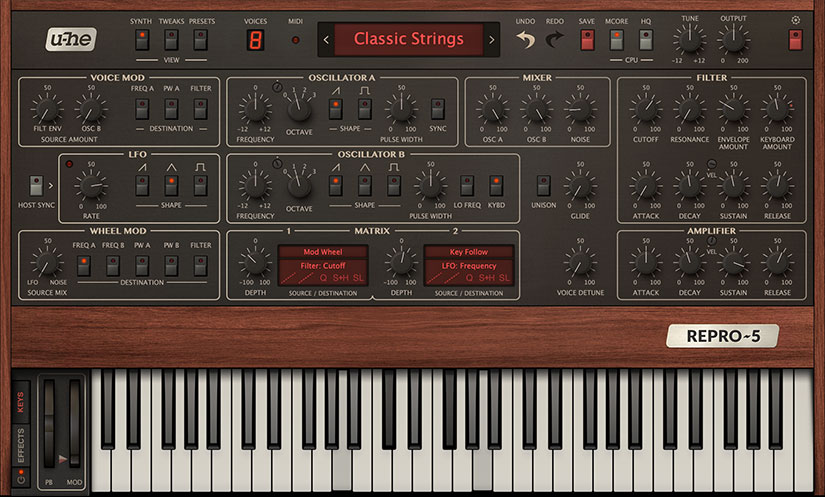
Repro-5 is the one I would open for chords. It supports up to eight voices, can run those voices in unison, gives each voice individual pan positioning and adds polyphonic distortion before the rest of the effect chain. That makes it naturally better for pads, brass-like stabs, vintage keys and huge detuned leads.
How does Repro sound?
Repro's appeal is not pristine neutrality. It is the small movement and saturation that make a simple patch feel less static. The oscillators and filter can sound clean enough for exposed parts, but the instrument becomes more interesting when you drive the signal, add voice variation or use the built-in effects.
My take: Repro is strongest when you resist the urge to over-design the patch. A two-oscillator bass through the filter can already sound finished enough to arrange around. That is useful in production because “interesting” does not automatically mean “complicated.”
For darker electronic music, synthwave, house, techno, hip-hop and cinematic work, the core tone fits naturally. Repro-5 can also do softer pads and understated keys; it does not have to sound aggressively retro. The trick is to treat the analogue character as a texture rather than a genre preset.
Repro-1: basses, leads and the sequencer
Repro-1 is proudly monophonic. It has two multi-wave oscillators, a resonant four-pole low-pass filter, an arpeggiator and a sequencer that can store two patterns of up to 32 notes each. Chaining those patterns gives you 64 steps.
The sequencer stores with the preset and supports velocity, rests and recording from a MIDI controller. That makes Repro-1 especially good for patches where the sequence and the sound are designed together. Change the filter envelope or oscillator tuning and the musical phrase immediately behaves differently.
My take: use the sequencer as a composition tool, not just a demo feature. A simple one- or two-bar pattern can tell you more about whether a bass patch works than auditioning the same note repeatedly in a preset browser.

Repro-5: pads, chords and unison
Repro-5 takes the shared Repro character into a polyphonic design with up to eight voices. Those voices can also be stacked into unison, which turns a relatively simple oscillator section into thick leads and basses when you want more width.
The voice-panning controls are particularly useful for subtle stereo movement. Rather than adding a huge chorus after the synth, you can distribute voices across the field and keep the central tone intact.
Repro-5 also includes a distortion stage per voice. Because each voice is processed independently before the rest of the effects, chords can be pushed without every note collapsing into the same shared distortion behaviour.
My take: Repro-5 is the half of the bundle I would use more often in full arrangements. Polyphony simply gives it more roles. Repro-1 may be the more distinctive specialist; Repro-5 is the broader everyday instrument.

The built-in effects are part of the instrument
Both Repro instruments include a set of stomp-box-style effects. Repro-1 includes the Jaws wavefolder, while Repro-5 uses the Velvet saturation/tape-style processor. Both also provide Lyrebird delay/chorus, RESQ EQ/resonator, Drench plate reverb and Sonic Conditioner.
The effects can be rearranged, which matters more than it sounds. Distortion before a resonant filter-style effect behaves differently from processing a large reverb tail. You can therefore change the personality of a patch without leaving the plug-in.
I would still avoid automatically filling every slot. If the raw patch already works, keep it dry. Use the internal processing when it is part of the sound design and leave final mix decisions to your normal DAW chain.
Tweaks, modulation and MPE
The Tweaks page exposes deeper changes to the behaviour of the modeled modules. It is there for people who want to move beyond the standard front-panel response without turning Repro into a modular synth.
The current 1.1.3 release also doubled the number of modulation slots to four and added MPE support for polyphonic presets in Repro-5. CLAP support, native Apple silicon AAX support and GUI improvements were also added in that release.
My take: these deeper options are useful precisely because they are secondary. You can ignore them while writing, then return when a patch needs a particular response. Repro does not make you configure a modulation matrix before it sounds good.
Are the factory presets good enough?
u-he lists more than 500 factory presets for Repro-1 and more than 950 for Repro-5. That is enough material to use Repro as a preset-driven instrument before you learn the synthesis architecture.
I would still save a small personal favorites folder early. A large preset count can become another browsing problem. Mark the basses, pads and sequences that consistently fit your music, then use those as starting points instead of reopening the entire library every session.
There is also a large third-party soundset ecosystem for Repro. Buy extra presets only after the factory library stops covering a specific need; more sounds are not automatically more useful.
How heavy is Repro on CPU?
CPU use is the main practical downside I would consider before buying. Detailed analogue modelling is more demanding than many lightweight virtual-analogue synths, and Plugin Boutique's own review summary repeatedly notes high CPU use as the main complaint from otherwise very positive user reviews.
Repro-1 includes a Sleepy mode that reduces CPU when the synth is idle, but that does not make a dense active patch free. Repro-5 naturally becomes heavier when you increase voice count or use unison.
My workflow would be simple: write at the quality and voice settings that let the project stay responsive, then freeze or bounce finished Repro tracks. A great synth that makes the DAW unpleasant to use is not helping the production.
u-he Repro price and demo
Plugin Boutique lists u-he Repro at $149 on October 6, 2026. That license includes both Repro-1 and Repro-5. u-he's own store lists Repro at €149. Prices and promotions can change, so check the live listing before purchasing.
u-he also provides a demo. It is not a time-limited “three days and it stops” trial; instead, the unregistered version introduces mild crackling at irregular intervals after some use. That still lets you test the full workflow in your own DAW before paying.
Repro vs Diva
For the full head-to-head breakdown, see our Repro vs Diva comparison.
Repro and other virtual-analogue synths are often compared on sound, but Repro vs Diva is especially useful because both come from u-he and both chase convincing analogue behaviour.
| Decision | Repro | Diva |
|---|---|---|
| Core concept | Two focused recreations with fixed vintage-inspired architectures | Mix-and-match analogue-inspired oscillator, filter and envelope modules |
| Price checked | $149 | $179 |
| Best for | A specific Pro-One / Prophet-style family of sounds and workflow | Broader analogue palette and hybrid vintage architectures |
| My choice | When I want character quickly | When I want more model variety inside one synth |
I would choose Repro if I specifically liked its architecture and tone. I would choose Diva when variety matters more and I want to combine different vintage-inspired components in one patch. Neither purchase makes the other redundant, but buying both only makes sense if those workflow differences matter to you.
Repro-5 vs Arturia Prophet-5 V
If the Prophet-style side is what interests you most, Arturia's Prophet-5 V is an obvious alternative. It is also listed at $149 when checked, so this is less about price and more about which modelling, interface and added features you prefer.
My take: trial both before deciding. Repro gives you Repro-1 as part of the same purchase, which is a real value advantage if you also want a strong mono synth. Arturia may make more sense if you are already invested in the V Collection ecosystem or prefer its implementation.
u-he Repro pros and cons
| Pros | Cons |
|---|---|
| Two genuinely different synths in one license | CPU use can be high |
| Strong vintage analogue character without a complicated interface | Narrower synthesis palette than a modern do-everything synth |
| Excellent mono workflow in Repro-1 and useful polyphony in Repro-5 | No standalone version; it requires a host/DAW |
| Large factory preset library | Producers who already own several Prophet-style emulations may have overlap |
| Built-in effects and deeper tweak options extend the basic architecture | The demo crackle can be annoying during longer tests |
System requirements and plugin formats
Repro requires a DAW or other host software; it is not standalone. u-he currently lists CLAP, AUv2, VST3 and AAX on macOS, and VST3, CLAP and AAX on Windows. The current release supports Apple silicon, and Repro is NKS-ready for compatible Native Instruments hardware.
u-he lists macOS 10.10 or newer, Windows 7 or newer, at least 1 GB RAM, a modern CPU and a 1000 × 600 or larger display. Linux builds are also available, although u-he describes Linux support as beta-level compared with macOS and Windows.
Who should buy u-he Repro?
Buy Repro if you want vintage-style synth character and you actually like working within a focused architecture. It is especially easy to recommend to producers making synthwave, techno, house, electronic pop, hip-hop or cinematic music where basses, sequences, pads and classic polysynth colours are useful.
I would skip it if your main goal is modern wavetable design, granular processing or extremely deep modulation. In that case, something broader may give you more creative range. Our Omnisphere 3 guide covers a very different, much larger sound-design environment.
I would also think twice if you already own a Prophet-style emulation that you genuinely use. Repro can sound excellent and still be unnecessary. The right question is not “is this authentic?” but “does this give me a workflow or sound I do not already reach quickly?”
Final verdict: is u-he Repro worth it?
Yes, if you value sound and immediacy more than feature count. At $149, getting both Repro-1 and Repro-5 makes the package more versatile than buying a single vintage recreation. The mono synth gives you a focused bass/lead/sequencer instrument, while the poly synth covers the chord and pad side of the same sonic family.
The main reason not to buy it is overlap. Producers with a large collection of analogue emulations may already have these roles covered. The other practical concern is CPU. Test the demo inside a normal project, not an empty DAW, and see whether the sound justifies the processing cost on your machine.
If it does, Repro is the kind of synth that can stay useful for years because its value is not tied to a trend or an enormous content library. It gives you a small set of strong tools and asks you to make musical decisions with them.
Frequently asked questions about u-he Repro
Does Repro include both Repro-1 and Repro-5?
Yes. Repro is one product and one license containing both synthesizers.
What is the difference between Repro-1 and Repro-5?
Repro-1 is monophonic and includes a step sequencer and arpeggiator. Repro-5 is polyphonic with up to eight voices, unison, voice panning and polyphonic distortion.
Is Repro a Prophet-5 emulation?
Repro-5 is clearly inspired by the architecture and character of a famous five-voice late-1970s polysynth. Repro-1 targets the related classic monophonic design. u-he's own documentation describes them as detailed component-level models of those vintage concepts.
How much does u-he Repro cost?
Plugin Boutique listed Repro at $149 when checked on October 6, 2026. u-he's own store showed €149. Check the current listing because pricing can change.
Can I demo Repro before buying?
Yes. u-he offers an unregistered demo that introduces mild intermittent crackling rather than disabling the instrument after a fixed trial period.
Is Repro CPU heavy?
It can be. Detailed analogue modelling and polyphony can use more CPU than lighter synths. Test it in a real project and freeze or bounce tracks when necessary.
Does Repro work on Apple Silicon?
Yes. The current release supports Apple silicon, including native AAX support in the current 1.1.3 release.
Research notes and official references
This review combines documented product features with editorial judgments about workflow and buying decisions. It does not claim a controlled hands-on benchmark. Pricing and compatibility information were checked on October 6, 2026.
Sources: u-he Repro product page, u-he Repro release notes, Repro at Plugin Boutique, Diva at Plugin Boutique and Arturia Prophet-5 V at Plugin Boutique.
![[background image] image of recording equipment (for a musician & band)](https://cdn.prod.website-files.com/68efa70811edd8e5af30a90d/6acd43b8998701bbde84e11a_Best%20Export%20Settings%20for%20FL%20Studio.png)
![[background image] image of recording equipment (for a musician & band)](https://cdn.prod.website-files.com/68efa70811edd8e5af30a90d/6acd3f9347bd0dd62b202621_ShaperBox%203%20vs%20Infiltrator%202.png)
![[background image] image of recording equipment (for a musician & band)](https://cdn.prod.website-files.com/68efa70811edd8e5af30a90d/6acd3d99fa68785e0f58960e_Kontakt%208%20vs%20Decent%20Sampler.png)