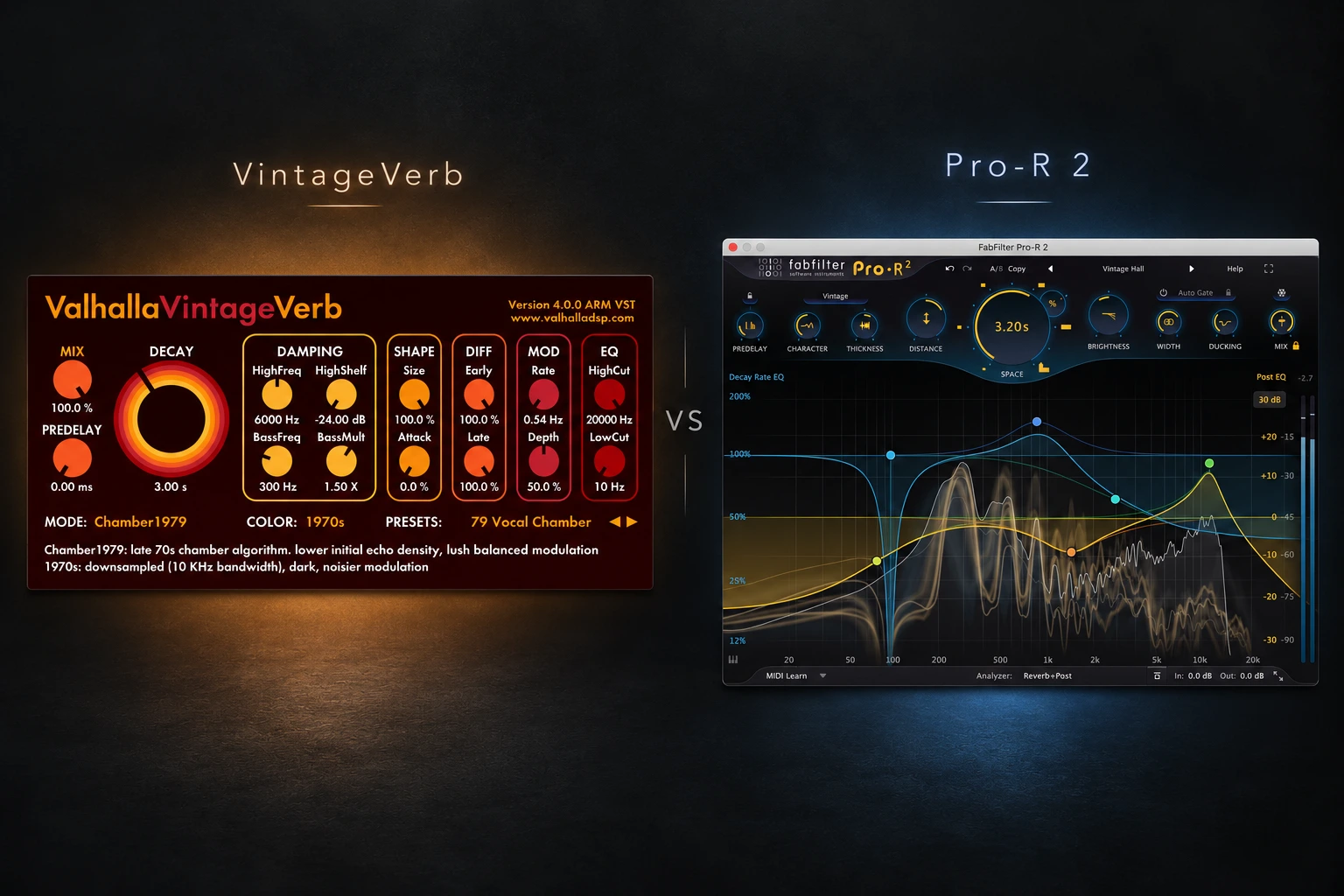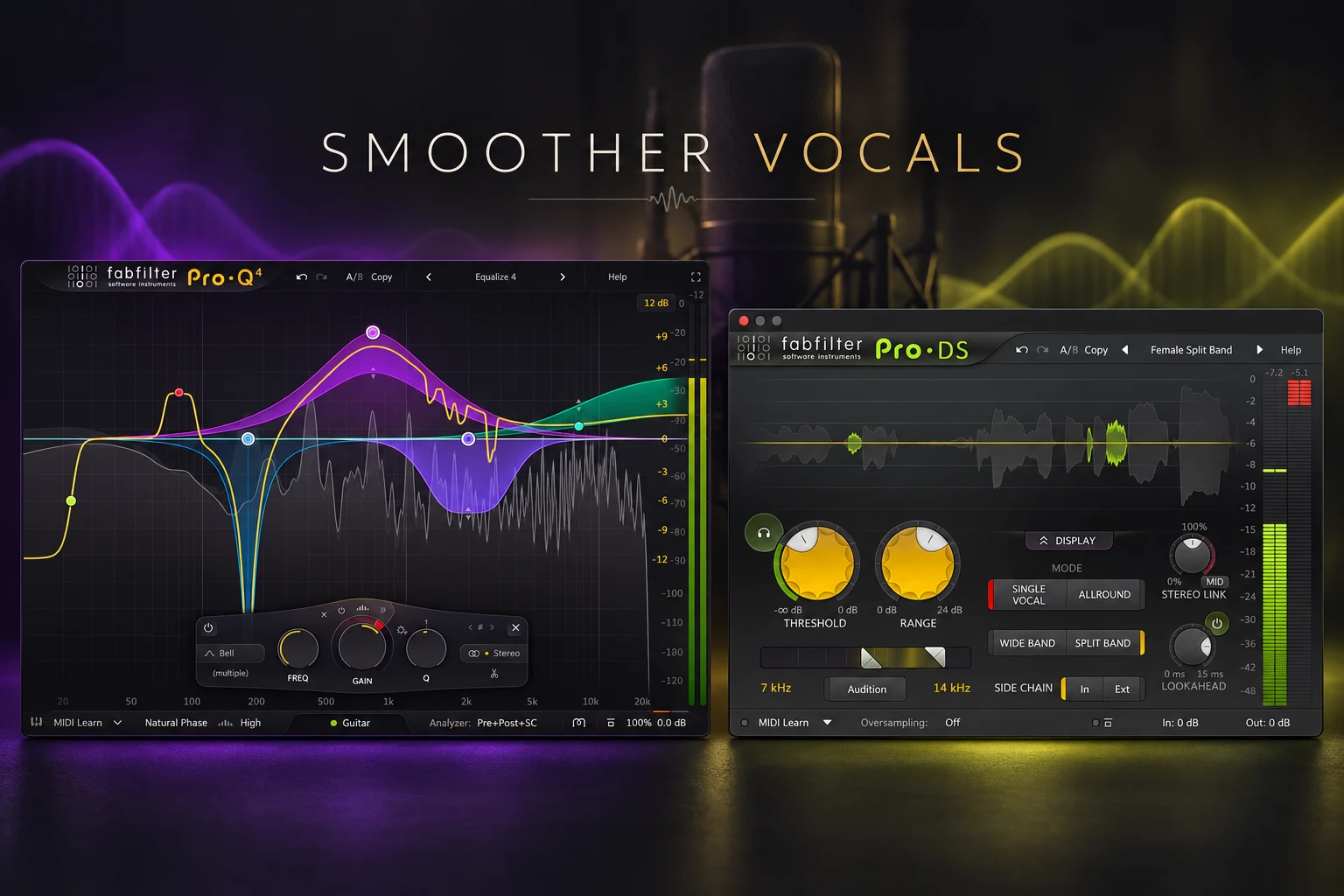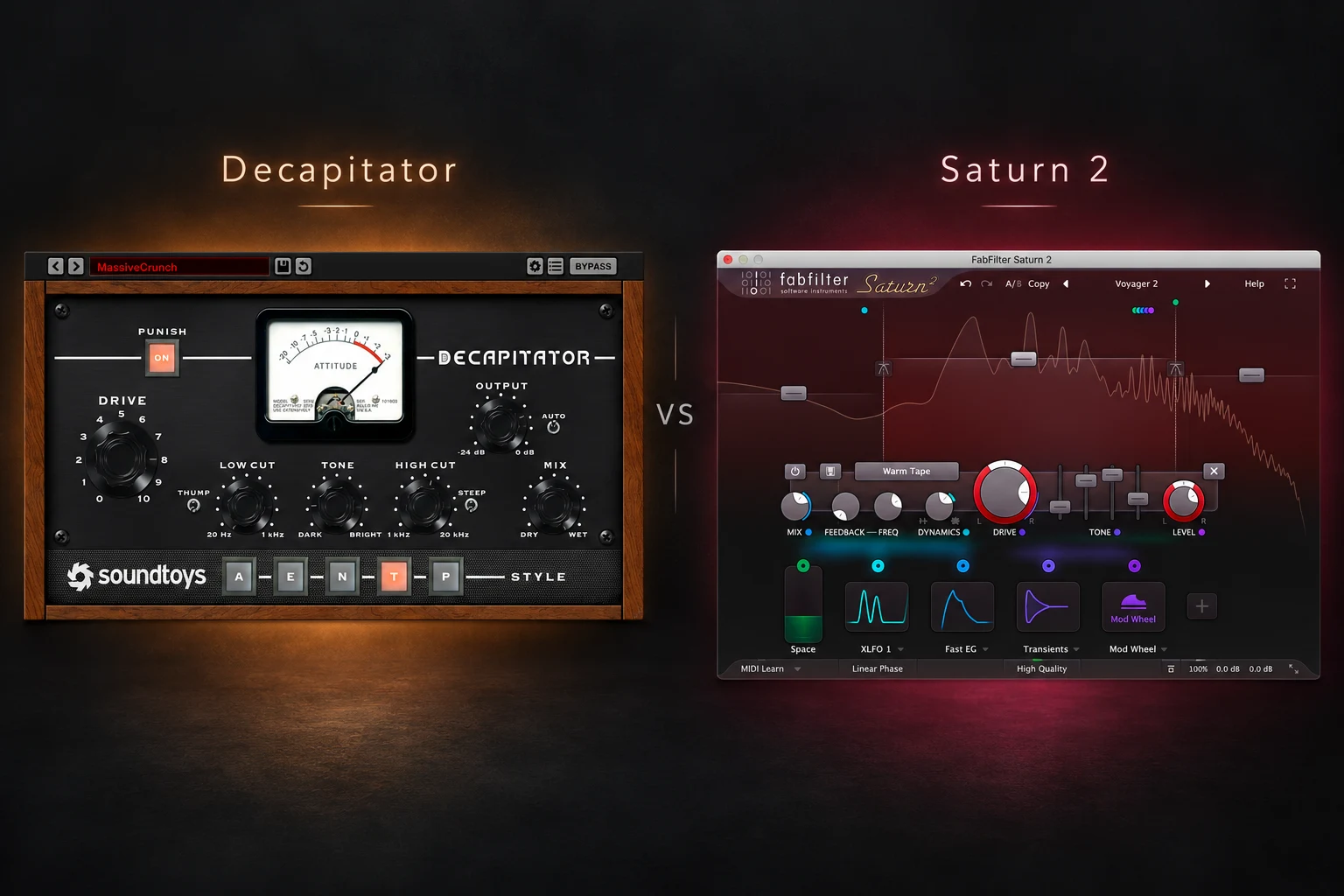
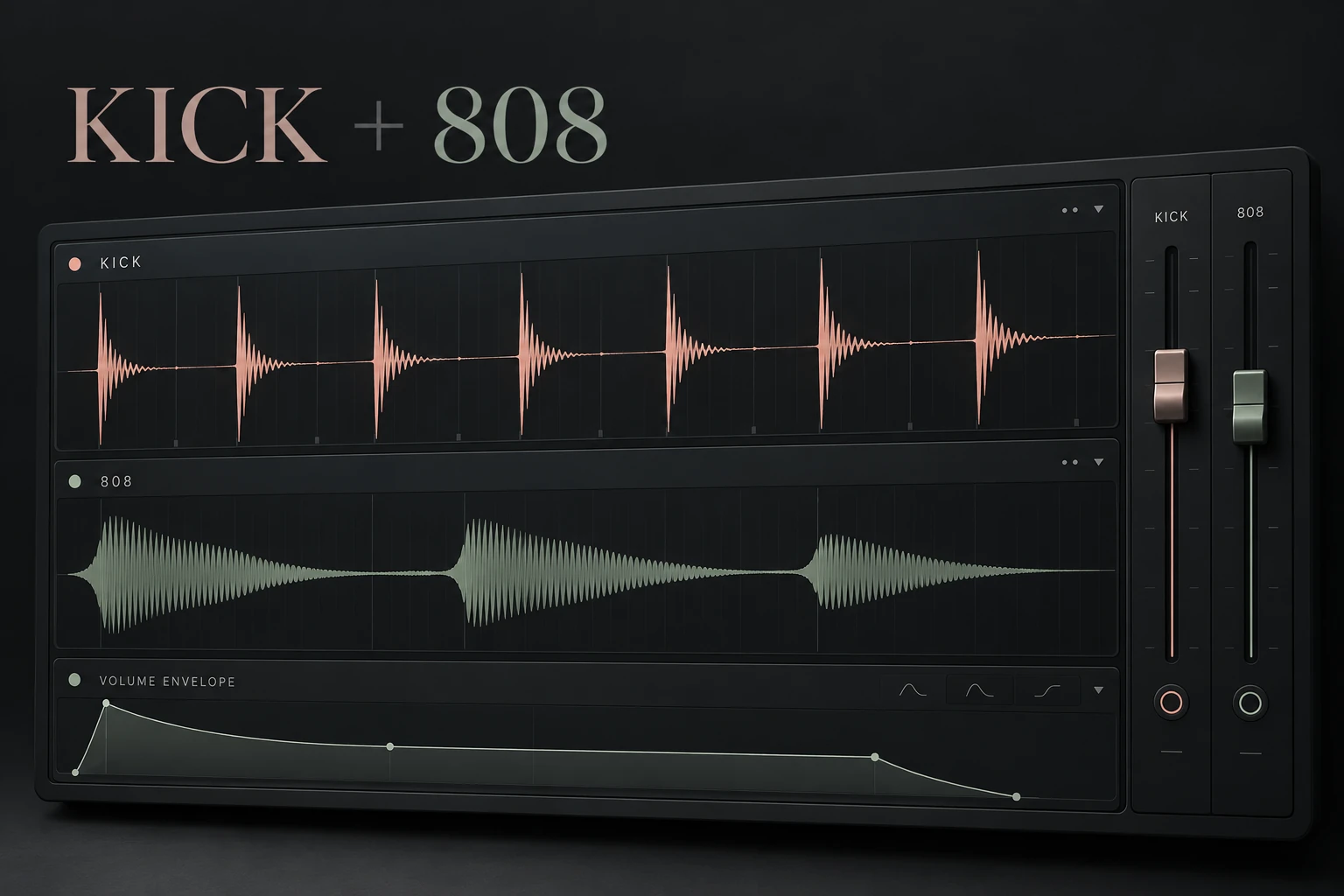

To mix a kick and 808, give them clear jobs: let the kick provide the hit and let the 808 carry the bass line, then control the overlap where they meet. Start with compatible sounds, correct bass tuning and sensible note lengths. Add EQ or ducking only where the pair still needs help.
That is our starting recommendation for a sustained 808 bass line in trap, drill or hip-hop. A track built around a huge, ringing kick may need a different balance. The right result is a readable groove with enough weight, rather than two impressive solo sounds competing for the same moment.
First, identify what is actually going wrong
Loop a section containing several bass notes and the busiest kick pattern. Listen to the pair briefly, then bring the full beat back. Use these symptoms to choose your next move.
The kick disappears when the 808 enters: check their relative levels, attack and overlapping low-frequency energy.
The pair sounds weaker together: investigate polarity and timing as well as masking. Do not assume every weak hit is a phase problem.
Some bass notes boom while others disappear: check tuning, note levels, sample behavior and playback on another familiar system.
The bass line keeps dropping away: bypass sidechain processing. Your ducking may last too long for the pattern.
The beat is clear before the master chain: revisit clipping, limiting or bus compression before redesigning the bass sound.
Choose a pair that works before reaching for EQ
Here, “808” means a pitched, sustained bass sound, rather than every drum sound from the original Roland machine. Many modern 808 samples already contain a strong attack. Adding another kick is a musical choice, not an obligation.
In his 808 mixing walkthrough, Kevin McHugh shortens the kick's decay so that its initial punch complements the sustained bass. By contrast, engineer Lu Diaz's contribution to Waves' producer roundup stresses how widely 808s vary and how adding a kick changes their relationship.
SoundShaper advice: for a long 808, audition a shorter kick first. Compare a few at similar perceived levels, inside the beat. Keep the one that adds useful definition without requiring you to hollow out the bass. If the 808 already supplies the hit you need, try removing the extra kick from some notes.
When both sounds have long, heavy tails, decide which tail you actually want to hear. Making both louder usually postpones that decision.
Tune the bass line; judge the kick by its tone
Check the 808's sustained pitch against the song, rather than judging only its initial pitch drop. Verify the actual notes produced by your sampler: a sample filename and a Piano Roll label do not guarantee correct mapping. Play several notes against the harmony before committing to the part.
Producer Bruce Aisher's drum-tuning tutorial distinguishes long, clearly pitched kicks from short, clickier sounds. The former warrant more attention to tuning. Transposing a sample also changes its character, so listen to the whole hit after making an adjustment.
Our approach would be to tune an obviously tonal kick if it clashes, but keep a short kick that already works. Forcing every kick onto the song's root note is too rigid a starting rule. A moving 808 line will not stay on that root anyway.
As a practical check, loop three different notes from the real bass part. Does the kick still feel connected on all three? A pairing that works only on the first note needs another listen.
Shape the overlap in time
A long kick decay can cover the beginning of the 808. An 808 note that rings past its intended ending can also crowd the next kick or bass note. Try shortening the relevant tail before making a permanent frequency cut.
Phil Speiser's kick-and-bass workflow puts envelope shaping first and uses roughly a sixteenth note as his kick-length target. We take the envelope-first idea, but would choose the length from the actual beat. His dance-oriented target is not a requirement for every trap pattern.
For reference, a sixteenth note at 140 BPM lasts about 107 ms. That is a timing reference, not a claim that every kick should end there. An isolated hit can afford more space than a rapid fill.
In FL Studio Sampler: open the envelope/instrument settings, select Volume and enable the envelope. Hold, decay, sustain and release determine how the sound continues and ends. The Image-Line envelope documentation explains these controls. Adjust them while the real notes play, keeping a short fade where needed to avoid abrupt clicks.
Image-Line also notes in its Sampler manual that samples can continue after note release unless the volume envelope is active. Simply drawing a shorter Piano Roll note may therefore leave the tail unchanged.
Check polarity without sacrificing the groove
Overlapping low-frequency waveforms can reinforce or partially cancel. Compare the pair with the polarity of one sound reversed, keeping their levels unchanged. Listen across the whole bass phrase, including slides and repeated notes, before keeping the change.
Polarity inversion flips the signal's sign; moving a sample changes its timing. These are different operations, as the iZotope phase guide explains.
Our recommendation is to use waveform inspection as a clue. A fixed kick and a changing bass line do not maintain one identical cycle relationship throughout the song. Improving the first overlap does not guarantee that every later note improves.
If you audition a small timing shift, check the snare, hats and full groove afterwards. Keep it only if the musical result improves. When alignment becomes an endless repair job, return to sound selection or reduce the overlap instead.
Choose the kind of separation you need
Static EQ: useful when a sound has unwanted weight throughout the phrase. A cut stays active between kicks too, so be careful about removing the 808's foundation to fix a brief collision.
Full-band sidechain compression: lowers the whole 808 when the kick triggers the compressor. Try it when a brief dip in the entire bass sound suits the groove.
Dynamic EQ or multiband ducking: reduces a selected frequency area during the overlap. The iZotope kick-and-bass guide demonstrates band-specific ducking. It is an option when you want the upper part of the bass to remain more continuous.
Volume shaping: lets you draw the dip and recovery directly. For an irregular kick pattern, use a trigger that follows the actual hits. A repeating beat-synced curve may otherwise dip on an empty beat or miss a syncopated kick.
Our preference for a melodic 808 would be the smallest dip that restores the kick's outline. If the line starts sounding chopped into pieces, reduce the depth or shorten the recovery. Obvious pumping is a valid effect when you want it.
FL Studio: sidechain the kick to the 808 with Fruity Limiter
1. Route the kick and 808 to separate Mixer tracks. Select the kick track, right-click the routing switch beneath the 808 track and choose Sidechain to this track.
2. Put Fruity Limiter on the 808 track. Open its COMP tab, right-click the SIDECHAIN selector and choose the kick's Mixer track.
3. Increase Ratio and lower Threshold until the kick triggers a small reduction. Adjust Attack and Release while the phrase loops. Listen for a clear hit followed by the return of the bass.
These routing steps follow the Fruity Limiter manual. Image-Line warns that a release set too low can cause distortion. Lengthen it if the bass becomes rough, then check whether the recovery still fits the groove.
Make sure the bass survives beyond your headphones
Kevin McHugh's 808 guide explains why upper harmonics help a low bass note register on systems that cannot reproduce much sub-bass. If the line disappears on a small speaker, audition some saturation instead of continually boosting the lowest frequencies.
Our check would be whether you can follow the bass melody at a modest level without making the kick harsh. Keep distortion intentional; a sample that already has plenty of harmonics may need no extra processing.
Also compare stereo and mono playback. A centered, stable low-end foundation is our default starting point, while higher bass texture can be wider if it survives the comparison. A stereo effect should earn its place through the audible result.
Finally, compare the full beat before and after your loudness processing at similar listening levels. If the kick loses definition only when the limiter works hard, try reducing the level into that stage. For related issues, see soft clipping versus limiting in FL Studio and our muddy-mix troubleshooting guide.
Optional tools: buy for a specific workflow
The stock route above is enough to begin. A paid tool is worth considering when it makes a task you repeat easier.
Duck 2 offers drawn volume envelopes and MIDI, audio and sidechain triggering, according to Devious Machines. Consider it if you prefer editing the recovery shape visually. Our Kickstart 2 versus Duck 2 comparison covers the workflow choices.
Trackspacer applies a changing inverse EQ curve based on its sidechain input. Wavesfactory provides frequency-range controls so you can restrict the processing. Consider it for recurring spectral masking; read our Trackspacer review before deciding.
SoundShaper opinion
For most sustained trap 808s, we would start with a shorter kick, a correctly tuned bass line and deliberate note endings. Then we would use subtle ducking only if the kick still loses definition. That combines McHugh's division of roles with Diaz's emphasis on the actual source material.
For sliding drill bass, we would check the complete phrase rather than phase-aligning one isolated note. For a distorted 808 with a strong attack, we would first ask whether a second kick improves the beat. For a sparse, heavy track, we would allow more sustain if that weight is central to the sound.
This is a research-based editorial guide. The linked engineering perspectives inform our recommendations; we are not presenting them as SoundShaper listening-test results.
Conclusion
A kick and 808 work together when the hit is clear and the bass line keeps its musical shape. Choose compatible sounds, check pitch and note lengths, then address the overlap with the appropriate tool. Judge every change across the actual phrase and through the finished beat.
If you need to build the 808 sound itself, our 808-layering guide covers that separate task.
Sources and further reading
Kevin McHugh / iZotope: How to Mix 808s — kick length and bass harmonics.
Waves: 808 tips from producers and mixers — different source sounds and production priorities.
Bruce Aisher / Attack Magazine: Drum Tuning Basics — tuning and tonal character.
Phil Speiser: Kick-and-bass workflow — envelope shaping and ducking approaches.
iZotope: How to Mix Kick and Bass — EQ and selective ducking.
iZotope: Phase in Audio — polarity and timing.
Image-Line: Sampler envelopes, sample playback and Fruity Limiter — FL Studio controls and routing.