
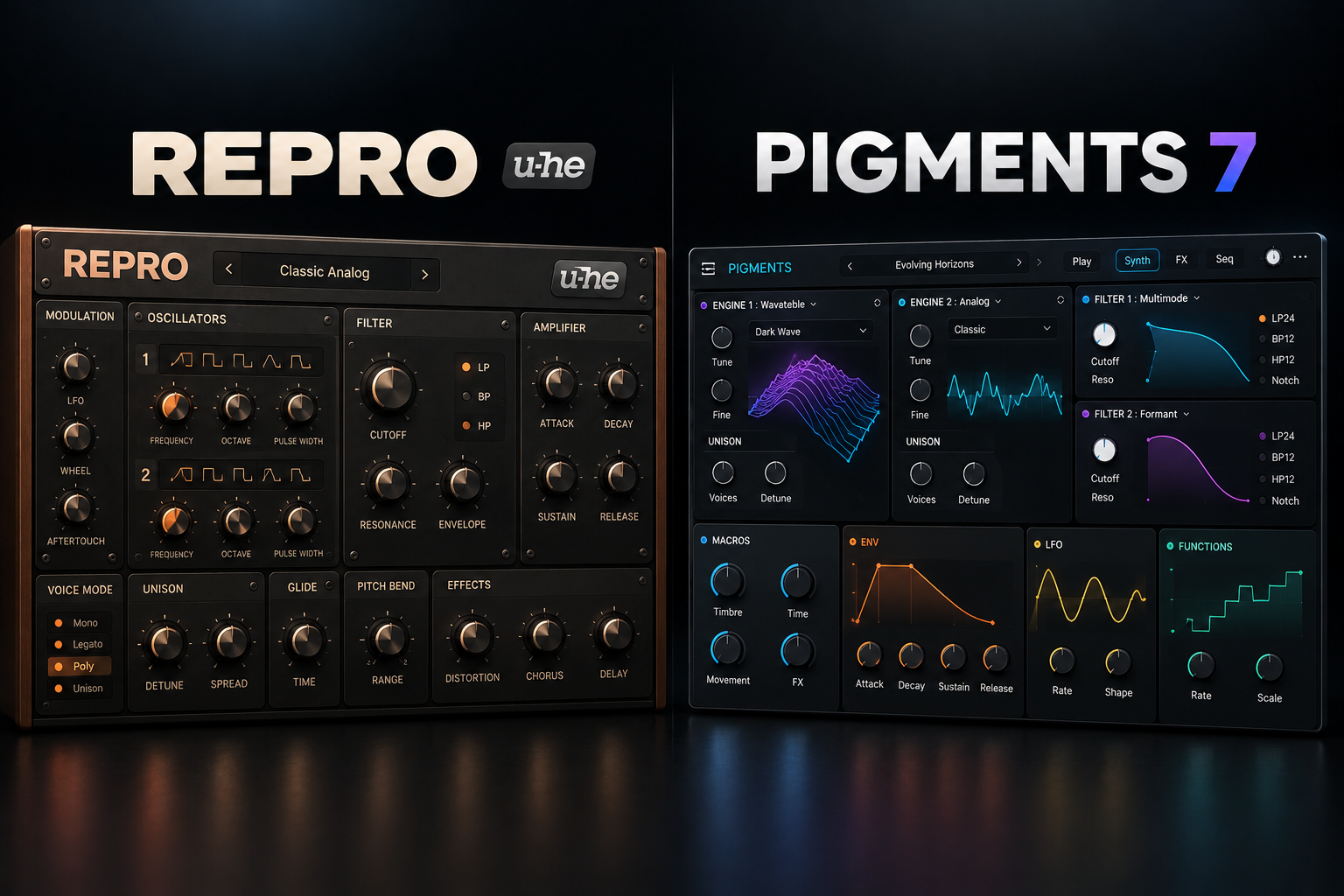

Some producers want a synth that makes a classic analog sound feel immediate. Others want a workstation for shaping completely new textures. u-he Repro and Arturia Pigments 7 sit on opposite sides of that choice: Repro recreates the character and workflow of two vintage instruments, while Pigments combines multiple synthesis methods with extensive modulation. For warm, focused analog-style leads and basses, we would start with Repro. For evolving pads, unusual basses and more experimental sound design, Pigments 7 is the more flexible choice.
Neither purchase guarantees a better track. The most useful synth is the one that helps you create the parts you actually need.
Repro vs Pigments 7: quick comparison
| Feature | u-he Repro | Arturia Pigments 7 |
|---|---|---|
| Core concept | Two modeled vintage-inspired synthesizers | Modern hybrid synthesizer with multiple sound engines |
| Included instruments | Repro-1 and Repro-5 | One flexible multi-engine synth environment |
| Best strengths | Classic leads, bass, pads and analog-style character | Complex modulation, moving textures and modern sound design |
| Workflow | Focused, hardware-inspired controls | Deeper visual modulation and synthesis routing |
| Developer price checked 18 Oct 2026 | €149 | Check Arturia / retailer checkout |
| Best first choice | Vintage analog sounds | Broad experimentation and evolving presets |
What makes Repro different?
u-he Repro comes with two synths. Repro-1 focuses on a classic monosynth workflow with oscillators, filtering, modulation and an arpeggiator. Repro-5 extends the family into polyphonic sounds for chords and pads. The emphasis is on the character of carefully modeled analog components, including subtle variations and circuit behavior.
This is particularly useful when you have a clear musical target: a vintage-style bass, a bold lead or a lush synth chord. Rather than choosing between many unrelated synthesis engines, you work within a deliberately defined instrument design.
SoundShaper advice: Repro suits producers who enjoy sculpting classic synthesizer tones and want to learn a focused instrument deeply. It can be less appropriate if your main goal is granular experimentation or elaborate multi-stage modulation.
What makes Pigments 7 different?
Arturia Pigments 7 is designed around several synthesis engines, modulation sources, filters and effects. That means a single patch can travel far beyond a conventional analog-style sound. You can animate timbre and movement through envelopes, LFOs and modulation assignments, making it useful for cinematic atmospheres, modern electronic basses and evolving textures.
That flexibility comes with a learning curve. If you mainly need a simple warm pad, Pigments can provide one, but its strongest advantage appears when you use the advanced sound-shaping possibilities.
SoundShaper advice: choose Pigments 7 when programming and transforming sounds is a regular part of your production. If most of your sessions involve choosing a vintage lead and playing it, Repro may be simpler.
Which synth is better for your music?
House, disco and synthwave
We would trial Repro first for classic bass, leads and pads. Its focused vintage architecture suits tracks built around recognizable analog-style sounds. Pigments remains a good option when you want to add extensive rhythmic movement.
Dubstep, drum and bass and modern EDM
Pigments 7 is our starting point for elaborate modulation and experimental patches. Repro can still create strong basses, but it was not primarily designed as an all-purpose modern sound-design workstation.
Lo-fi, hip-hop and R&B
Both are viable. Repro can provide a warm, simple musical part, while Pigments can create atmospheric keys and moving textures. If a sample or stock synth already fits, neither paid plugin is required.
Ambient and film scoring
Pigments is the more versatile option for evolving soundscapes. Repro makes sense when the arrangement calls for a focused vintage synth sound rather than complex layered movement.
Sound design: focused versus flexible
Imagine you want a bass with a strong analog filter sweep. Repro gives you a relatively direct route to that sound. If instead you need a texture that mixes different sound sources and changes dramatically over eight bars, Pigments provides a broader toolkit. One approach is not automatically higher quality; they are different creative constraints.
Presets and learning curve
Repro is relatively easy to understand if you already know oscillators, envelopes and filters. Pigments offers more visual feedback for modulation, but also significantly more options. We would learn one synth well rather than bounce between hundreds of presets without finishing a song.
Test a meaningful task: create a bass, a chord patch and an evolving texture with each trial. Note which instrument gets you to the musical result faster.
Price, demo and compatibility
On 18 October 2026, u-he lists Repro at €149, with the public 1.1.3 release dated 10 December 2024. It supports VST3, CLAP and selected AU/AAX configurations across Windows and macOS, with Linux support also listed. Repro requires a DAW rather than running standalone. The demo emits occasional crackling, so it is suitable for evaluating the interface but not for a clean release recording.
For Pigments 7, confirm the latest version, platform requirements and region-specific price on the official Arturia product page or Plugin Boutique. Temporary retailer discounts should not be mistaken for fixed prices.
Both buttons above use affiliate destinations already present in other SoundShaper CMS articles. They may earn SoundShaper a commission without changing this comparison's recommendations.
Do you need either one?
No. A free synth such as Vital or Surge XT can cover a great deal of subtractive and modern sound design. If you are still learning synthesis, work with your existing plugins first. Purchase Repro for its particular vintage architecture and Pigments for its broader creative environment—not because a paid synth is necessary to write good music.
Related SoundShaper articles
Read Repro vs Diva for another analog-focused decision, our Pigments 7 review for a closer look at Arturia, and Phase Plant vs Serum for a different modern synthesis comparison.
SoundShaper opinion
We recommend Repro when character and a focused analog-style workflow are the priority. Its two instrument designs and detailed component modeling provide a clear reason to choose it for classic patches. We recommend Pigments 7 when a broader sound-design toolkit matters more. Its synthesis and modulation options make it the more adaptable creative environment.
These conclusions reflect published specifications and workflow tradeoffs, not a claim that we performed controlled sonic measurements.
Frequently asked questions
Is Repro better than Pigments for analog sounds?
Repro specializes in modeled vintage-style instruments. Pigments can also make analog-like sounds, but its appeal is wider than that particular style.
Does Repro include two synths?
Yes. The package includes Repro-1 and Repro-5.
Which is easier for beginners?
Repro offers a more focused traditional synthesis workflow. Pigments gives visual modulation feedback but has more possibilities to learn.
Can I use both in FL Studio?
Both are available in supported plugin formats. Confirm the current operating-system and FL Studio requirements before purchasing.
Final verdict
Choose Repro for vintage-inspired analog leads, basses and pads. Choose Pigments 7 for flexible, evolving modern synthesis. Use a free synth if you are still learning the fundamentals. Pick based on how you like to make sounds, not which plugin has the bigger feature list.
![[background image] image of recording equipment (for a musician & band)](https://cdn.prod.website-files.com/68efa70811edd8e5af30a90d/6ad53c88c34497c2eb304ce9_Spaced%20Out%20Review.webp)
![[background image] image of recording equipment (for a musician & band)](https://cdn.prod.website-files.com/68efa70811edd8e5af30a90d/6ad53bb7ce283b927fe945fd_smart-EQ%204%20Review.webp)
![[background image] image of recording equipment (for a musician & band)](https://cdn.prod.website-files.com/68efa70811edd8e5af30a90d/6ad53a9f39eac7580cb27057_Eventide%20SplitEQ%20Review.webp)