For years, Serum was the easy recommendation for producers who wanted a visual wavetable synth. Serum 2 makes the Phase Plant vs Serum 2 comparison much less obvious. It is no longer focused mainly on wavetable synthesis: Xfer has added sample, multisample, granular and spectral engines, bringing it much closer to the hybrid sound-design territory Phase Plant has occupied for years.
On paper, the two synths now overlap more than ever. Both can create modern basses, pads, leads, textures and heavily modulated patches. The real difference is not what they can produce, but how they make you build the sound.
Serum 2 gives you a defined structure and keeps most of the important controls within a familiar workflow. Phase Plant is more open-ended, allowing you to build the instrument around the patch using modular generators, routing and modulation.
That difference matters more than any feature count. Serum 2 makes more sense when you want to open a synth and start shaping a sound immediately. Phase Plant becomes more appealing when designing the signal path is part of the creative process itself.
In this comparison, we’ll look at workflow, sound design, modulation, effects, presets, CPU use and value to help you decide which synth actually fits the way you produce—and whether either one is worth buying if you already own the other.
Serum 2 is the better choice for most producers. Its structured workflow makes it easier to move from an initial idea to a usable sound without spending too much time setting up routing, generators and modulation.
Phase Plant is the stronger option for producers who want more control. It takes a little more effort to build a patch from scratch, but its open architecture becomes more useful as sounds grow more layered, heavily modulated and complex.
We compared Phase Plant and Serum 2 in FL Studio on a MacBook Pro with an M3 Max processor. Both synths were used at the same project settings and tested through a series of practical sound-design tasks rather than judged only by their feature lists.
The comparison focused on how quickly each synth could move from an initialized patch to a usable bass, pluck and pad. We also looked at how both instruments handled layered sounds, modulation, effects and more complex routing. Preset browsing and general workflow were considered alongside sound-design depth, since the fastest synth on paper is not always the fastest one to use in a real project.
CPU performance was evaluated while playing comparable patches inside the same FL Studio session. Because processor load can change significantly depending on polyphony, unison, oversampling and effects, we have avoided presenting one synth as universally lighter than the other. Instead, the performance section explains which types of patches placed the most demand on the system and where the practical differences became noticeable.
The goal was not to recreate identical patches at all costs. Phase Plant and Serum 2 encourage different approaches, so we focused on how easily each synth achieved the intended result and how much control it offered along the way.
Serum 2 is faster when you want to turn a basic idea into a usable sound with as little setup as possible. A new patch opens with one wavetable oscillator already active, along with a basic envelope and LFO. The main sound sources, filters and modulation controls also follow a more defined layout, so building a bass, pluck or lead feels direct from the beginning.
Phase Plant takes a different approach. Instead of giving every patch the same fixed structure, it lets you add the generators, modulators and processing lanes you need. That freedom is one of its biggest strengths, but it also means you may spend more time constructing the patch before shaping the actual sound. Phase Plant supports analog oscillators, wavetables, samples, granular synthesis and noise generators within the same modular environment.
For straightforward sounds, Serum 2 usually gets you moving faster. Selecting a sound source, adjusting the filter and dragging an envelope or LFO onto a parameter takes very little preparation. Its more structured interface also makes it easier to understand what is happening when returning to a patch later.
Phase Plant becomes more efficient when the sound requires several layers or an unusual signal path. You can build the patch around the idea instead of working within a predefined oscillator and filter structure. Once you are familiar with its workflow, that can reduce the number of compromises needed for more ambitious sounds.
Winner for speed: Serum 2. It is the easier synth to open and start using immediately. Phase Plant asks for more decisions at the beginning, but rewards that extra setup with greater freedom as the patch becomes more complex.
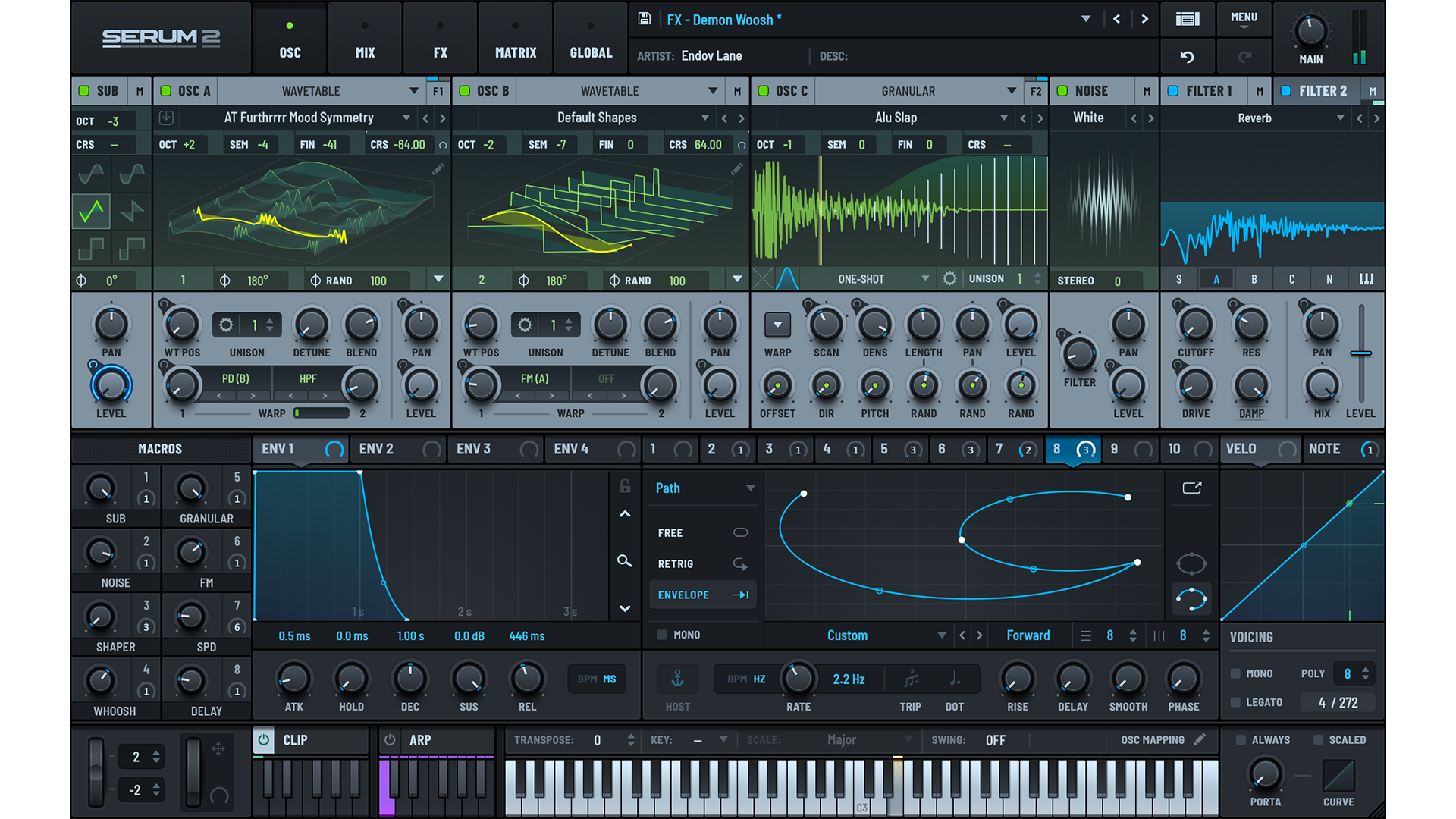
Phase Plant is the stronger synth once a patch starts becoming more layered and complex. You can add multiple generators, filters, effects and modulation sources without being limited to a fixed signal flow. That makes it easier to build sounds with separate layers for the body, texture, attack and movement, while still keeping control over how each part is routed.
Serum 2 is much more flexible than the original Serum, but its workflow remains more structured. That structure is useful because complex patches stay easier to follow, especially when you are working quickly. The trade-off is that you sometimes need to shape your idea around the way Serum 2 is organized rather than designing the entire signal path yourself.
This difference becomes most noticeable with evolving pads, cinematic textures and heavily processed basses. In Phase Plant, each layer can have its own processing and modulation before being combined with the rest of the patch. Serum 2 can produce similarly detailed sounds, but Phase Plant generally gives you more freedom over how every component interacts.
That extra flexibility does come with a learning curve. A large Phase Plant patch can become harder to understand when too many generators and modulation connections are added without a clear structure. Serum 2 is usually easier to reopen later and understand at a glance.
Winner for complex sound design: Phase Plant. Serum 2 offers more than enough depth for most producers, but Phase Plant is the better choice when you want to build the instrument around the sound rather than work within a predefined structure.
Both synths make modulation visual and easy to assign, but Phase Plant gives you more freedom once the routing becomes complicated.
In Serum 2, you can drag envelopes, LFOs and other modulation sources directly onto a parameter. The amount is shown around the control, so it is easy to see what is moving and how strongly it is being affected. This makes common tasks such as adding movement to a filter, wavetable position or oscillator pitch fast and intuitive. Serum 2 also allows its sound sources to be routed between two filters or sent to a combination of both.
Phase Plant uses a similarly visual approach, but its modulation system is more open-ended. You can add as many envelopes, LFOs and utility modulators as the patch needs, then connect them to almost any available parameter. Modulation amounts can also be modulated by other sources, making it easier to create movement that changes over time rather than repeating in exactly the same way.
The larger difference is routing. Serum 2 gives you a clear structure that remains relatively easy to follow, even as the patch grows. Phase Plant lets you build signal groups, route generators more freely and use audio-rate modulation between generators. That opens the door to deeper FM-style sounds, cross-modulation and unusual interactions between layers, but it also requires more understanding from the user.
For most everyday modulation tasks, Serum 2 is faster and easier to read. Phase Plant becomes more powerful when the modulation itself is a major part of the sound or when several layers need their own routing and movement.
Winner for modulation and routing: Phase Plant. Serum 2 offers a smoother workflow for common assignments, but Phase Plant provides more control when the patch needs advanced routing, audio-rate modulation or several interconnected modulation sources.

Serum 2 has the smoother workflow when you want to move between different synthesis methods without rebuilding the patch. Its oscillator slots can work with wavetables, individual samples, multisamples, granular material and spectral synthesis, all within the same structured interface. You can also convert imported audio into a wavetable directly inside the synth, which makes experimenting with your own recordings quick and accessible.
Phase Plant offers wavetable, sample and granular generators as separate building blocks. This gives you more freedom to combine several synthesis methods within one patch and process each layer differently. For example, a granular texture can sit beside a wavetable layer and a sample-based attack, with each source routed and modulated independently.
For traditional wavetable sound design, Serum 2 feels more immediate. The workflow is focused, visual and easy to understand, while importing audio and switching between oscillator types requires relatively little setup. Phase Plant’s wavetable tools are deeper when you want to design the wavetable itself or use it as one component inside a larger modular patch. It includes a dedicated wavetable editor and also supports creating wavetables from imported samples.
The difference is similar with granular synthesis. Serum 2 keeps granular controls inside a familiar oscillator workflow, which makes it easier to start transforming a sample quickly. Phase Plant gives the granular generator more freedom to interact with other generators, modulation sources and routing choices, making it better suited to unusual textures and experimental sound design.
Winner for the easiest hybrid workflow: Serum 2. It makes switching between wavetables, samples and granular synthesis feel more direct. Phase Plant is better for combining those methods inside a larger custom instrument, especially when every layer needs its own processing and modulation.
Serum 2 is the easier synth when you want to browse presets, find a useful starting point and begin producing quickly. Its preset browser is straightforward, and the fixed layout makes it relatively easy to understand how a sound was built. That is especially helpful for newer producers who want to learn by opening a preset and adjusting the oscillators, filters, envelopes and effects.
Phase Plant also includes a large range of presets, but many of them showcase the synth’s modular depth. These patches can be more inspiring for experimental sound design, although they may take longer to understand because every preset can use a different combination of generators, routing and modulation.
The difference becomes clearer when editing presets. In Serum 2, the most important controls usually remain in familiar locations, so making a sound brighter, shorter or more aggressive is generally quick. In Phase Plant, you may first need to identify which generator, group or processing lane is responsible for the part of the sound you want to change.
For experienced sound designers, Phase Plant’s flexibility can make its presets more valuable as learning material. You can study unusual routing choices and see how several synthesis methods have been combined inside one patch. For producers who mainly want fast access to polished sounds, Serum 2 is more immediate.
Winner for presets and ease of use: Serum 2. Phase Plant rewards deeper exploration, but Serum 2 makes it easier to find, understand and modify a sound without interrupting your workflow.
Serum 2 has a strong built-in effects section that fits naturally into its workflow. You can shape a patch with distortion, compression, delay, reverb, filtering and other processing without leaving the synth. Because the effects are presented inside a clear, familiar chain, it is easy to reorder them and quickly hear how each stage changes the sound.
Phase Plant takes a more modular approach. Audio can be sent through three effect lanes, which can run in series or parallel. Each lane can hold Kilohearts Snapins, and effects can be modulated like other parameters inside the synth. Phase Plant also supports polyphonic effect processing, allowing selected effects to run separately for each voice rather than only on the combined output.
The included Kilohearts Essentials collection gives Phase Plant a useful starting selection of effects. Its main advantage, however, is how freely those effects can be combined and routed. You can process different sound layers separately, create parallel chains or use modulation to make the processing change with each note.
Serum 2 is more convenient when you want polished results quickly. Its effects feel like a direct extension of the synth and require less routing. Phase Plant becomes more powerful when the effects are part of the patch design itself rather than simply the final processing stage.
Winner for effects workflow: Serum 2. Winner for effects flexibility: Phase Plant. Serum 2 is faster and easier for everyday processing, while Phase Plant gives advanced users more control over routing, modulation and per-voice effects.
CPU usage depends heavily on the patch rather than the synth alone. Unison, polyphony, oversampling, granular processing and long effect chains can all increase the load, so neither Phase Plant nor Serum 2 is automatically lighter in every situation.
Serum 2 generally feels efficient for straightforward patches such as basses, plucks and leads. Its structured architecture makes it easier to see which parts of the sound are active, and unnecessary oscillators or effects can be disabled quickly. CPU use becomes more noticeable when combining high unison values, several synthesis engines and heavier effects.
Phase Plant can also run simple patches efficiently, but its open architecture makes it easier to build extremely demanding sounds. Multiple generators, polyphonic effects, granular layers and complex modulation can increase CPU usage quickly. The advantage is that you have detailed control over the patch and can remove or simplify individual layers without rebuilding the entire sound.
On a MacBook Pro with an M3 Max, both synths were comfortable to use in FL Studio during normal production. The practical difference became more noticeable with large, layered patches rather than everyday sounds. Phase Plant gives you more opportunities to create CPU-heavy instruments, while Serum 2 usually makes it easier to keep the patch under control.
Winner for predictable CPU use: Serum 2. Phase Plant is not necessarily inefficient, but its deeper routing and layering options make it easier to create demanding patches. For either synth, reducing unison, polyphony, oversampling and unnecessary effects will usually make a bigger difference than switching instruments.
Serum 2 costs $249 as a one-time purchase, but you do not have to pay the full price upfront. Through Splice, you can try Serum 2 free for 3 days and then use Rent-to-Own for $9.99 per month for 25 months. You can cancel the plan at any time, there are no interest charges, and once all payments are completed, you own the plugin permanently.
Phase Plant costs $199 for a perpetual license. Buying it through Plugin Boutique currently also qualifies for a free software gift at checkout, which adds extra value if you already know Phase Plant is the synth you want.
For a new buyer, Phase Plant has the lower outright price. Serum 2 costs more in total, but Splice makes it much easier to try before committing and spreads the cost over time. That is especially useful if you are still deciding whether Serum 2’s faster workflow and broader synthesis engines are worth the extra money for your production style.
Choose Serum 2 if you want a powerful synth that remains quick and easy to use in a normal production workflow. Its structured interface makes it easier to move from an initial idea to a finished sound without spending too much time building generators, routing and processing chains.
Serum 2 is likely the better choice if you:
Choose Phase Plant if sound design is a major part of your creative process. Its modular structure gives you more freedom to combine generators, create custom signal paths and control how individual layers are processed and modulated.
Phase Plant is likely the better choice if you:
For most producers, Serum 2 is the easier recommendation because it offers a strong balance between depth and speed. Phase Plant is the better investment for advanced users who want the synth to adapt to the patch rather than build every patch within the same structure.
Best for most producers: Serum 2. Best for advanced sound designers: Phase Plant.
Serum 2 is the better choice for most producers. It combines a fast, visual workflow with enough depth for advanced wavetable, sample, granular and spectral sound design. It is easier to learn, quicker to navigate and generally requires fewer decisions before you can start shaping a useful sound.
Phase Plant is the stronger option for experienced sound designers who want complete freedom over generators, modulation, effects and signal routing. It takes more time to learn and build patches, but it gives you considerably more control when sounds become layered, experimental or highly complex.
Choose Serum 2 for speed, accessibility and an all-round production workflow. Choose Phase Plant for modular freedom and deeper sound design. Neither synth is limited in terms of sound quality—the deciding factor is whether you prefer a structured instrument or one you can build around every patch.

![[team] image of team member (for a mobile gaming)](https://cdn.prod.website-files.com/68efa70811edd8e5af30a90d/690abaa8987a07a672c4cd2c_channels4_profile.jpg)
![[background image] image of recording equipment (for a musician & band)](https://cdn.prod.website-files.com/68efa70811edd8e5af30a90d/6aa35b3b03d3771388765f76_Main%20Image.png)
![[background image] image of recording equipment (for a musician & band)](https://cdn.prod.website-files.com/68efa70811edd8e5af30a90d/6aa35785b8608362620d46e3_Main%20Image.png)
![[background image] image of recording equipment (for a musician & band)](https://cdn.prod.website-files.com/68efa70811edd8e5af30a90d/6aa351f638777f809800a4ff_Main%20Image.png)