
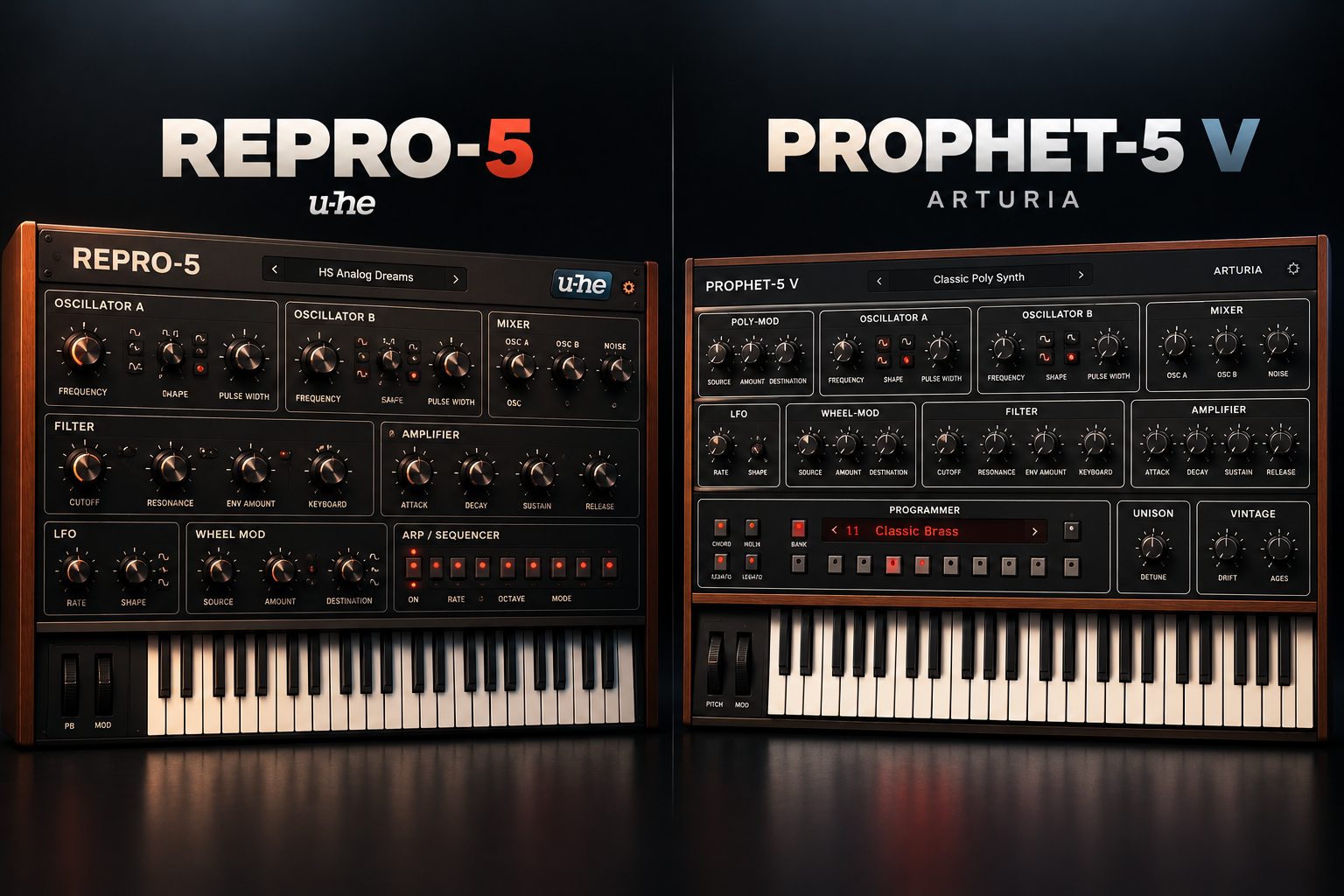

Classic Prophet-style synthesizers are loved for their warm pads, punchy basses and expressive leads, but choosing a software version is not straightforward. u-he Repro-5 and Arturia Prophet-5 V both recreate vintage polyphonic synthesis, yet they take different approaches to controls, effects and modern features. Repro is part of a two-synth bundle with a deep circuit-modeling focus, while Prophet-5 V is a dedicated recreation of the early Prophet-5 with expanded modulation and performance tools. We would start with Repro if you also want its monophonic sibling, and with Prophet-5 V if its Poly-Mod architecture and modern extras fit your workflow.
Repro-5 vs Prophet-5 V: quick comparison
| Question | u-he Repro-5 | Arturia Prophet-5 V |
|---|---|---|
| What is included? | Repro-5 plus Repro-1 monosynth | Prophet-5 V instrument |
| Modeling focus | Detailed circuit-level analog emulation | Arturia TAE modeling of Rev 2-inspired design |
| Polyphony | Up to eight voices | Polyphonic and unison operation |
| Extra controls | Tweaks, voice panning, effects and per-voice distortion | Poly-Mod, Voice Dispersion, extra modulation sources and effects |
| Free demo | Demo with occasional crackling | Demo through Arturia Software Center |
| Official price checked 18 Oct 2026 | €149 for full Repro bundle | €149 displayed on Arturia European page |
What makes Repro-5 different?
u-he Repro is sold as one product containing Repro-1 and Repro-5. Repro-1 is a monophonic synthesizer with a step sequencer, while Repro-5 is a polyphonic instrument with up to eight voices. Repro-5 adds adjustable internal model settings through the Tweaks page, a four-slot modulation matrix, individual voice panning, polyphonic distortion and high-quality built-in effects.
That package makes sense for producers who want both punchy vintage-style mono sounds and expressive polyphonic chords. The circuit-modeling emphasis is part of the appeal, although it does not mean every preset will always sound better than an alternative.
SoundShaper advice: buy Repro if you enjoy hands-on vintage synth programming and expect to use Repro-1 as well as Repro-5. The added monosynth changes the value comparison.
What makes Prophet-5 V different?
Arturia Prophet-5 V is modeled on the Rev 2-era instrument, including the characteristic SSM-style oscillator and filter behavior. Its Poly-Mod architecture is a major part of the experience, and Arturia adds voice dispersion to reproduce small variations between analog voices.
Unlike a strict historical recreation, Prophet-5 V also includes extra modulation options, an arpeggiator, MPE support, chord mode and 16 built-in effects that can be arranged in three slots. These additions make it useful for modern keyboard performance as well as vintage-inspired production.
SoundShaper advice: choose Prophet-5 V if you want its dedicated Prophet workflow, a flexible preset browser and more modern modulation and performance options built around that particular synth identity.
Which is better for your music?
Synthwave, indie electronic and retro pop
Both can deliver warm pads, detuned brass, basses and expressive leads. We would compare a few patches in the context of the actual song and choose the interface that makes adjustments faster. Repro is attractive if you also need vintage-style monophonic sequences.
Neo-soul, R&B and hip-hop
Prophet-5 V is a strong candidate for mellow chords and expressive keyboard parts, especially when performance modulation matters. Repro-5 is equally worth auditioning for its filter and voice behavior. Neither automatically beats a great Rhodes or sampled keyboard for every track.
Ambient and film scoring
Prophet-5 V's added modulation and effect tools are useful for creating evolving patches. Repro-5 can provide a focused vintage polyphonic texture, especially when subtle detuning and per-voice characteristics matter.
Effects and sound design
Repro-5 offers per-voice distortion, a detailed Tweaks page and five additional effects, including EQ/resonator, delay, reverb and a dynamics-related effect. Prophet-5 V provides 16 effects across three configurable slots as well as expanded modulation. Think about whether you prefer tweaking the behavior of a vintage circuit or shaping a patch with a broader range of modern tools.
Is Repro-1 part of the decision?
Yes. Repro-1 is included with Repro, not sold as a separate required purchase. If your music frequently uses mono basslines, leads and step-sequenced patterns, this strengthens Repro's value. If you already own a monosynth you love, that benefit may be less important.
Price, system requirements and demos
As checked on 18 October 2026, u-he lists Repro at €149 and version 1.1.3, released on 10 December 2024. It requires a DAW host and supports Windows, macOS and Linux; Linux builds are described as beta. Its demo produces occasional crackling.
Arturia lists Prophet-5 V at €149 on its European product page and version 1.3.5.6366 in the current downloads area. It supports Windows 10 or newer and macOS 11 or newer, with VST, AU and AAX formats and standalone operation on supported systems. Check your exact hardware and plugin host before purchase. Prices and promotions can change.
What should you try before buying?
- Create a basic bass patch in each plugin and compare how quickly you reach the intended sound.
- Make a four-note pad and adjust filter, envelopes and voice settings.
- Try one more experimental patch using each instrument's modulation tools.
- Listen at matched loudness in the full song.
- Check CPU performance with the same polyphony and buffer size.
- Consider whether Repro-1 would add value to your setup before making a purchase.
Do you need either plugin?
Not necessarily. Free instruments such as Surge XT and Vital can produce excellent synth parts. If you already have a suitable analog-style synth, try making the sound you need before buying another one. These two products mainly make sense when you want their specific vintage workflows and modeling approaches.
Related SoundShaper guides
Read our Repro vs Diva comparison for two u-he approaches, the Repro review for more detail, and Repro vs Pigments 7 if you are choosing between vintage synthesis and modern hybrid sound design.
SoundShaper opinion
Repro is the more compelling bundle if you will actually use both Repro-1 and Repro-5. Its focused instruments, circuit modeling and detailed per-voice adjustments give producers clear reasons to invest. Prophet-5 V is our pick if you want a Prophet-specific instrument with modern performance and sound-design features. Its Poly-Mod, voice dispersion and added modulation options make the workflow distinct.
This is an editorial assessment of documented capabilities, not a claim of controlled listening tests or invented benchmarks.
Frequently asked questions
Does buying Repro-5 include Repro-1?
Yes. Repro includes both Repro-1 and Repro-5 in the same purchase.
Is Prophet-5 V a standalone instrument?
Yes. Arturia offers standalone use and DAW plugin formats on supported operating systems. Repro requires a host.
Which is better for beginners?
Both use a recognizable oscillator-filter-envelope layout. The best learning experience depends on whether you prefer Repro's focused models or Prophet-5 V's added controls and tutorials.
Will either one work in FL Studio?
Both support plugin formats usable in compatible FL Studio installations. Verify the current system and format requirements first.
Final verdict
Choose Repro if you value both a classic mono synth and a modeled poly synth. Choose Prophet-5 V if you want a dedicated Prophet experience with added effects and modern modulation controls. Try both demos if you mainly want one excellent analog-style pad or lead.
![[background image] image of recording equipment (for a musician & band)](https://cdn.prod.website-files.com/68efa70811edd8e5af30a90d/6ad532001f619a451720a81e_6ad531d144bf4757a103150f_trackspacer-review.webp)
![[background image] image of recording equipment (for a musician & band)](https://cdn.prod.website-files.com/68efa70811edd8e5af30a90d/6ad5249509c44abef3dec403_Diva%20vs%20Pigments%207.png)