
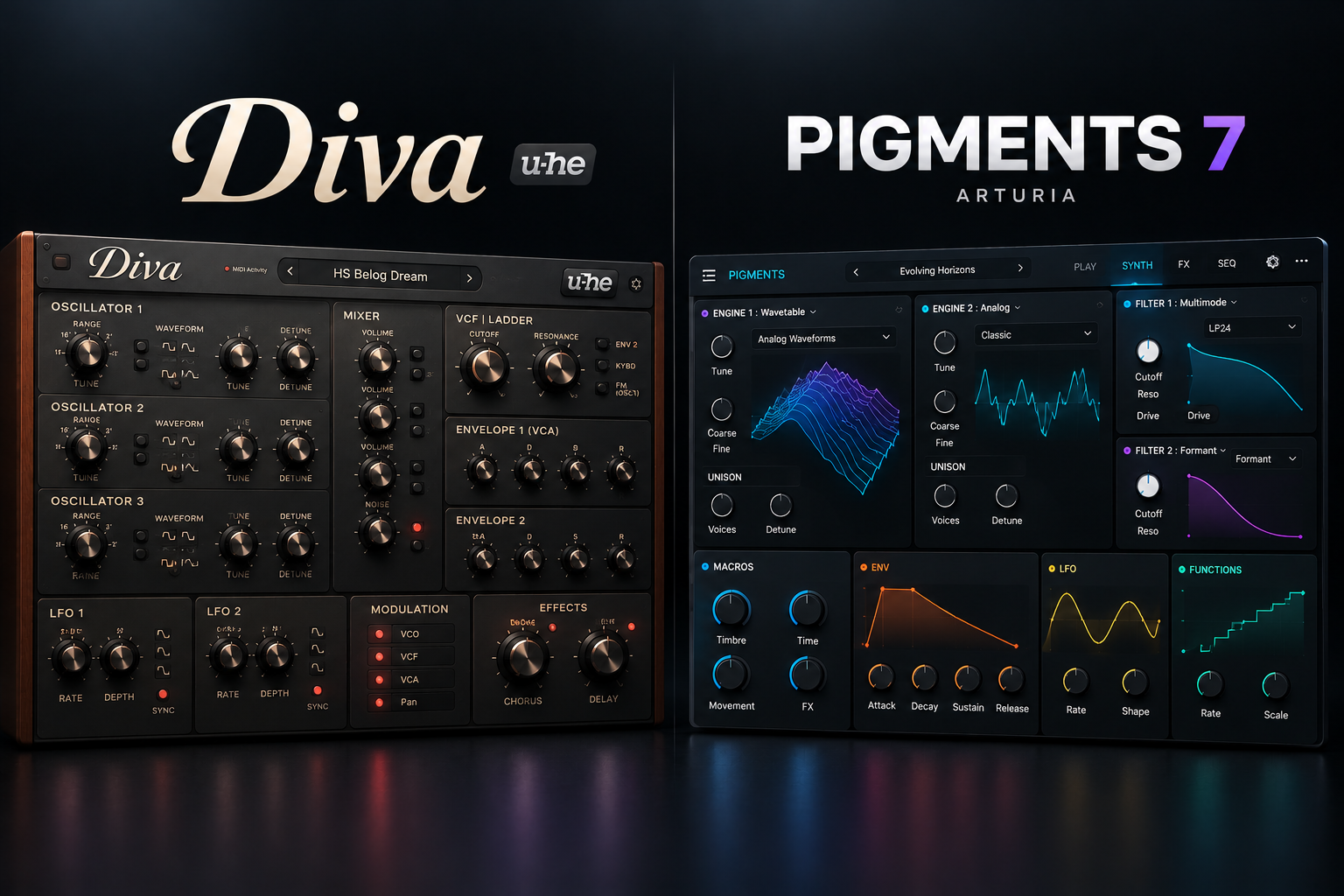

Choosing a synthesizer becomes easier when you know what kind of sound you want to create. u-he Diva specializes in the feel of classic analog instruments, while Arturia Pigments 7 gives you a broad environment for modern synthesis and detailed modulation. Both work for basses, leads and pads, but Diva is our starting recommendation for vintage analog-style parts and Pigments for evolving textures and experimental sound design. Your workflow matters more than the number of features on the product page.
Diva vs Pigments 7: quick comparison
| Feature | Diva | Pigments 7 |
|---|---|---|
| Focus | Detailed analog modeling | Hybrid modern synthesis |
| Sound sources | Five oscillator model families | Multiple synthesis engines |
| Modulation | Envelopes, LFOs and classic controls | Extensive visual modulation routing |
| Best for | House, synthwave, analog leads | EDM, cinematic textures, experimental sounds |
| Performance | Can be demanding on CPU | Patch-dependent; version 7 includes optimizations |
Why choose Diva?
Diva models classic synth components, letting you combine oscillators, filters and envelope styles inspired by different eras. u-he documents five oscillator models, five filters, three envelope models, two LFOs and over 1,200 factory presets. Its zero-delay-feedback filter approach can require significant processing resources.
For classic basses, synthwave leads and vintage-style chords, that focused architecture is appealing. You can shape a familiar analog sound without first building a complicated modulation system.
SoundShaper advice: choose Diva if you want rich analog-inspired patches and enjoy a traditional synthesizer workflow. Test polyphonic presets at your normal buffer size because CPU usage can be substantial.
Why choose Pigments 7?
Arturia Pigments 7 is designed for more open-ended sound creation. Its multiple engines, filters, modulation sources and effects let you build patches that change dramatically over time. Version 7 introduces the Rage, Ripple and Reverb filters, the Corroder effect, a redesigned Play page, additional tutorials and performance improvements.
These features make Pigments useful for animated bass, granular-like atmospheres and cinematic movement. They also require time to learn.
SoundShaper advice: choose Pigments if original sound design is a regular part of your workflow. If you only want a vintage bass sound, Diva may be more straightforward.
Which synth fits your genre?
House, disco and synthwave
Diva is a natural starting point for the analog basses, pads and leads common in these styles. Pigments remains useful if you want more unusual rhythmic movement.
Dubstep, drum and bass and experimental electronic music
Pigments has the advantage for deep modulation and complex sound construction. Diva can still provide a strong classic layer within a larger production.
Hip-hop and R&B
Both work. Diva is well suited to warm synth chords and bass parts, while Pigments makes sense for evolving textures. Consider whether your existing plugins already provide what the track needs.
Ambient and cinematic
We would start with Pigments for long evolving textures, but Diva can be ideal for simple expressive parts. Complexity does not automatically make a sound more musical.
Workflow and learning curve
Diva follows a familiar oscillator-filter-envelope layout. Pigments offers visual tools for creating more elaborate modulation relationships. Try designing the same bass, pad and lead in both demos, and note which approach helps you finish an arrangement more quickly.
CPU use and compatibility
Diva's analog modeling may use considerable CPU power, although adjustable quality settings can help. Pigments 7 includes efficiency improvements, but a demanding polyphonic patch may still be heavy. Actual performance depends on the patch, sample rate and computer. Do not rely on an invented benchmark.
As checked on 18 October 2026, Diva costs €179 on u-he's official store and its published version is 1.4.8, released on 27 August 2024. It supports macOS, Windows and Linux, with Linux support described as beta. Confirm the latest Pigments 7 price and your computer's format compatibility before buying; promotional offers can change.
Are free synths enough?
Yes. Vital and Surge XT are strong options for learning synthesis and creating useful patches. Choose a paid synth when its workflow or particular sound architecture becomes important to your music.
Related SoundShaper guides
Read Repro vs Diva, Repro vs Pigments 7 and our Pigments 7 review for further context.
SoundShaper opinion
Our recommendation is Diva for focused analog-style synthesis and Pigments 7 for modern, experimental sound design. Diva's component models and more traditional workflow are attractive for classic sounds. Pigments' broader engines and modulation tools offer more ways to create complex movement. This judgment is based on documented features and intended workflows, not invented testing experience.
FAQ
Can Pigments make analog sounds?
Yes. It includes analog-style synthesis capabilities, although its overall design extends beyond analog emulation.
Is Diva CPU-heavy?
It can be, especially with demanding polyphonic patches. Use appropriate quality settings and test your own setup.
Which is easier for beginners?
Diva follows a focused traditional layout; Pigments provides visual modulation tools but more options to learn.
Should you buy both?
Not necessarily. Start with the one whose workflow suits your music, then add another synth only if a repeated need remains.
Final verdict
Buy Diva for classic analog-style sounds. Choose Pigments 7 for flexible synthesis and detailed modulation. Use free synths first if budget is tight or you are still learning the basics.
![[background image] image of recording equipment (for a musician & band)](https://cdn.prod.website-files.com/68efa70811edd8e5af30a90d/6ad532001f619a451720a81e_6ad531d144bf4757a103150f_trackspacer-review.webp)
![[background image] image of recording equipment (for a musician & band)](https://cdn.prod.website-files.com/68efa70811edd8e5af30a90d/6ad525ca541f84cd109a4180_Repro-5%20vs%20Prophet-5%20V.png)