
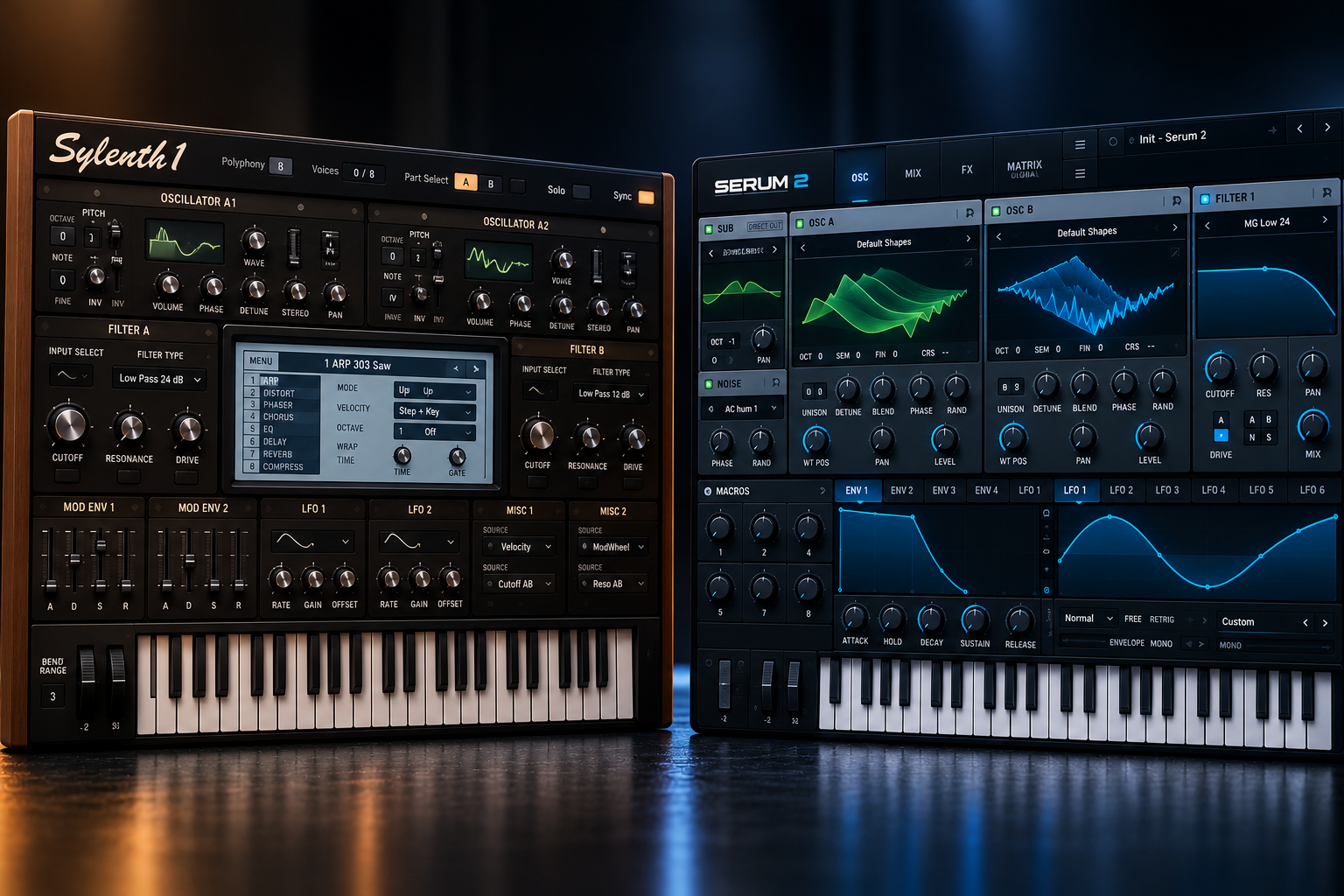

Sylenth1 and Serum 2 represent two very different ways to make synth sounds. Sylenth1 is a focused virtual-analog instrument built around oscillators, filters, envelopes, unison and effects. Serum 2 is a much broader hybrid synth that combines wavetable, multisample, sample, granular and spectral synthesis with a visual modulation system, flexible routing and built-in sequencing.
My short answer: choose Sylenth1 if you want classic dance leads, plucks, basses and pads quickly without a huge sound-design environment. Choose Serum 2 if you want one modern synth you can keep growing into for years.
Sylenth1 currently costs €139 excluding VAT, or can be paid in €9.95 monthly installments until the full amount is reached. Serum 2 costs $249, or $9.99 per month for 25 months through Splice Rent-to-Own. They are not priced in the same currency, so compare your final checkout total rather than treating those headline numbers as a direct exchange-rate comparison.
| Decision | Sylenth1 | Serum 2 |
|---|---|---|
| Best for | Classic virtual-analog leads, plucks, basses and pads | Modern sound design, wavetable, granular, sample and spectral synthesis |
| Current price | €139 excl. VAT | $249 |
| Payment plan | €9.95/month until paid off | $9.99/month × 25 via Splice |
| Oscillator architecture | 4 virtual-analog unison oscillators | 3 main multi-purpose oscillators + Noise + Sub |
| Synthesis types | Virtual analog / subtractive | Wavetable, multisample, sample, granular, spectral and subtractive |
| Factory presets | 2,500+ | 626+ |
| Modulation | 2 LFOs, envelopes and 16 modulation slots | Extensive drag-and-drop modulation with visual feedback |
| Sequencing | Arpeggiator with step-sequencer functions | Arpeggiator + clip sequencer |
| CPU philosophy | Very focused and highly optimized | Optimized, but complex Serum 2 patches can do much more |
| My pick for classic dance sounds | Sylenth1 | Also excellent, but often more than you need |
| My pick as a first serious modern synth | Only if you specifically want its sound/workflow | Serum 2 |
Sylenth1 vs Serum 2: the quick verdict
Sylenth1 wins on focus. It has four oscillators, two analog-style filter sections, 16-note polyphony, a straightforward modulation system and a compact effects section. You can open it, build a supersaw lead or pluck and be back in the arrangement quickly.
Serum 2 wins on range. It can do classic subtractive sounds too, but it also gives you wavetable editing, granular processing, multisampling, spectral resynthesis, flexible oscillator routing, deep modulation and sequencing.
The question is therefore not “which synth sounds better?” It is whether you want a specialized virtual-analog workflow or a much broader modern synthesis platform.
Why Sylenth1 still makes sense in 2026
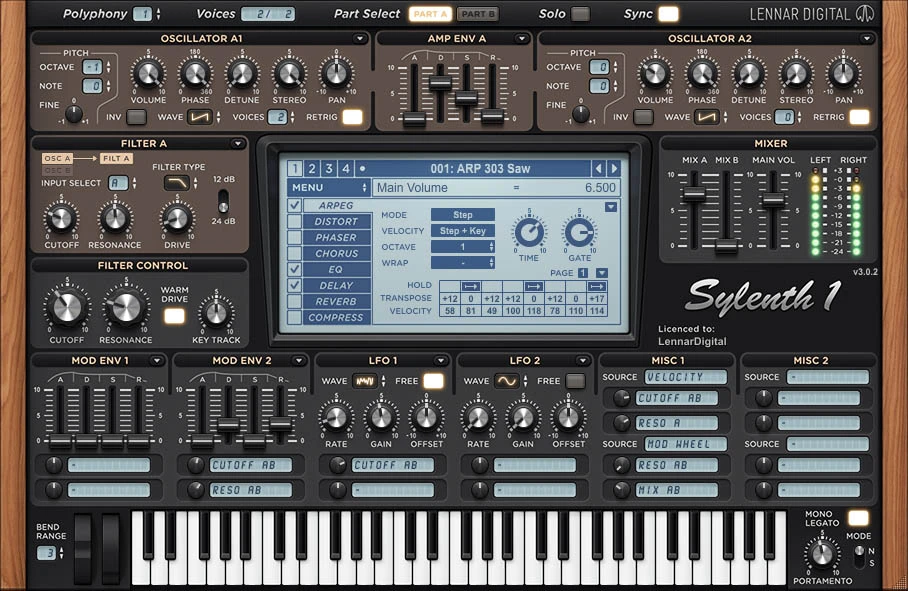
Sylenth1 is old by software-synth standards, but it is not abandoned. LennarDigital released version 3.075 in April 2026 with Windows 11 fixes, improved loading speed and fixes for Ableton, Reason VST3 and AAX. The current product also supports VST3 and native Apple silicon.
Its architecture is intentionally simple compared with Serum 2. Four unison oscillators feed two filter sections, with envelopes, LFOs and modulation slots handling movement. The built-in effects cover the usual production needs: distortion, phaser, chorus, EQ, delay, reverb and compression.
My take: the reason to buy Sylenth1 today is not nostalgia. It is that a focused architecture can be faster when the sound you want is already inside that lane. For trance leads, house plucks, classic EDM basses and wide pads, you often do not need granular synthesis or imported samples.
Read our full Sylenth1 review for the deeper look at presets, pricing, compatibility and preset banks.
Why Serum 2 is the stronger long-term sound-design synth
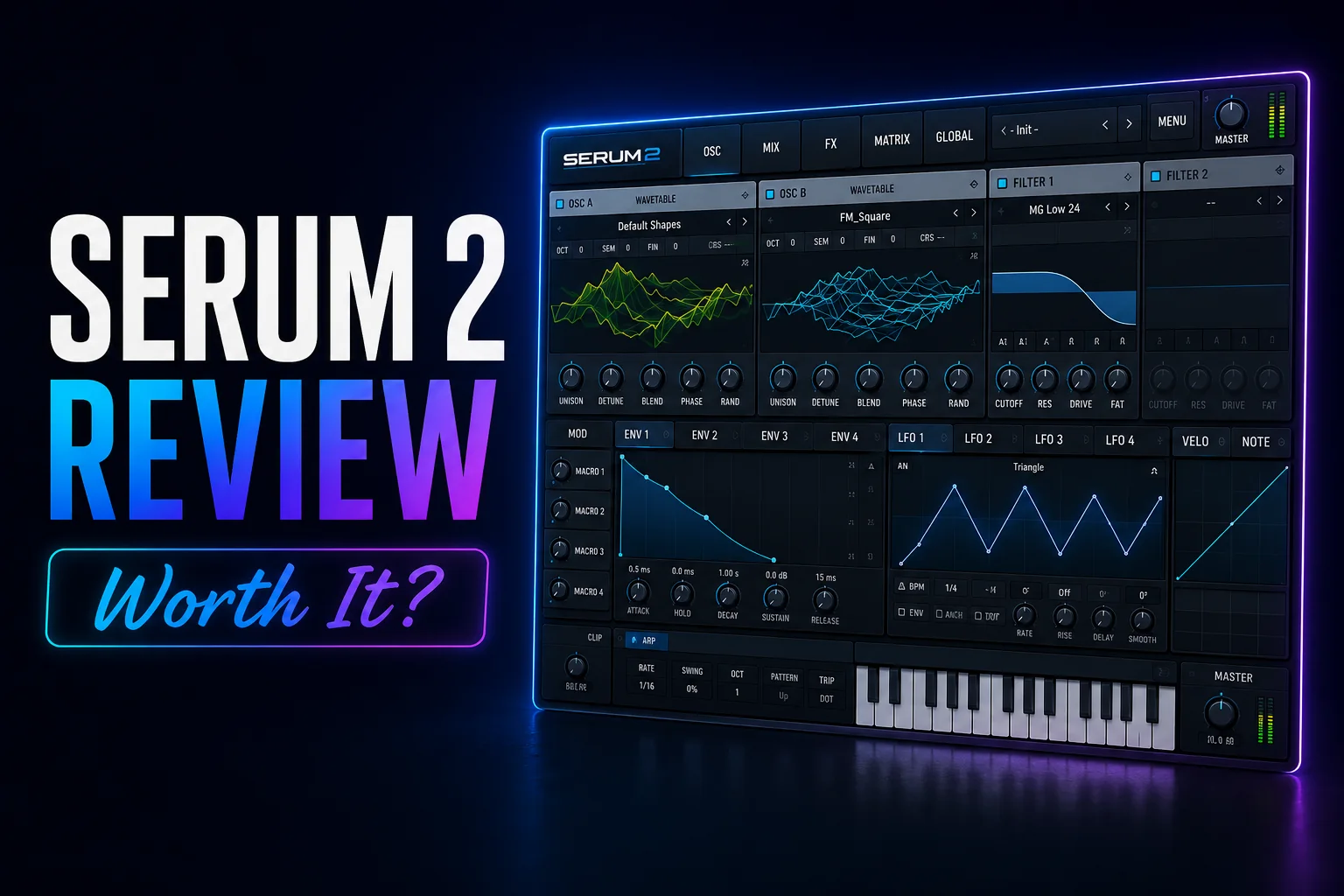
Serum 2 starts where Sylenth1 stops. Its three main oscillators can use different sound-generation methods, and dedicated Noise and Sub sections expand the architecture further. Xfer lists wavetable, multisample, sample, granular and spectral modes in the current version.
The modulation system is one of the clearest reasons to choose it. Drag an LFO or envelope onto a parameter and you can immediately see the movement. That makes complex patches easier to understand than a traditional modulation matrix.
Serum 2 also includes an arpeggiator and clip sequencer, so rhythmic sound design can live inside the patch rather than depending completely on the DAW.
My take: if I were paying for my first serious synth in 2026 and did not specifically want the Sylenth1 sound or workflow, I would choose Serum 2. There is simply more room to grow.
Read our full Serum 2 review for the detailed breakdown.
Sound: warm virtual analog vs modern flexibility
Sylenth1 is known for clean, bright virtual-analog sounds and wide unison. Its filters include nonlinear saturation, and the instrument is especially comfortable doing the sounds that defined trance, progressive house and EDM for years.
Serum 2 can recreate that general territory easily, but it is not limited to it. You can morph through wavetables, import material, granulate samples, resynthesize spectra and combine those techniques in a single patch.
I would not say Serum automatically makes Sylenth1 obsolete. If a Sylenth patch gets you to the exact sound in two minutes, building a technically more advanced version in Serum is not an improvement. The broader synth is only better when you use the extra range.
Which is better for leads and supersaws?
Sylenth1 remains extremely good at classic stacked saw sounds. Each of its four oscillators can create up to eight unison voices, so the instrument naturally lends itself to wide trance leads, plucks and pads.
Serum 2 is also excellent for supersaws and gives you much more control over unison, warp modes, filtering and modulation. If you want a straightforward classic lead, Sylenth can be faster. If you want that lead to evolve into something more unusual, Serum gives you more directions to go.
Which is better for bass sound design?
Serum 2 wins for modern bass design. Wavetable warping, FM-style options, granular processing, spectral synthesis and deeper modulation make it much better suited to moving basses, reeses, aggressive growls and experimental low-end textures.
Sylenth1 is still excellent for straightforward house basses, trance basses, plucks and solid analog-style low end. I would choose it when the bass needs to support the groove rather than become the main sound-design feature.
Presets: Sylenth1 actually ships with more
LennarDigital currently includes more than 2,500 presets with the full Sylenth1 license. Serum 2 ships with more than 626 presets and 288 wavetables.
That does not mean Sylenth is the better preset instrument automatically. Serum has an enormous modern third-party ecosystem, while Sylenth has years of legacy preset banks covering house, trance, progressive and EDM.
My take: preset count is less important than relevance. If your music is classic melodic dance, Sylenth's ecosystem remains very useful. If you produce newer bass-heavy or experimental electronic styles, Serum's current ecosystem is broader.
Modulation: Serum 2 wins clearly
Sylenth1 gives you envelopes, LFOs and 16 modulation slots. That is enough for most traditional synth patches and keeps the workflow controlled.
Serum 2 is far more visual and flexible. Modulation can be dragged directly to parameters, amounts are shown on the controls and complicated movement remains easier to inspect after the patch is built.
If modulation is a major creative tool in your music, I would choose Serum without much hesitation. If you mostly need filter movement, vibrato, envelope shaping and a few rhythmic changes, Sylenth is already enough.
Effects and sequencing
Sylenth1 includes a classic effects chain plus an arpeggiator with step-sequencer controls for pitch, velocity and hold. For straightforward trance and house patches, this is still a practical combination.
Serum 2 goes further with a larger modern effect system, flexible routing and a dedicated clip sequencer alongside its arpeggiator. That makes it easier to build self-contained rhythmic patches, sequence automation and create more elaborate movement without leaving the instrument.
CPU: is Sylenth1 still lighter?
Sylenth1 was designed around efficient processing and LennarDigital still emphasizes its optimized engine. Its architecture is also much simpler than Serum 2, so it is naturally easier to keep patches restrained.
Xfer says Serum 2 is optimized to use the same or less CPU than Serum 1 for equivalent patches, but Serum 2 can also build much more complex patches than Sylenth1. Granular, spectral, heavy unison and layered effects can increase processing significantly.
My take: Sylenth1 is the safer choice when you want lots of straightforward synth instances in a large project. Serum 2 is not inherently “CPU heavy”; it simply gives you more ways to create a heavy patch.
Price and value
| Purchase | Current price | My view |
|---|---|---|
| Sylenth1 full license | €139 excl. VAT | Good value if you specifically want its virtual-analog workflow and preset ecosystem |
| Sylenth1 installment plan | €9.95/month until paid | Useful for spreading the cost; license is held if you stop payments before completion |
| Serum 2 full license | $249 | Higher price, but far broader synthesis capabilities |
| Serum 2 Rent-to-Own | $9.99/month × 25 | Strong low-upfront-cost option; you own it after the plan is completed |
| Existing Serum 1 owner | Free upgrade | Easy recommendation |
Sylenth1 is the less expensive instrument before tax and currency conversion, but value depends on what you would otherwise buy. If Serum 2 replaces several separate synths for you, the higher price can make sense. If you only need classic subtractive sounds, paying for granular and spectral tools you never touch is wasted money.
Which one is easier to learn?
Sylenth1 has fewer concepts, so there is less to learn overall. Once you understand oscillators, filters, envelopes, LFOs and effects, most of the instrument makes sense.
Serum 2 contains far more features, but its visual feedback makes modulation unusually easy to understand. The learning curve is longer because the instrument is bigger, not because the interface is badly designed.
For a complete beginner: Sylenth1 is simpler. For someone who wants to learn modern synthesis deeply: Serum 2 is the more useful education.
Demo and payment options
LennarDigital offers a Sylenth1 demo with a reminder sound around every 60 seconds, limited modulation, no preset saving/exporting and a reduced preset selection. It is enough to judge the basic sound and workflow.
Xfer offers a Serum 2 demo limited to 15-minute sessions. Through Splice, Serum 2 also has a 3-day trial before the $9.99-per-month Rent-to-Own plan begins.
I would demo both on the same project. Make a lead, bass and pad in each. The synth that gets you to useful sounds with less friction is the better purchase for you.
Which one should you choose?
| Choose Sylenth1 if... | Choose Serum 2 if... |
|---|---|
| You mainly make classic house, trance or melodic dance sounds | You want one modern synth with many synthesis methods |
| You value speed and a focused interface | You enjoy designing sounds from scratch |
| You already own useful Sylenth1 preset banks | You want visual drag-and-drop modulation |
| You mostly need leads, plucks, basses and pads | You want wavetable, granular, sample and spectral synthesis |
| You want a lighter, simpler virtual-analog instrument | You want a synth that can grow with more advanced sound design |
| You specifically like Sylenth1's tone and workflow | You are buying your first serious all-round synth in 2026 |
Does it make sense to own both?
Yes, but less urgently than some plugin combinations. Serum 2 can cover much of the sonic territory Sylenth1 handles, so there is overlap.
The reason to keep or buy Sylenth1 alongside Serum is workflow. Sometimes opening a focused instrument and choosing between a small set of options is faster than working inside the larger synth.
If you already own Serum 2 and have no existing Sylenth preset collection, I would only buy Sylenth1 after trying the demo and deciding that you genuinely prefer its sound or speed. If you already own Sylenth1 and keep running into its architectural limits, Serum 2 is a very logical next step.
Final verdict: Sylenth1 or Serum 2?
For a new buyer in 2026, I would choose Serum 2 in most cases. It costs more, but it gives you far more synthesis depth, better visual modulation and a much broader long-term sound-design platform.
I would choose Sylenth1 when I specifically wanted its focused virtual-analog workflow. It still sounds excellent for dance leads, basses, plucks and pads, ships with more than 2,500 presets and is still actively maintained.
So the conclusion is not that Sylenth1 is obsolete. It is that Serum 2 is the safer all-round purchase, while Sylenth1 is the more specialized one.
For deeper product reviews, read our Sylenth1 review and Serum 2 review.
Frequently asked questions
Is Serum 2 better than Sylenth1?
Serum 2 is much more capable for modern sound design, but Sylenth1 can be faster for straightforward virtual-analog patches. The better choice depends on whether you value range or focus.
Is Sylenth1 outdated in 2026?
No. Its synthesis architecture is intentionally traditional, but LennarDigital still maintains it. Version 3.075 was released in April 2026 with compatibility and stability fixes.
How much does Sylenth1 cost?
LennarDigital currently lists Sylenth1 at €139 excluding VAT, with a €9.95 monthly installment option until the full amount is paid.
How much does Serum 2 cost?
Serum 2 costs $249 directly or $9.99 per month for 25 months through Splice Rent-to-Own.
Does Sylenth1 have more presets than Serum 2?
The current Sylenth1 package lists more than 2,500 presets. Xfer lists Serum 2 with more than 626 factory presets and 288 wavetables, although Serum also has a very large third-party preset ecosystem.
Which is better for trance?
Sylenth1 remains an excellent choice for classic trance leads, plucks and supersaws. Serum 2 can do the same sounds and gives you more room for modern processing and sound design.
Which is better for dubstep or modern bass music?
Serum 2. Its wavetable, granular, spectral and modulation tools make it far better suited to complex moving basses and experimental low-end design.
Which is easier on CPU?
Sylenth1 has a simpler architecture and is designed for efficient processing. Serum 2 is also optimized, but its more advanced patch types can use more CPU depending on how they are built.
Research notes and official references
Pricing and product details were checked on October 6, 2026. Recommendations are editorial judgments about workflow and value rather than claims that one synth is universally superior.
Sources: LennarDigital Sylenth1, Sylenth1 specifications, Sylenth1 version history, Xfer Serum 2 and Serum 2 on Splice.
![[background image] image of recording equipment (for a musician & band)](https://cdn.prod.website-files.com/68efa70811edd8e5af30a90d/6ad51b453ad0e932c58d82a6_Vintage%20Audio%20Plugins%20Comparison.png)
![[background image] image of recording equipment (for a musician & band)](https://cdn.prod.website-files.com/68efa70811edd8e5af30a90d/6ad51aedbbd6c56e894f3b7b_Kickstart%202%20vs%20Duck%202%20Plugins.png)
![[background image] image of recording equipment (for a musician & band)](https://cdn.prod.website-files.com/68efa70811edd8e5af30a90d/6ad51a8539eac7580cac832c_Dual%20Audio%20Plugin%20Comparison.png)