
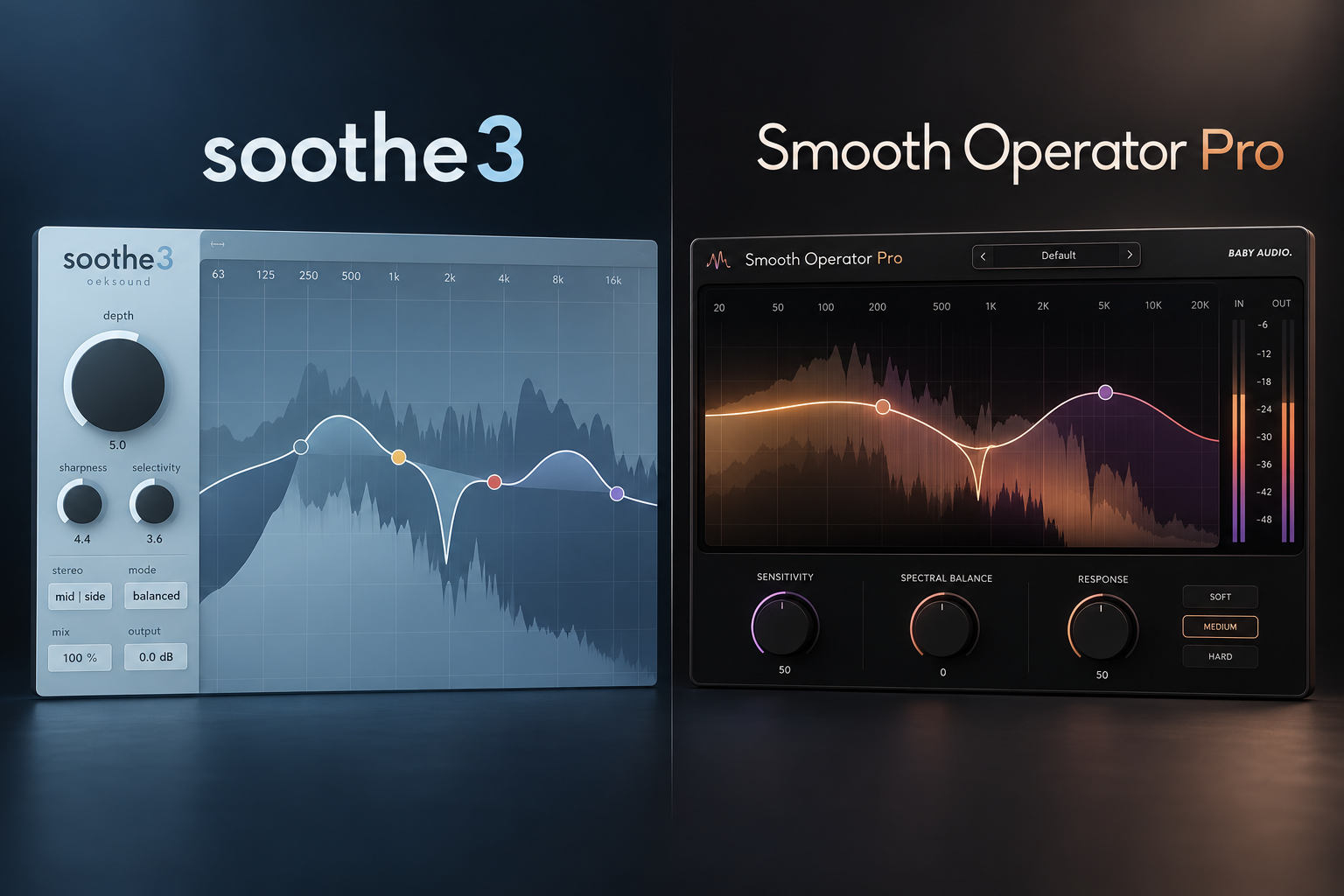

Harsh resonances can be easy to hear but difficult to control, especially when they move with the performance. soothe3 and Smooth Operator Pro both tackle that problem, but they are built around different workflows. We would choose soothe3 for focused resonance suppression, while Smooth Operator Pro makes more sense if you prefer broader, visual spectral shaping. If you only need to tame one or two harsh frequencies occasionally, a free dynamic EQ may already be enough.
soothe3 vs Smooth Operator Pro: quick answer
| What matters | soothe3 | Smooth Operator Pro |
|---|---|---|
| Main purpose | Focused dynamic resonance suppression | Creative spectral balancing and shaping |
| Our starting choice | Harsh vocals, ringing cymbals, resonant instruments | Broad spectral problems and experimental sound design |
| Best budget alternative | Try your existing EQ or the free TDR Nova first | |
These plugins overlap, but the workflow is different. SoundShaper would make the decision based on how frequently you face difficult resonances and whether you want a specialist processor or broader shaping controls.
What does soothe3 do?
oeksound's soothe3 is designed for dynamic resonance suppression. When troublesome frequency peaks move with the performance, it can respond as they change. This makes it interesting for vocals with varying harshness, guitars with resonant notes, or cymbals whose ringing varies by hit.
A static EQ cut affects the same frequency all the time. That may dull passages where the problem was not present. A carefully configured resonance processor can be more selective. But heavy reduction can also reduce articulation and energy, so always compare against bypass at a similar perceived level.
Our advice: start by targeting the problem area and use only as much reduction as you need. Do not assume that a flatter graph means a better sound.
What does Smooth Operator Pro do?
Baby Audio's Smooth Operator Pro is a spectral processing tool built around a visual shaping workflow. Producers can use it to control spectral buildup and explore tonal changes across a sound. This can feel more immediate if you are used to drawing curves and working visually.
Our advice: consider Smooth Operator Pro if you want to experiment on synths, drums and layered arrangements, not just suppress narrow resonances. But check its results by listening in the full mix. A dramatic visual change is not necessarily an improvement.
Which plugin should you use on vocals?
For a lead vocal that turns harsh only on certain words, we would start by auditioning soothe3. We want to address the changing resonance without removing brightness everywhere. Use restrained processing and listen to consonants, sustained notes and intelligibility.
For a vocal with broad tonal buildup, Smooth Operator Pro may be a useful comparison. Neither product replaces basic recording technique, standard EQ or a dedicated de-esser when sibilance is the real issue.
See our best vocal plugins guide for more context.
Drums, synths and full mixes
Drums and cymbals
If a cymbal rings sharply on particular hits, start with gentle resonance reduction. Too much processing can soften the attack and take life out of the groove. Compare with a simple EQ cut before committing to a specialist tool.
Synths and pads
Moving filters and dense harmonics can build up energy in changing ranges. We would try both workflows, then keep the version that preserves the movement and character of the sound. Sometimes adjusting the synth patch itself is the better solution.
Mix bus
Be conservative. Broad processing changes many instruments at once. If the problem comes from one track, fix that track rather than processing the entire song.
Do you need either plugin?
No. A normal EQ is enough for a stable, predictable peak. A dynamic EQ can address frequencies that become excessive only at certain moments. The free TDR Nova is a sensible starting point if your budget is limited.
Buy a dedicated spectral tool only when that process has become a regular need and the workflow makes your mixing easier.
How to choose in your own session
- Find a familiar recording with an obvious resonance problem.
- Try basic EQ or dynamic EQ first.
- Audition soothe3 and Smooth Operator Pro on the same passage.
- Compare at similar perceived loudness, not only by the displayed curve.
- Listen for lost attacks, articulation and useful harmonics.
- Repeat on a second source before making a purchase.
Price and compatibility
Check the latest version, license terms, operating system and supported plugin formats on the official product pages before purchase. Retailer prices vary by currency, taxes and temporary discounts, so we are not presenting an unverified fixed price as current.
SoundShaper opinion
We would prioritize soothe3 for recurring, difficult resonance problems. Its specialist design is a clear reason to trial it on harsh vocals or resonant instruments. We would consider Smooth Operator Pro if we wanted a more visual, flexible spectral-shaping tool across many sources.
This recommendation is based on the published product features and their intended workflows, not on claimed hands-on testing or invented benchmarks.
Frequently asked questions
Is soothe3 just a dynamic EQ?
No. Both can respond to changing frequencies, but soothe3 is purpose-built for resonance suppression. A dynamic EQ uses individually configured bands and is often sufficient for simpler jobs.
Can Smooth Operator Pro replace soothe3?
They overlap for some spectral-balancing tasks but their controls and intended workflows differ. Try both in your own session before treating them as interchangeable.
Should beginners buy either one?
Start with stock EQ and a free dynamic EQ. A specialist processor becomes useful when you can clearly identify a repeated problem your existing tools do not solve comfortably.
Final verdict
Choose soothe3 for focused resonance suppression, Smooth Operator Pro for a more flexible spectral-shaping workflow, and a free dynamic EQ if you only need occasional corrective moves. Do not spend more until the difference matters in your own music.
![[background image] image of recording equipment (for a musician & band)](https://cdn.prod.website-files.com/68efa70811edd8e5af30a90d/6ad525ca541f84cd109a4180_Repro-5%20vs%20Prophet-5%20V.png)
![[background image] image of recording equipment (for a musician & band)](https://cdn.prod.website-files.com/68efa70811edd8e5af30a90d/6ad5249509c44abef3dec403_Diva%20vs%20Pigments%207.png)
![[background image] image of recording equipment (for a musician & band)](https://cdn.prod.website-files.com/68efa70811edd8e5af30a90d/6ad5234388e811ebd04ea1f7_Battery%204%20vs%20XO.png)