
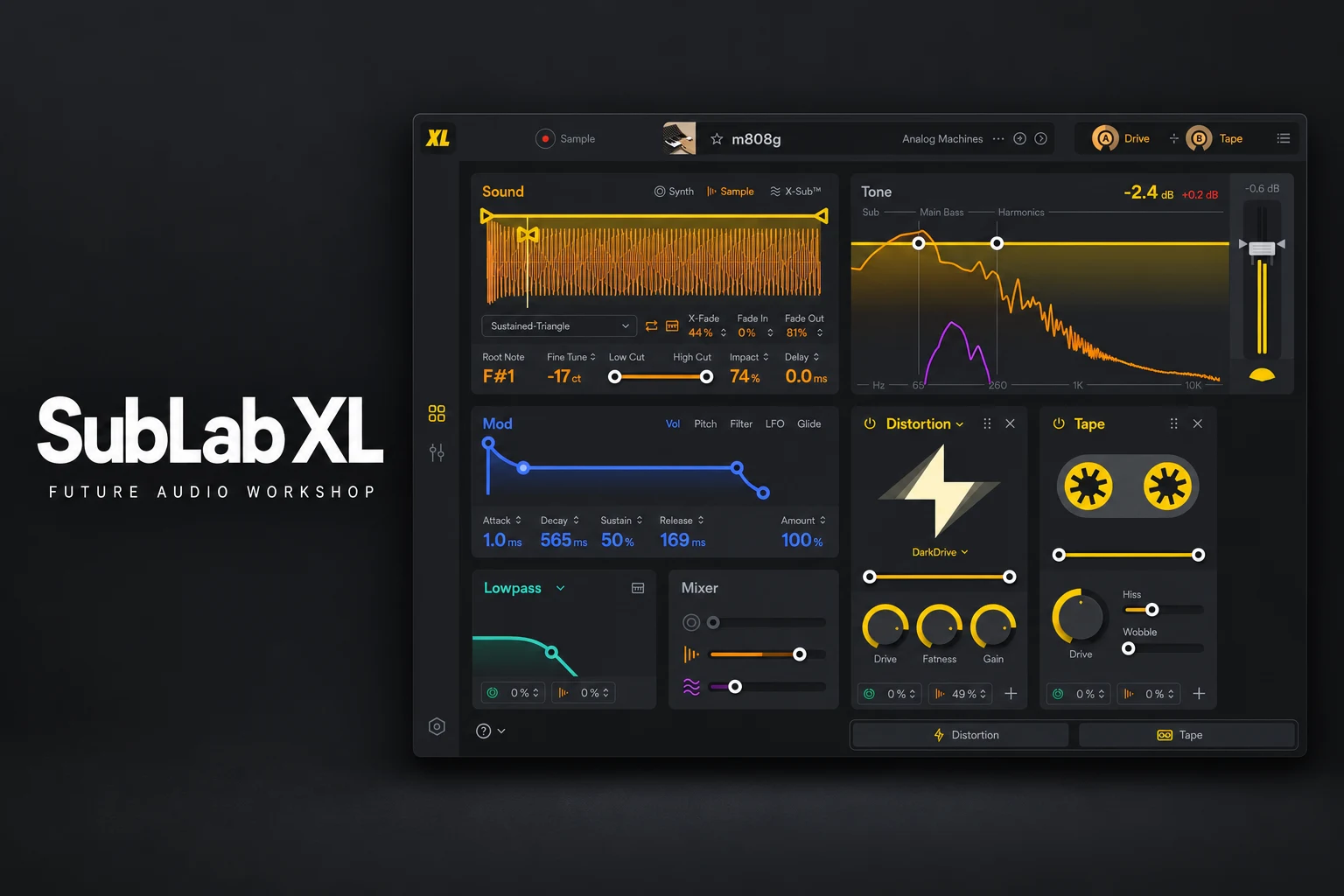

SubLab XL is worth considering if 808s and sub bass are a regular part of your production and you want to shape them in one focused instrument. It brings synthesis, samples, a dedicated sub engine and effects into the same workflow. We would shortlist it for trap, drill and bass-led hip-hop. If you already have a well-tuned 808 sample that suits the beat, you may not need another plugin.
This review looks at its documented features and the practical buying decision. Our recommendations are editorial guidance, not claims of hands-on listening tests or measured bass performance.
What is SubLab XL?
SubLab XL is a bass instrument from Future Audio Workshop. Its foundation combines a synth engine, a sample engine and the X-Sub engine. XL adds a Super Oscillator, more effects, modulation and macros to the original SubLab approach.
You play the instrument with MIDI notes. It is not an effect you insert on a finished mix to automatically repair the low end. Begin with the bassline and a suitable tone, then decide what processing the song needs.
The three sound sources, explained simply
| Source | Documented role | Our suggested use |
|---|---|---|
| Synth | Waveform-based bass generation, including Super Oscillator options | Build a consistent pitched foundation. |
| Sampler | Factory or imported audio, with root-note, tuning and editing controls | Add the attack or character of a particular recording. |
| X-Sub | A dedicated sub-bass engine with harmonic controls | Explore the balance between low-frequency weight and audible character. |
SoundShaper advice: begin with one source. Add another only when you can explain what it contributes. Three active layers are not automatically better than one well-chosen bass sound.
Is it better than using an 808 sample?
A good sample is often the quickest answer. If its tuning, decay and character already match the song, load it into your sampler and write the part.
SubLab XL becomes more interesting when the sample nearly works but needs a different body, attack or movement. The sample engine supports importing your own material, setting the root note, fine tuning, looping and crossfades. That gives you more ways to adapt a source within the instrument.
We would choose based on the task you repeat. If you constantly layer and reshape bass sounds, a dedicated interface may save effort. If you mostly pick one sample and leave it alone, keep that simpler workflow.
A sensible 808 workflow
1. Write the notes first. Check the bassline against the chords before chasing more weight.
2. Start with one source. Get a usable sustain and decay with the kick playing.
3. Check tuning. Treat automatic pitch detection as a starting point and confirm the root note yourself.
4. Add character carefully. Introduce a sample layer or distortion only if the part needs it.
5. Set the note endings. Listen for bass tails covering the next kick or musical change.
6. Compare at similar loudness. Keep the setting that improves the groove, not simply the louder option.
These are suggested audition steps, not a tested preset. For a deeper look at combining layers, read our guide to layering 808s.
Glide matters more than an aggressive preset
SubLab XL includes editable glide curves and tempo-synced glide times. We would audition those with a short bassline containing both small movements and a wider jump.
For drill, make sure the slide arrives where the rhythm needs it. For a slower trap part, leave enough space for the sustained note to establish the harmony. Avoid choosing a slide setting in isolation and assuming it will fit every phrase.
If a line feels wrong, revisit the notes and their lengths before adding effects. No bass instrument removes the need to make those musical decisions.
Distortion, movement and the small-speaker question
XL lets you arrange up to four effects, including distortion, waveshaping, tape, bitcrushing and compression options. Its LFO can modulate two parameters at a time, while macros provide broader control over assigned settings.
Our advice is to identify the missing quality before processing. For a bass that lacks definition, try a little more harmonic character. For a note that feels too static, explore restrained movement. If the low end already dominates, more drive may move you further from the goal.
Do not interpret X-Sub's marketing as a promise that a phone will reproduce deep sub frequencies. Check whether the bassline remains recognizable on smaller playback systems as well as whether the low end holds together on full-range monitoring. Those are different listening checks.
We would compare a clean version with a more colored one in the complete beat. Preserve the version that supports the vocal and drums.
SubLab vs SubLab XL: should you upgrade?
The original SubLab already contains the synth, sampler and X-Sub foundation. XL expands that with the Super Oscillator, a more flexible effects workflow, LFO modulation, macros and new sounds.
Future Audio Workshop describes them as separate instruments: installing XL does not replace the original plugin in existing projects. Its FAQ also confirms that SubLab presets can be imported into XL.
Our recommendation: upgrade for a specific missing feature. If you want the new effects routing or modulation, XL has a clear purpose. If the original already creates the basses you use, there is no need to upgrade simply to own the larger edition.
Existing SubLab owners should check the eligible crossgrade rather than automatically paying for another full licence. The following option requires ownership of the original SubLab:
What if you already own a capable synth?
You can make useful basses with many instruments. SubLab XL's buying argument is its focus: the source choices and shaping tools sit around the job of making low-end sounds.
Try rebuilding one of your regular bass parts in the demo. If the dedicated controls make the task easier, that may justify the purchase. If your existing synth or sampler reaches the result comfortably, use it.
For a broader instrument choice, our synth plugin guide covers other production roles. SubLab XL should be a bass decision rather than a replacement for an entire synth collection.
Price and compatibility: check before buying
On 18 October 2026, Plugin Boutique displayed a €40.66 promotional price, compared with €78.34, advertised through 31 October. That is a dated storefront observation; confirm the current price, eligibility and checkout total.
The official specifications list 64-bit VST2, VST3, AU and AAX formats, macOS 10.12 or later with Intel or M1 support, and Windows 8 or later. Future Audio Workshop names FL Studio among its tested hosts. Online activation is required, after which the instrument can be used offline.
These published minimums are not a guarantee for every newer system or host combination. Plugin Boutique lists a trial: install the current version and check it in your exact DAW before purchasing. In a disposable test project, confirm playback, your preferred plugin format and any project-recall behavior that the demo permits.
SoundShaper opinion
SubLab XL is most attractive when you regularly construct 808s rather than simply select them. Its combined sources and bass-focused shaping tools give it a clear role for producers who spend time adjusting attacks, sustain, slides and character.
We would be less quick to recommend it to someone who already has a reliable sample workflow or mainly needs realistic electric bass performances. Buy it for a repeatable improvement in the way you build bass parts, and only after confirming the current version works comfortably in your setup.
Frequently asked questions
Can I import my own 808 samples?
Yes. The sample engine supports your own audio as well as the included material. Check the root note and tuning before writing the final bassline.
Is it only for trap?
No. Its bass-focused workflow can also be relevant to other electronic styles. We would audition the sounds against your actual genre and arrangement.
Do I need the original SubLab?
Not for the full SubLab XL licence. A SubLab-owner crossgrade is a different purchase with an ownership requirement.
Will XL replace SubLab in old projects?
The developer says the two appear as separate instruments. Keep the original installed when your existing projects need it.
Conclusion
Choose SubLab XL if you want one focused instrument for building and shaping 808s and sub bass. Try the sample workflow, glide and effects on a real bassline, and compare the result with your current tools. A good fit is a faster route to the part you want, not simply a larger-looking low end.
Sources: Future Audio Workshop product information, SubLab XL FAQ and the Plugin Boutique full-licence and crossgrade listings. Details checked 18 October 2026.
![[background image] image of recording equipment (for a musician & band)](https://cdn.prod.website-files.com/68efa70811edd8e5af30a90d/6ad5421eaf14ef1dbac4dfa8_TAIP%20Review.webp)
![[background image] image of recording equipment (for a musician & band)](https://cdn.prod.website-files.com/68efa70811edd8e5af30a90d/6ad5413cb1504db30162273f_Phoscyon%202%20Review.webp)
![[background image] image of recording equipment (for a musician & band)](https://cdn.prod.website-files.com/68efa70811edd8e5af30a90d/6ad5403dd747f3fbbe4286ab_Chordjam%20Review.png)