
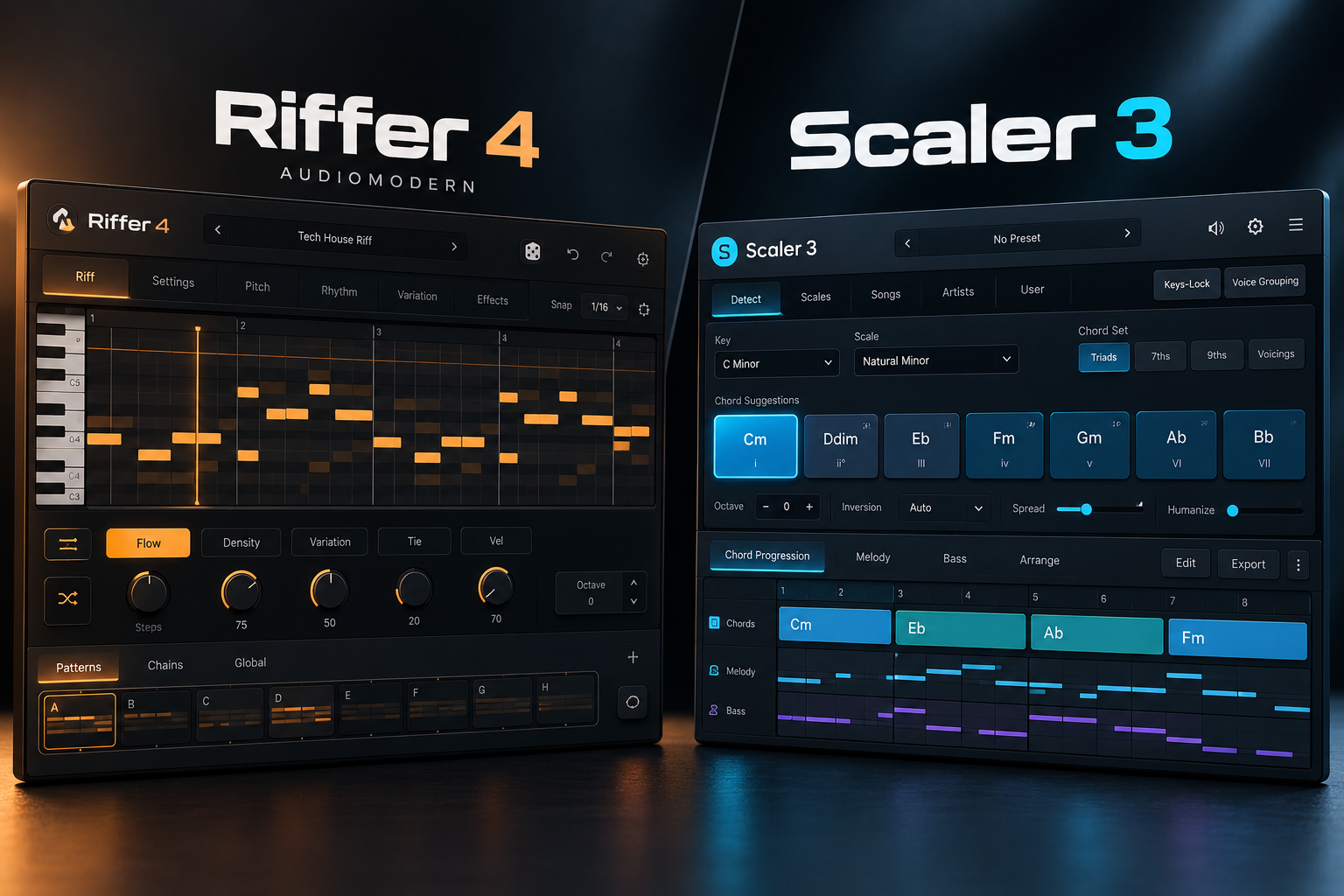

Riffer 4 and Scaler 3 can both help when you are stuck for musical ideas, but they solve that problem from different angles. Riffer is more useful when you want fresh riffs and melodic patterns to build on, while Scaler 3 is stronger when chords and harmonic direction are what slow you down. Both can go beyond those roles, so the better choice depends on which part of writing music you want help with most.
Both can help with melodies and basslines, so this is not simply a melody generator versus a chord generator. Below, we compare their approach, price and practical value, then explain which we would choose for different production needs.
Disclosure: This article contains affiliate links. SoundShaper may earn a commission if you purchase through them, at no extra cost to you. SoundShaper’s recommendations are editorial buying advice based on current product documentation and buying options.
Riffer 4 vs Scaler 3: Quick Comparison
Buying questionRiffer 4Scaler 3What is its main focus?Generating and developing MIDI riffsHarmony and broader compositionCan it help with melodies and bass?YesYesWhat makes its approach different?Five riff-generation enginesChord tools and an arrangement timelineOur suggested starting pointYou like your chords but need another ideaYou need help with the chord progression itselfPrice shown when checkedAbout €49 on saleAbout €98 for the full desktop licence
SoundShaper view: A focused tool is often the better purchase when you already know what is missing. A broader tool makes more sense when you want help with several stages of writing.
What Does Riffer 4 Do?
Audiomodern Riffer 4 generates editable MIDI ideas. Set a key and scale, create a phrase, then change the notes, range, density or timing. Its five engines cover sequences, hooks, guitar-inspired patterns, arpeggios and basslines. You can export the MIDI to continue working in your DAW.
That makes Riffer 4 worth considering if your usual writing habits keep producing similar phrases. You still choose the instrument sound and decide which notes deserve to stay.
SoundShaper view: Treat the generated phrase as a suggestion. Keep an interesting rhythm or a small note pattern, remove what gets in the way, and develop it against your drums. Finding one useful detail is enough; you do not need to keep the whole result.
What Does Scaler 3 Do?
Scaler 3 combines chord exploration with tools for developing a composition. It suggests chords, helps with voicings and offers ways to move between keys. Its Arrange page has lanes for chords, melodies, bass and phrases, while Motions turn harmonic ideas into performances.
Scaler 3 also includes MIDI editing, internal sounds and support for hosting VST/AU instruments and effects. Its appeal is the relationship between the parts, rather than just the number of ideas it produces.
SoundShaper view: If you keep writing the same four chords, spend time listening to different voicings before adding more layers. A different inversion or bass note can make an existing idea feel more useful than another instrument on top.
Which Is Better for Melodies and Basslines?
Our recommendation is Riffer when you want to audition fresh phrases and take the useful notes back into your own workflow. Scaler is our recommendation when you want those parts to grow from a progression you are developing.
Imagine a beat with a chord loop you already like. The open question is a short hook that leaves space for a vocal. We would start by trying Riffer, then simplify the idea until it sits comfortably with the loop.
Now imagine starting with a piano progression and wanting a bass part that supports its changes. We would start with Scaler, then check whether the bass movement strengthens the progression or makes it unnecessarily busy.
Our advice: Listen against the full track. A busy phrase can sound impressive on its own and still compete with the singer or kick. Before generating another idea, try deleting a few notes from the one you have.
Which Is Better for Chords and Songwriting?
For a buyer whose main problem is harmony, we would choose Scaler 3. Its chord suggestions and composition tools directly address that need. Riffer is the more focused purchase when you want phrases to develop within a musical direction you already understand.
If you struggle to move from a verse into a chorus, do not judge either tool only by its first eight-bar loop. Ask whether it helps you make a second section that feels connected but different.
SoundShaper view: Write a clear description of the problem before shopping. “My chord changes feel flat” and “I need a better lead rhythm” call for different experiments. Buy the plugin that helps with your actual problem.
Riffer vs Scaler for Beginners and FL Studio Users
Both developers list FL Studio among their supported DAWs. Riffer 4 is available in VST3, AU and AAX formats on desktop, plus standalone. Scaler 3 also supports major desktop plugin formats and standalone use.
If you are new to MIDI, remember that MIDI describes a performance; the receiving instrument supplies its sound. Our guide to MIDI vs audio explains that distinction.
For a first trial, use an instrument you already know. Make a short idea, bring the MIDI into your normal project, and edit it there. That checks the workflow you will actually use, rather than just whether the demo sounds impressive.
Riffer has a narrower purpose to explore. Scaler offers more areas to learn. We would not call either universally easier without knowing what you want it to do.
Price, Offers and Upgrade Options
On 9 October 2026, Plugin Boutique showed Riffer 4 at approximately €48.59, with the offer listed until 30 November 2026. Scaler 3 was approximately €98.18 for the full desktop purchase. Currency, tax and offers can change, so check the product page before paying.
Check the current Riffer 4 offer and check the current Scaler 3 price both lead to the full purchase pages. Existing users should check the Riffer 4 upgrade or Scaler 3 upgrade instead, and confirm the qualifying licence requirements.
SoundShaper view: Riffer is the smaller commitment at these prices, but the cheaper option only saves money if it solves the right problem. We would pay more for Scaler when harmonic guidance is the reason for buying.
Should You Buy Both?
We would start with one. There is enough overlap in musical idea creation that buying both immediately could leave you learning two tools before finishing a track.
Try to complete a short arrangement with your first choice. If a clear gap remains, then consider the other. The useful question is what the second purchase adds to your working process.
SoundShaper Verdict: Which Should You Buy?
Choose Riffer 4 if you already have a harmonic direction and want fresh hooks, sequences or bassline ideas to reshape yourself.
Choose Scaler 3 if you want help with chord choices and developing connected musical parts. It is our broader recommendation for producers buying a composition assistant.
If neither describes your problem, keep your money for now. Take a track you have struggled to finish and try the developers’ Riffer trial and Scaler trial on it. The better purchase is the one that helps you make a musical decision and keep working.
Frequently Asked Questions
Can Scaler 3 make melodies, or only chords?
It can help with melodies, basslines, arpeggios and phrases as well as chords. That overlap is why your preferred writing process matters in this comparison.
Does Riffer 4 replace a synthesizer?
No. Its main job is creating MIDI ideas. You need an instrument to turn that performance into your chosen sound.
Which should I choose if I already own Scaler?
Try its melodic tools first. We would only add Riffer if you still want a different way to generate phrases, rather than another purchase with a similar purpose.
Do I need music theory knowledge?
You can explore either without advanced theory, but listening and editing still matter. Learn a little about keys, chord tones and rhythm as you work; it will help you judge the suggestions.
Feature and buying information checked against Audiomodern, Scaler Music and the linked Plugin Boutique listings on 9 October 2026.
![[background image] image of recording equipment (for a musician & band)](https://cdn.prod.website-files.com/68efa70811edd8e5af30a90d/6ad51b453ad0e932c58d82a6_Vintage%20Audio%20Plugins%20Comparison.png)
![[background image] image of recording equipment (for a musician & band)](https://cdn.prod.website-files.com/68efa70811edd8e5af30a90d/6ad51aedbbd6c56e894f3b7b_Kickstart%202%20vs%20Duck%202%20Plugins.png)
![[background image] image of recording equipment (for a musician & band)](https://cdn.prod.website-files.com/68efa70811edd8e5af30a90d/6ad51a8539eac7580cac832c_Dual%20Audio%20Plugin%20Comparison.png)