

Phase Plant is worth considering when you want to build sounds around your own signal path. It makes less sense as an expensive way to collect another folder of familiar presets. The buying question is whether choosing and combining the building blocks will help you finish music, or give you another place to get distracted.
Our recommendation is to try it with one unfinished track before buying. Build a bass, a playable texture and one simple lead. If the open layout helps you make decisions, Phase Plant has a clear role. If you prefer a synth that presents the same controls every time, that preference matters more than a long feature list.
This review assesses the documented features and their practical tradeoffs. It does not claim original listening tests or measured CPU results.
Quick Comparison
| Buying question | Our advice |
|---|---|
| Best reason to buy | You enjoy designing patches and want to choose the signal path. |
| Less convincing reason | You already have the sounds you need and mostly browse presets. |
| What to check before paying | Included effects, premium effect editing rights and your local checkout price. |
| Useful first step | Use the developer’s trial in an actual project. |
What makes its modular layout useful?
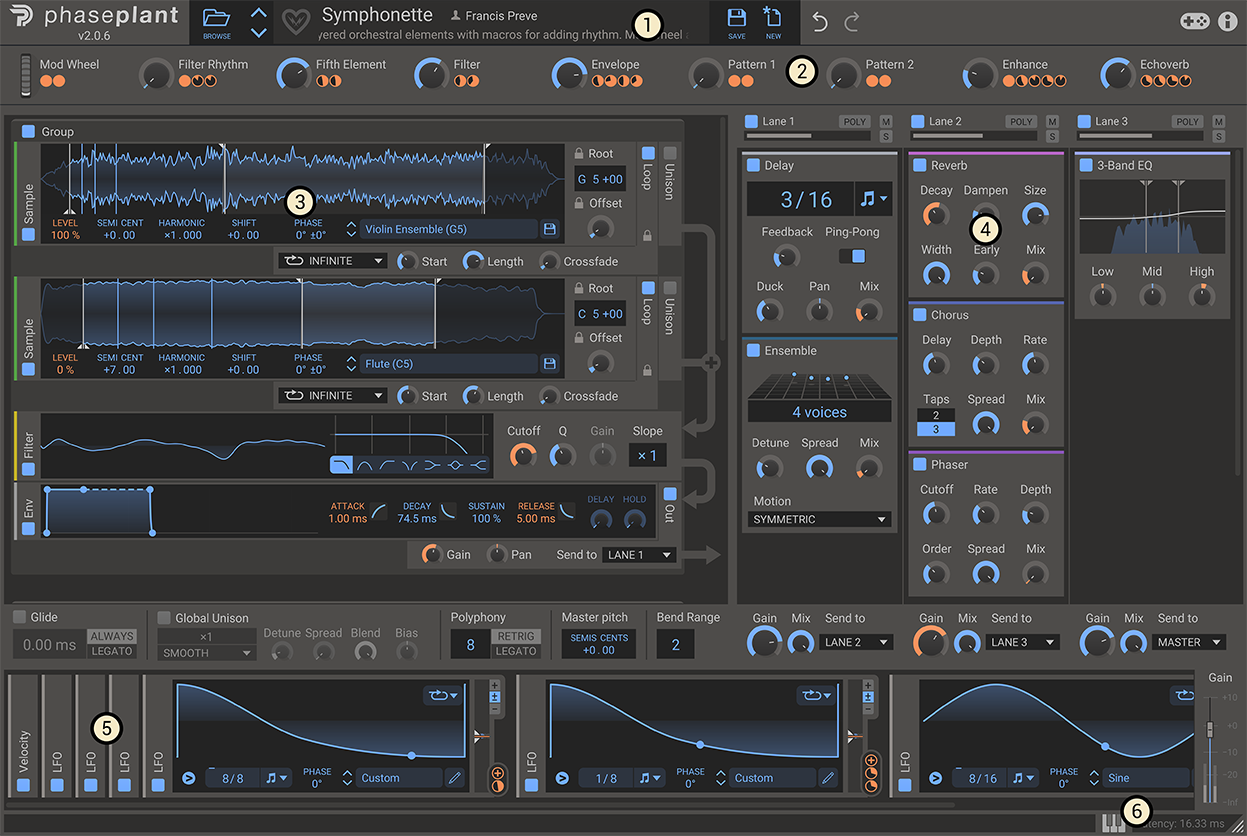
Phase Plant combines analogue-style oscillators, wavetables, samples, granular material and noise. Its modulation section and three effects lanes sit alongside the sound generators. Instead of starting with one fixed architecture, you assemble the parts a patch needs.
Build one simple patch before layering: an Analog generator, a low-pass Filter below it, then an Envelope Output in the same group. Set the output to FX Lane 1. The generator section processes downward within a group; an output module is what sends that sound onward. If a new group is silent, check its output and destination before adding more generators.
Use a short amplitude attack and a moderate release, then assign a modulation envelope to the filter cutoff for a pluck. Set the cutoff low enough that the envelope movement is audible. Once that works, put a second generator in its own group with its own output. You can now change the upper layer without forcing the low layer through the same filter.
The downside is that an open canvas asks you to make more decisions. Someone who wants to record a melody immediately may find a familiar, fixed layout more helpful. Modularity has value when you use the freedom; it is not automatically a better workflow for every producer.
Granular synthesis: a reason to use your own material
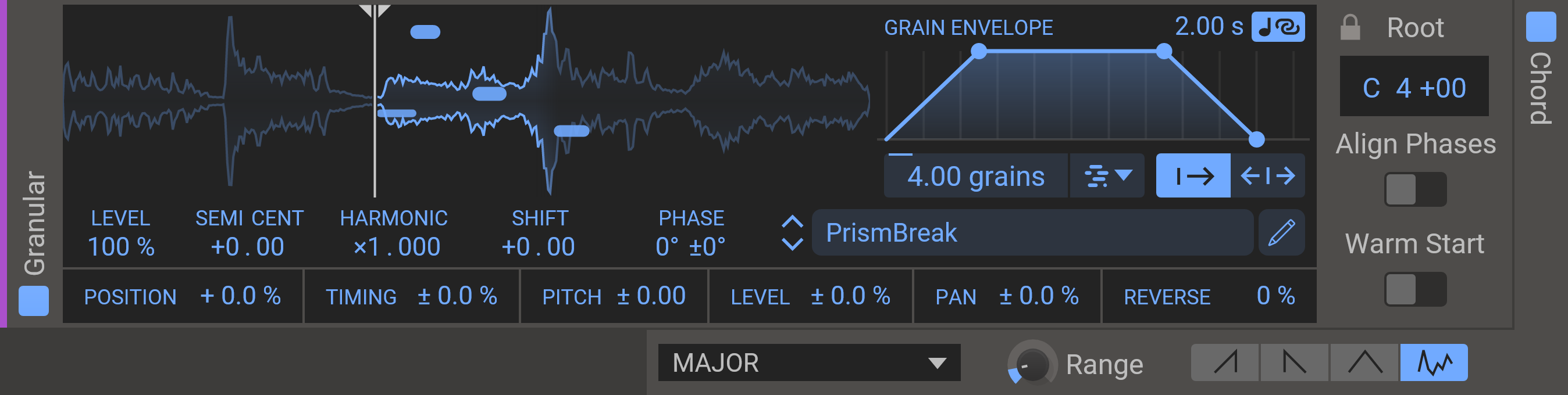
The granular generator breaks sampled material into short grains. That gives Phase Plant a route into textures built from recordings, rather than only conventional oscillator tones.
For a meaningful trial, use a recording you know well: a short vocal sound, a guitar note or a piece of room noise you recorded yourself. Aim for a layer that supports an existing chord progression. Keep the pitched part simple while you explore the texture, so you can tell whether the result belongs in the arrangement.
This is also where restraint helps. An interesting texture can occupy too much of the same space as the vocal or lead. Judge the patch with the song playing, then decide whether you need the full sound or only a quiet part of it. Buying a flexible instrument does not remove the need to arrange carefully.
Modulation should give you a playable sound
The documented modulation system includes envelopes, LFOs and audio-rate interactions between generators. There are also eight macro controls for bringing important changes together.
That last point deserves attention during a demo. A patch with twenty moving parameters can still be awkward to perform. Choose two or three changes that make musical sense, such as brightness, motion and effect amount, and put them within easy reach.
Then record a short passage without stopping to adjust the interface. If the sound responds usefully throughout the phrase, you are testing the instrument as an instrument. If you spend the whole session adding more modulation, set a time limit and return to the arrangement. The value of a synth is partly whether you can turn exploration into a usable part.
What is included, and what costs extra?
Phase Plant includes Kilohearts Essentials. You do not need to buy every premium Kilohearts effect to start building patches. However, the base licence and the complete Kilohearts ecosystem are different purchases.
Kilohearts explains that presets using premium effects you do not own can still play, while direct editing of those effects is restricted; assigned macros can still control them. This matters if you like taking presets apart. Hearing a preset work does not mean you own every processor inside it.
Before buying a larger bundle, write down which extra effect you actually want to edit. If you cannot name one, begin with the included tools. It is easier to assess an expansion after encountering a real limitation than while comparing bundle screenshots.
Price and licence: check the complete purchase
Kilohearts lists the standalone instrument at US$199 and offers a 10-day trial. Check the retailer’s current U.S. price, tax and license details before buying.
Compare the cost of the instrument you need with the bundle you are considering. A larger discount does not necessarily mean a smaller bill. Also make sure the offer is for a full licence if you do not already own a qualifying product.
During the trial, check installation, project recall and performance in your own DAW. Load the sort of arrangement you normally make. A single impressive preset in an empty project tells you little about whether the instrument fits your everyday sessions.
Phase Plant or another synth?
Start with the synth you already know. Write down the specific operation that feels slow or awkward, then try that same task in Phase Plant. You have a useful reason to switch if the new workflow removes a repeated obstacle.
If Serum is on your shortlist, our Phase Plant vs Serum 2 comparison focuses on that decision. For a free starting point, explore our free synth plugin guide. Neither comparison should replace spending time with the interface.
Owning several synths is reasonable when you give them different jobs. It becomes less useful when each purchase restarts the process of learning envelopes, filtering and modulation from scratch. There is no requirement to replace an instrument that already lets you express your ideas.
Conclusion
We would shortlist Phase Plant for producers who actively want to design sounds, especially when combining synthesis and sampled material is part of the appeal. Its architecture gives that work a clear home.
We would be more cautious if your main goal is faster preset selection. Set yourself a small trial brief and judge the results against a current project. Three sounds you can actually use are stronger evidence for a purchase than an evening of impressive experiments.
Sources and product information
Kilohearts: Phase Plant and trial; Phase Plant manual; Kilohearts: included effects and preset permissions. Product information checked 2 November 2026.


