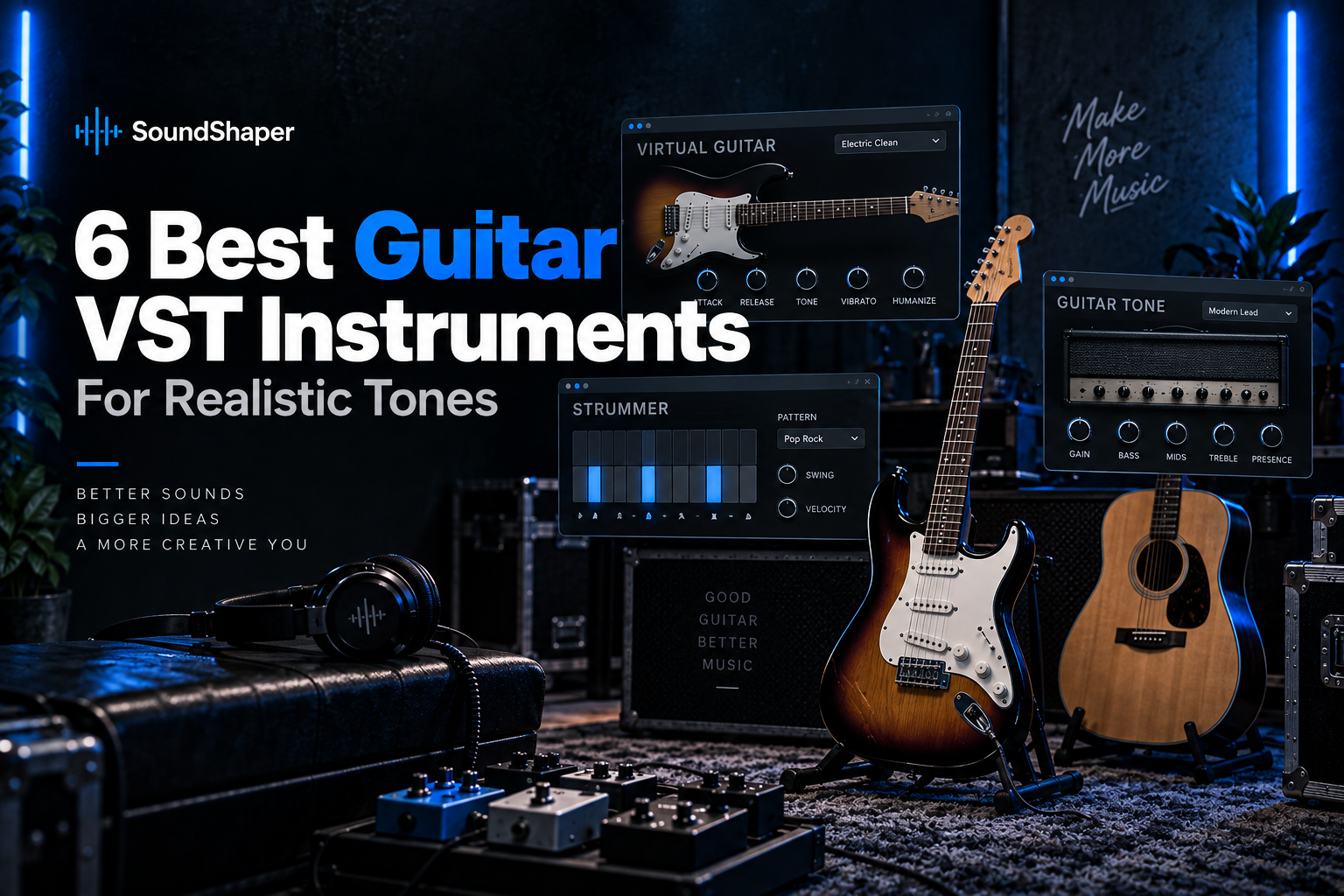
Real guitar recordings take time, gear, and a player who actually knows how to track a clean take. When you don't have that, a vst instrument guitar is the fastest way to get believable acoustic, electric, or bass guitar parts into your session without booking a studio or waking up the neighbors. The problem is that most guitar plugins sound stiff, robotic, or obviously fake the moment you play a real chord progression.
That's exactly what this list solves. We tested and picked the 6 best guitar VST instruments available right now, covering everything from realistic strumming engines to riff-based rock libraries, so you can find the right virtual guitar plugin for your genre and budget instead of guessing based on marketing screenshots.
Below you'll find honest breakdowns of tone quality, playability, and articulation depth for each pick, plus notes on which ones handle realistic strumming patterns and dynamic picking best. Whether you need a subtle acoustic layer behind vocals or a full electric rhythm track, one of these guitar vst plugins will get you a mix-ready tone in minutes, not hours.
Shreddage 3 Stratus is the guitar VST instrument I reach for when a track needs a real electric guitar feel without hiring a session player. Built around a Fender-style single-coil axe, it runs in Kontakt (you can download Kontakt Player for free) and uses Impact Soundworks' RS² (Riff Style engine) alongside deep multi-sampling to capture how a guitarist actually attacks strings, not just single notes triggered from a keyboard. It's a strong fit if you're building rock, pop, or funk tracks and need rhythm parts that hold up under scrutiny.

The library was recorded with three pickup positions and includes a huge range of articulations that most guitar vst plugins skip entirely.
This is where Stratus separates itself from cheaper alternatives. The realistic strumming patterns and round-robin sampling avoid the machine-gun repetition you hear in budget libraries, and the chord engine tracks your MIDI input closely enough that fast strumming passes for a real take in a mix.
A guitar VST is only as convincing as its transitions between notes, and Stratus nails that better than almost anything else in this price range.
Producers working in rock, pop, indie, or singer-songwriter styles will get the most mileage here. It's less suited to metal riffing, since the tone leans clean and single-coil rather than high-gain, but for rhythm guitar beds and melodic lead lines it's hard to beat.
Shreddage 3 Stratus retails around $149, with Impact Soundworks running frequent sales that drop it closer to $99. Check current Shreddage 3 Stratus pricing and bundle options.
Ample Guitar M3 is the acoustic counterpart to the brand's popular electric libraries, and it's become a go-to guitar vst plugin for producers who need a natural steel-string tone without micing a real instrument. Ample Sound built its own strumming engine, called ASK (Ample Score Kit), which reads your MIDI chords and generates believable strum patterns instead of forcing you to program every downstroke by hand.
Guitar M3 models a Martin-style dreadnought with true left-hand and right-hand sample capture.
The body resonance and string noise samples give this vst guitar instrument a warmth that cheaper acoustic libraries miss entirely. Strummed chords ring out with natural decay, and the fretboard logic avoids the awkward voicings that plague generic sample players.
An acoustic guitar VST lives or dies by its strum realism, and Ample Guitar M3 handles that better than most dedicated acoustic libraries.
Singapore-based Ample Sound built this for singer-songwriters, folk producers, and anyone layering acoustic rhythm under vocals or full-band arrangements.
Ample Guitar M3 sells for roughly $169 direct from Ample Sound, occasionally discounted during holiday sales. You can also get it cheaper through Plugin Boutique, where it may come bundled with a free plugin, making that the better-value option depending on the current promotion. Compare it against other picks on Soundshaper's guitar plugin roundup before committing your budget.
Evolution Ash brings a different approach to the table: instead of a fixed strumming engine, it uses Orange Tree's Auto-Strum technology paired with real recorded electric guitar tone from an Ash-body instrument. Producers who want more manual control over voicings while still getting a guitar vst instrument that sounds hand-played tend to land on this one after outgrowing simpler strum-only libraries.
The library focuses on flexibility rather than genre-specific presets, giving you raw material to shape into whatever tone you need.
What stands out here is the string resonance modeling, which keeps sustained chords from sounding clipped or synthetic. Sound quality stays consistent across the neck, and the picking articulations respond naturally to velocity changes instead of just switching samples abruptly.
Good articulation switching, not just sample count, is what makes a guitar VST feel alive under your fingers.
This suits producers scoring for media, working in indie rock, or building layered arrangements where guitar tone needs to sit precisely in a mix.
Evolution Ash runs around $129 direct from Orange Tree Samples, with occasional bundle discounts when paired with their other electric libraries.
Virtual Guitarist takes a completely different route than the sample-heavy libraries above. Instead of chords and articulations you build note by note, UJAM's engine plays entire strummed or picked patterns triggered from single keys, which makes it the fastest guitar vst on this list for sketching ideas or finishing tracks under deadline. It comes in several editions, from acoustic folk to metal rhythm guitar, so you pick the flavor that matches your genre rather than shaping one generic tone.
Each edition ships with genre-specific phrases recorded by real session guitarists.
Because every pattern is a real recorded performance, this guitar instrument vst avoids the robotic feel you get from note-by-note MIDI programming. The tradeoff is flexibility: you're choosing from a menu of pre-played parts rather than crafting a custom performance.
Speed and realism rarely come together in one guitar plugin, but Virtual Guitarist gets close by recording real players instead of simulating them.
Producers who don't play guitar, or who need a finished-sounding part fast, get the most value here.
UJAM Virtual Guitarist titles typically cost around $149 to $199 each, depending on the instrument and current promotion. Before buying direct, check Plugin Boutique, where UJAM products are often discounted and may also include a free software gift with your purchase. Bundles can offer even better value if you want multiple Virtual Guitarist instruments.
MusicLab RealStrat takes a physical-modeling approach instead of relying purely on multi-sampling, which makes it one of the more unusual vst instruments guitar producers can pick up. The engine simulates string behavior in real time, so bends, vibrato, and slides respond to how hard and where you play rather than triggering a fixed sample.
RealStrat ships with a compact but well-designed control set built around its modeling engine.
Sustain and pitch-bend behavior feel more organic here than in most sample-based libraries, since nothing is stretched or looped. That said, the tone leans slightly synthetic on sustained chords compared to Shreddage 3 Stratus, so it works best for lead lines and expressive single-note runs.
Physical modeling trades raw sample realism for expressive control, and RealStrat is one of the few guitar VSTs that gets that trade right.
Guitarists who already play a MIDI guitar controller, or producers who want expressive bends without hunting through articulation maps, will get the most out of this guitar vst instrument.
RealStrat costs around $139 direct from MusicLab, making it one of the more affordable options on this list.
Peel Guitar is the free option on this list, and like the other free VST plugins worth downloading, it's a genuinely useful one rather than a stripped-down demo. Spitfire recorded a nylon-string classical guitar and built a stripped-down instrument around it inside Spitfire Labs, their free plugin platform. If you just need a quiet, intimate acoustic texture without buying a full guitar vst instrument, this covers that gap without costing anything.

https://www.pluginboutique.com/?a_aid=685eb86b20349&a_cid=1461e21b
Labs instruments are intentionally minimal, and Peel Guitar follows that formula with a short but focused feature set.
The recording quality is excellent for a free instrument, with warm, close-mic'd tone that sits nicely under vocals or strings. It won't replace a dedicated strumming engine for full rhythm parts, since there's no chord or strum automation here, but for single-note melodies or sparse picked patterns it sounds convincing.
A free guitar VST rarely sounds this good, and Peel Guitar proves you don't need articulation switches to get a usable, emotional tone.
Composers, lo-fi producers, and anyone layering a soft acoustic accent into a mix will find real use here.
Peel Guitar is completely free through Spitfire Labs, with no time limit or watermark on the sound.
No single vst instrument guitar wins every category, and that's the point of testing all six before you buy. Shreddage 3 Stratus and Evolution Ash cover realistic electric rhythm work, Ample Guitar M3 handles acoustic strumming, UJAM Virtual Guitarist saves you time on deadline, RealStrat gives you expressive lead lines, and Spitfire's Peel Guitar proves free can still sound musical. Match the pick to the part you're actually writing instead of chasing the biggest sample library on the shelf.
Once you know your genre and playing style, the decision gets a lot easier. Acoustic layer under vocals? Grab Ample Guitar M3 or Peel Guitar. Full rock rhythm track? Stratus or Evolution Ash. Need it fast? UJAM wins. For more comparisons, reviews, and deal roundups on guitar vst plugins and everything else in your plugin folder, browse the SoundShaper blog before your next purchase.

![[team] image of team member (for a mobile gaming)](https://cdn.prod.website-files.com/68efa70811edd8e5af30a90d/690abaa8987a07a672c4cd2c_channels4_profile.jpg)
![[background image] image of recording equipment (for a musician & band)](https://cdn.prod.website-files.com/68efa70811edd8e5af30a90d/6aa35b3b03d3771388765f76_Main%20Image.png)
![[background image] image of recording equipment (for a musician & band)](https://cdn.prod.website-files.com/68efa70811edd8e5af30a90d/6aa35785b8608362620d46e3_Main%20Image.png)
![[background image] image of recording equipment (for a musician & band)](https://cdn.prod.website-files.com/68efa70811edd8e5af30a90d/6aa351f638777f809800a4ff_Main%20Image.png)