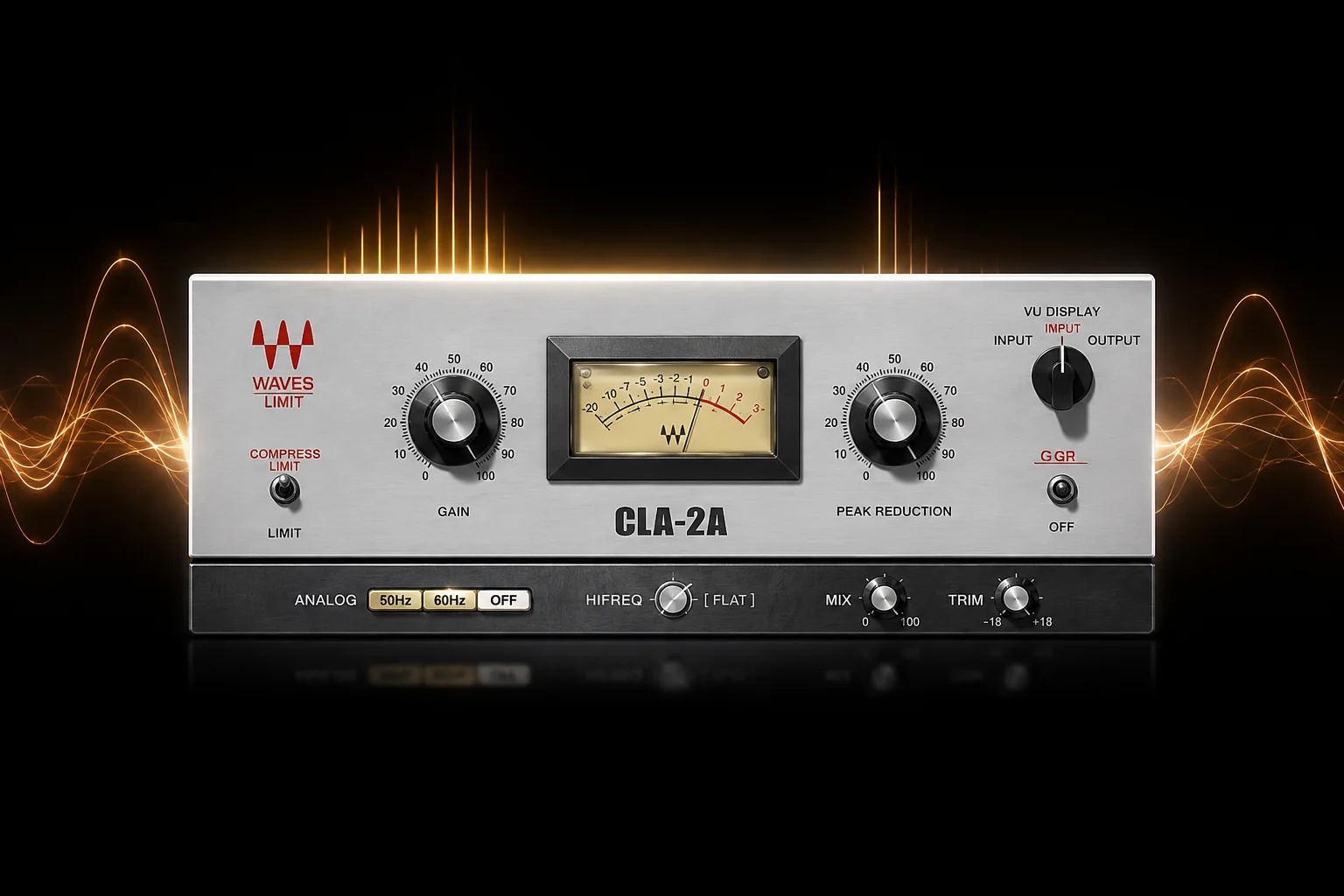
The Waves CLA-2A is one of those compressors that looks almost too simple compared with modern dynamics plugins.
There is no adjustable ratio, no traditional attack and release controls, and no large visual display. Instead, the workflow is built around a few core controls and the smooth, program-dependent compression associated with classic electro-optical hardware. Waves modeled the plugin from one of Chris Lord-Alge’s own vintage units and added modern conveniences such as a Mix control, sidechain frequency filter, Trim control and zero-latency operation.
That simplicity is exactly why the CLA-2A remains interesting.
Rather than spending time dialing in every compressor parameter, you can use it to quickly control dynamics while adding some of the harmonic character associated with its tube-based design. Waves specifically positions it for sources such as vocals, bass and guitars, where smoother compression and natural level control are often more useful than aggressive transient shaping.
But in 2026, there are countless compressors that offer far more control, cleaner processing and advanced visual feedback.
So the real question is not whether the CLA-2A has the most features.
It is whether its simple workflow and distinctive compression style still offer enough value to justify adding it to your plugin collection.
In this Waves CLA-2A review, we’ll look at how it works, where it makes the most sense, its limitations, value and whether it still deserves a place in a modern mixing workflow.
The Waves CLA-2A is still worth considering if you want a compressor that is fast, smooth and easy to use.
Its biggest strength is not flexibility. It is the fact that you can get useful compression quickly without adjusting ratio, attack or release. That makes it especially practical on sources such as vocals, bass and guitars, where you may want level control without making the sound feel overly processed.
The downside is that the CLA-2A is far less flexible than a modern compressor. You have less control over how the compression reacts, so it is not the best choice when you need precise transient shaping, transparent gain reduction or detailed dynamics control.
If you already own several good compressors, the CLA-2A is not essential. But if you like the workflow and character of optical-style compression, it can still be a useful tool to keep around.
The Waves CLA-2A is an electro-optical tube compressor and limiter plugin modeled from one of Chris Lord-Alge’s personal vintage hardware units. Its design is based around the classic optical compression style known for smooth, program-dependent gain reduction rather than precise manual timing controls.
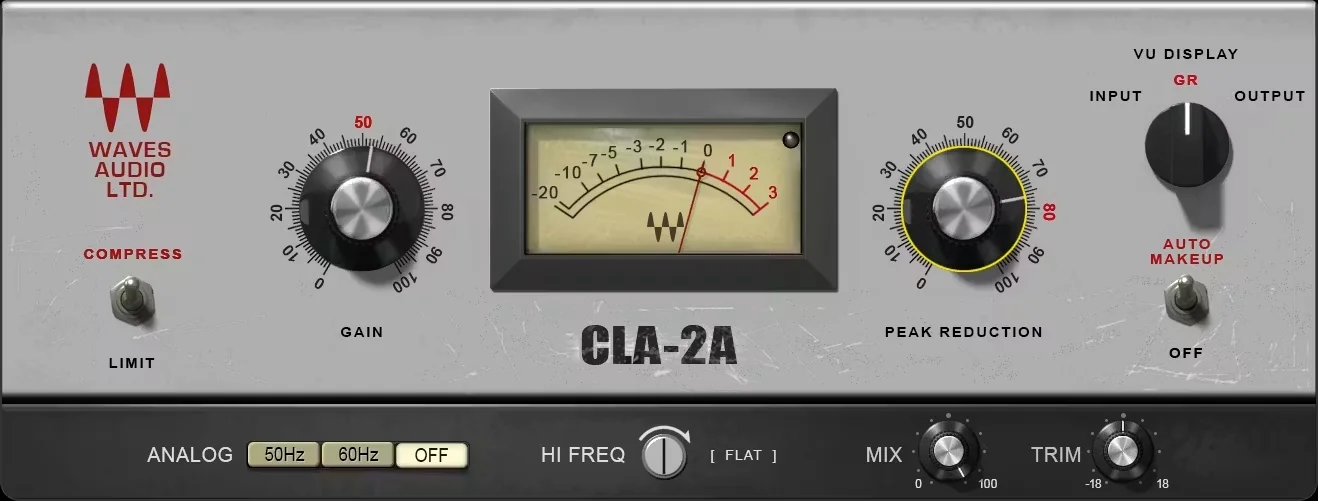
The core workflow is intentionally simple: use Peak Reduction to control how much compression is applied and Gain to bring the level back up. You can also switch between compression and limiting modes.
Waves adds several modern features around that classic workflow, including a Mix control for parallel compression, sidechain frequency filtering, Trim control, optional analog noise and zero-latency processing.
That makes the CLA-2A less about detailed dynamics shaping and more about getting to a smooth, controlled result quickly.
The CLA-2A is simple because the original optical compressor design was never built around detailed manual control.
Instead of setting a ratio, attack and release time, you mainly decide how much compression you want and then compensate for the level afterwards.
The optical circuit reacts differently depending on the incoming signal, so the compression timing changes naturally with the material. Louder or more sustained sounds can produce a different response than short transients, without you having to dial in separate timing settings.
That is also why the CLA-2A feels very different from a modern compressor.
A modern dynamics plugin may give you complete control over attack, release, ratio, knee and lookahead. The CLA-2A removes most of those decisions and gives you a much faster workflow instead.
That can be limiting when you need precision, but it is also the reason the plugin works so well as a quick leveling compressor.
You are not trying to design the compression curve.
You are simply deciding how hard you want the signal to hit the compressor and whether the result sounds better.
The CLA-2A is designed more for leveling and smoothing than aggressive transient control.
When you increase Peak Reduction, the louder parts of the signal are pulled back while quieter sections remain more consistent. Because the response is program-dependent, the compressor does not react with one fixed attack and release time.
That usually creates a smoother result than a fast, modern compressor.
On vocals, this can help keep phrases more even without making every word feel clamped down. On bass, it can reduce jumps between notes and make the performance sit more consistently in the mix.
The CLA-2A can also add some harmonic character and density, so the effect is not purely about reducing dynamic range.
The trade-off is control.
If you need to catch specific transients, set an exact release time or aggressively shape the envelope of a sound, another compressor will usually be more suitable.
Think of the CLA-2A as a leveler first and a precision dynamics tool second.
Vocals are one of the most natural uses for the CLA-2A.
The plugin works well when you want to smooth out level differences without making the vocal sound heavily compressed. Instead of aggressively catching every transient, it can gently pull louder phrases back and make the overall performance feel more consistent.
That makes it especially useful on lead vocals where you want the voice to stay present without constantly riding the fader.
The simple control layout also makes it fast to dial in. Increase Peak Reduction until the vocal starts sitting more evenly, then use Gain to match the output level.
For more control, the Mix control can also be useful for blending some of the uncompressed signal back in.
The CLA-2A is less ideal when a vocal has extremely sharp peaks that need to be caught immediately. In that situation, a faster compressor before the CLA-2A can make more sense, with the CLA-2A then handling the smoother overall leveling.
Bass is another source where the CLA-2A’s slower, smoother style can work particularly well.
Its main benefit is level consistency. Bass performances can easily have notes that jump forward or disappear depending on playing dynamics, and the CLA-2A can help even those differences out without making the part feel overly controlled.
Because it is not designed to clamp down aggressively on fast transients, the result can remain relatively natural while adding a little more weight and density to the sound.
The workflow is also very simple: increase Peak Reduction until the louder notes sit more consistently, then use the Gain control to compensate for the lost level.
For bass parts that need very tight transient control, a faster compressor may still be the better first choice. But for smoother leveling and a more consistent position in the mix, the CLA-2A fits naturally.
The CLA-2A is not limited to vocals and bass.
It can also work well on guitars, keyboards, pads and other sustained sounds where the goal is to smooth out level changes rather than aggressively shape transients.
On clean or lightly driven guitars, the CLA-2A can help keep chords and individual notes more consistent while preserving a natural feel.
On pads and keyboards, it can gently control peaks and make the sound sit more steadily behind the rest of the mix.
It can also be useful on buses when you only want a small amount of movement and character, although it is usually less suitable when you need very precise control over how the whole group reacts.
One of the CLA-2A’s biggest advantages is how quickly you can understand the interface.
The two main controls do most of the work. Peak Reduction determines how hard the compressor works, while Gain controls the output level after compression. You can also switch between Compress and Limit depending on how strongly you want the dynamics controlled.
Waves also adds a few controls that make the plugin more practical in a modern mix. There is a Mix control for parallel compression, a sidechain frequency filter, output Trim and an optional Analog mode that adds modeled hiss and hum.
The workflow is therefore extremely fast:
Increase Peak Reduction until the source feels controlled, compensate with Gain, and then judge the result at a similar output level.
You do not need to think about attack, release, ratio or knee settings every time you open the plugin.
That simplicity is a limitation when you need surgical control, but for quick compression it is also one of the CLA-2A’s strongest features.
The CLA-2A’s simplicity is also its biggest limitation.
You cannot directly control attack, release, ratio or knee, which means it is much less flexible than a modern compressor when you need precise dynamics shaping.
That becomes noticeable on drums, percussion and other transient-heavy material. If you want to control exactly how much punch gets through, a compressor with adjustable timing will usually be easier to dial in.
The CLA-2A is also not the best choice when you need very transparent compression. Part of its appeal is the character and behavior of the modeled optical and tube design, so there are cleaner options when you only want invisible gain reduction.
And while the interface is fast, it gives you far less visual feedback than many modern compressors.
That does not make the CLA-2A outdated. It simply means you should use it for the job it does well.
Probably not — at least not for functionality alone.
A modern compressor can usually give you much more control over attack, release, ratio, knee, sidechain behavior and visual feedback. If your goal is simply to control dynamics accurately, you may already have everything you need.
The reason to add the CLA-2A is different.
It gives you a very specific optical-style workflow and compression behavior with far fewer decisions to make. Instead of building the perfect compressor setting from scratch, you can load it, adjust Peak Reduction and quickly decide whether that smoother style works for the source.
That can make the CLA-2A useful even if you already own technically more powerful compressors.
It is less about replacing your main compressor and more about having a specialized option for vocals, bass and other sounds that benefit from smooth leveling.
If you already have another LA-2A-style emulation that you like, however, the Waves CLA-2A becomes much harder to justify.
You do not need the CLA-2A for more control. You buy it for its workflow and compression style.
The CLA-2A is a relatively simple compressor by modern standards, which also makes it easy to use across a larger mix.
There are no oversampling menus, lookahead controls, multiband sections or heavy visual analyzers to manage. The plugin is built around a straightforward optical-style compression workflow, so it generally fits well when you want to load the same type of processor on several tracks without turning the session into a complicated chain.
It also operates with zero latency, which is useful if you want to use it while recording or monitoring through the plugin.
The practical advantage is therefore less about chasing the absolute lowest CPU usage and more about the fact that the CLA-2A is quick to load, quick to understand and easy to repeat across a session.
If you are working on a very large project, exact CPU performance will still depend on your computer, DAW, sample rate and the rest of the plugin chain.
The CLA-2A becomes much easier to recommend when it is on sale.
Waves currently lists the plugin at $39.99, down from its regular $149 price. At that level, you are getting a specialized optical-style compressor for relatively little money rather than paying premium-plugin pricing.
That matters because the CLA-2A is not trying to replace every compressor in your collection.
You are mainly paying for a specific workflow and compression character that works particularly well when you want quick, smooth leveling on vocals, bass and other sustained sources.
At the full $149 price, the value proposition is harder to justify because there are many more flexible compressors available in that range.
At around $40, however, the CLA-2A makes much more sense as a specialist compressor you can reach for when its particular style fits the source.
It is also included in Waves Ultimate, so producers already using that subscription may already have access to it without buying the plugin separately.
Choose the Waves CLA-2A if you want a compressor that is fast to use and focused on smooth, musical leveling rather than detailed control.
It makes the most sense if you regularly work with vocals, bass, guitars or other sustained sounds and want a processor you can load quickly without spending time setting attack, release and ratio.
It is also a good fit if you like the workflow of classic optical compressors and want that style available alongside more modern dynamics tools.
You should probably skip it if you mainly need transparent compression, aggressive transient shaping or precise control over every dynamics parameter.
And if you already own another LA-2A-style plugin that you are happy with, the CLA-2A is unlikely to add anything essential.
The Waves CLA-2A is not the most advanced compressor you can buy in 2026, and that is exactly the point.
Its strength is the simple optical-style workflow. You can load it, increase Peak Reduction, adjust the output level and get smooth compression without spending time on attack, release, ratio or knee settings.
That makes it particularly useful on vocals, bass and other sustained sources where consistency and character matter more than surgical dynamics control.
The biggest downside is flexibility. If you want precise transient shaping, transparent gain reduction or deep control over compressor behavior, a modern compressor will usually be the better tool.
But as a specialist compressor, the CLA-2A still makes sense.
It is not a compressor you buy because it can do everything. You buy it because it can make one specific style of compression extremely fast and easy to achieve.
At its common discounted price, we think the Waves CLA-2A is still a useful addition for producers who want a straightforward optical-style compressor in their toolkit.
![[team] image of team member (for a mobile gaming)](https://cdn.prod.website-files.com/68efa70811edd8e5af30a90d/690abaa8987a07a672c4cd2c_channels4_profile.jpg)
![[background image] image of recording equipment (for a musician & band)](https://cdn.prod.website-files.com/68efa70811edd8e5af30a90d/6aa35b3b03d3771388765f76_Main%20Image.png)
![[background image] image of recording equipment (for a musician & band)](https://cdn.prod.website-files.com/68efa70811edd8e5af30a90d/6aa35785b8608362620d46e3_Main%20Image.png)
![[background image] image of recording equipment (for a musician & band)](https://cdn.prod.website-files.com/68efa70811edd8e5af30a90d/6aa351f638777f809800a4ff_Main%20Image.png)