
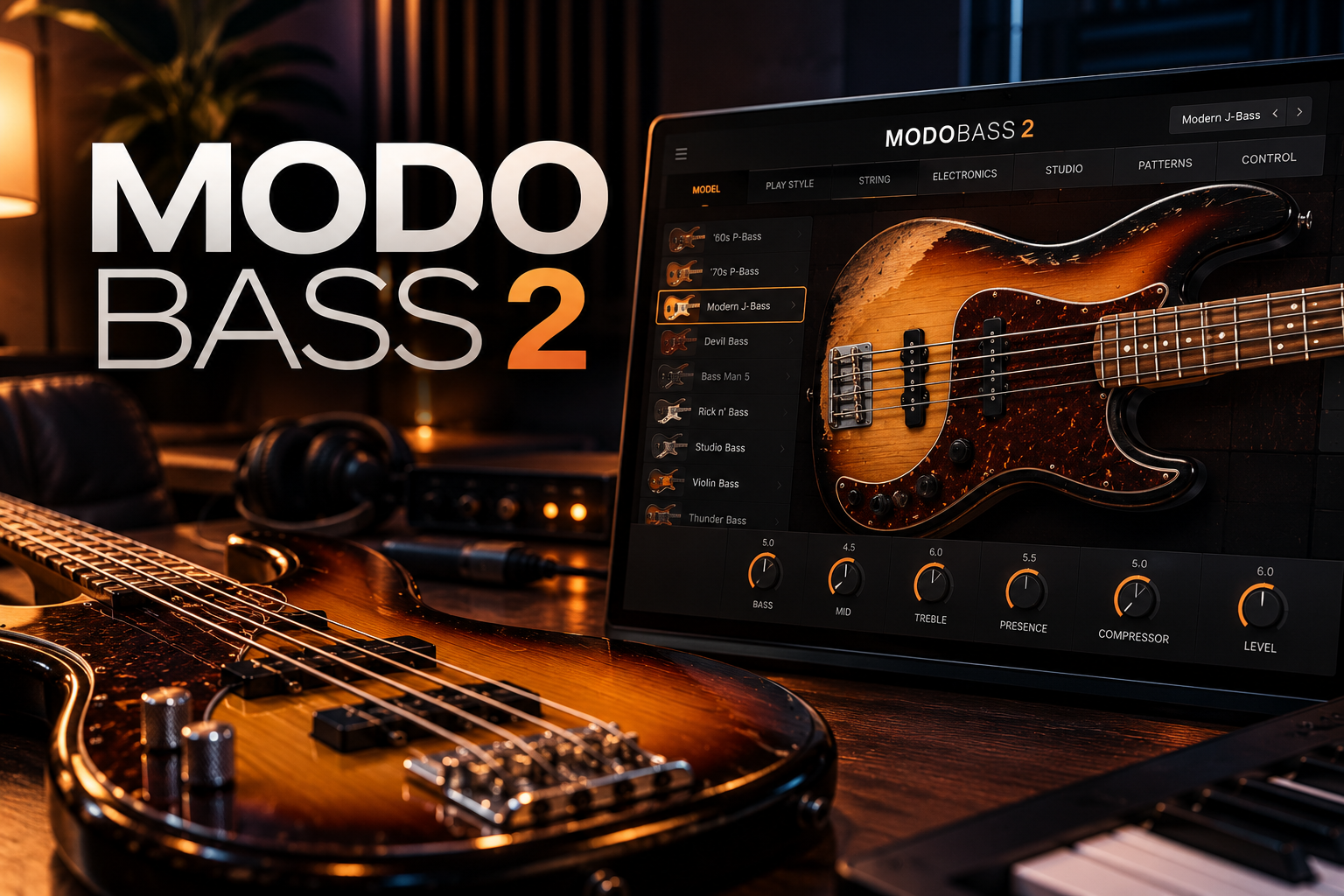

MODO BASS 2 is one of the most flexible virtual bass instruments you can put in a DAW. Instead of loading recordings of a bass guitar, IK Multimedia uses physical modeling to generate the instrument in real time. That means you can change the strings, pickups, playing position, scale, action, electronics and even turn standard models into fretless basses after the MIDI part has already been written.
The full version includes 22 electric, fretless and upright bass models, more than 1,500 MIDI patterns, multiple playing styles, two bass amps and seven stomp effects. The important question is whether all that flexibility actually makes it a better purchase than a sampled bass instrument.
My take: MODO BASS 2 is strongest for producers who do not play bass themselves but want to shape a realistic bass performance inside the DAW. It is not automatically more realistic than every sampled library. Its real advantage is that the instrument remains editable at a level samples cannot easily match.
| MODO BASS 2 at a glance | Details |
|---|---|
| Best for | Realistic electric, fretless and upright bass parts with deep tone and performance control |
| Sound engine | Real-time physical / modal modeling instead of a traditional sample library |
| Bass models | 22 in the full version |
| MIDI patterns | 1,500+ |
| Playing styles | Finger, slap, pick and mute controls |
| Current deal | $29.99 through October 7, 2026; regular price shown as $199.99 |
| Free version | MODO BASS 2 CS with the '60s P-Bass |
MODO BASS 2 review: the short verdict
At the current $29.99 sale price, MODO BASS 2 is very easy to recommend. IK Multimedia lists the same promotion as its lowest price yet, with the full 22-bass version reduced from $199.99 through October 7, 2026. At full price, the decision needs more thought; at $29.99, the breadth of the instrument is difficult to match.
The biggest strength is not simply “realism.” It is control. You can change the number and type of strings, string age, pickup choice and position, playing position, action, electronics, amp chain and performance behavior without loading a different sample library.
The main limitation is that the plugin still needs musical MIDI. Physical modeling cannot rescue a bass line that would be awkward or impossible for a real player. The more naturally you write the part, the more convincing MODO BASS becomes.
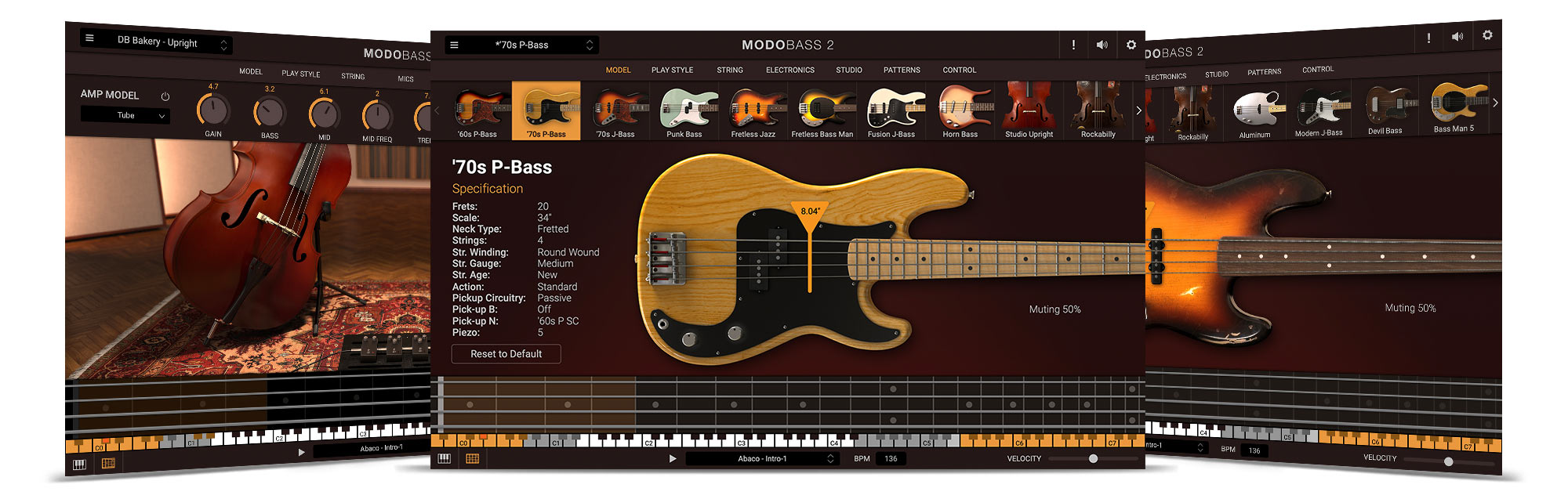
What is MODO BASS 2?
MODO BASS 2 is IK Multimedia's physically modeled bass virtual instrument. The engine calculates the behavior of the string, its interaction with the fretboard and body, the way the virtual player excites it and the response of pickups and electronics. The result is then fed through modeled amps and effects.
That approach gives MODO BASS a different workflow from a conventional sample library. A sampled bass records a real instrument and replays carefully captured articulations. MODO BASS instead creates the note from its model every time you play.
Neither approach is automatically superior. A high-end sampled instrument can capture the exact character of a real player, room and signal chain beautifully. MODO BASS wins when you want to keep changing the virtual instrument after the performance is already in place.
Why physical modeling actually matters here
Physical modeling becomes useful when you ask for changes that would normally require a different recording. Want older flatwound strings instead of fresh roundwounds? Move the pickups? Change a four-string model to five or six strings? Lower the action for more fret noise? MODO BASS lets you make those changes inside the same instrument.
IK currently gives you 32 pickup models, movable pickup positions, active or passive electronics, adjustable string gauge and age, different string constructions and control over scale length and action.
My take: this is the best reason to buy MODO BASS. I would not buy it because a marketing page says “physical modeling.” I would buy it because I can rewrite the tonal identity of a bass without rewriting the MIDI performance.
The 22 bass models: more useful than the number suggests
The full version contains 22 models covering familiar Precision- and Jazz-style instruments, five- and six-string options, modern metal basses, short-scale designs, fretless instruments and two upright basses. IK added eight models for version 2, including Fretless Jazz, Fretless Bass Man, Studio Upright, Rockabilly, Horn Bass, Punk Bass, Fusion J-Bass and Aluminum.
You do not need all 22 for every song. I would treat them as tonal starting points. A P-style bass can sit naturally under rock, pop or soul; a Jazz-style model gives you more attack and articulation; the extended-range models make more sense for modern metal or low tunings; the upright models cover an entirely different role.
The bigger advantage is that the model does not lock you into its factory setup. Even after choosing a starting bass, you can still change strings, pickups and playing behavior.
Finger, pick, slap and mute: where realism is won or lost
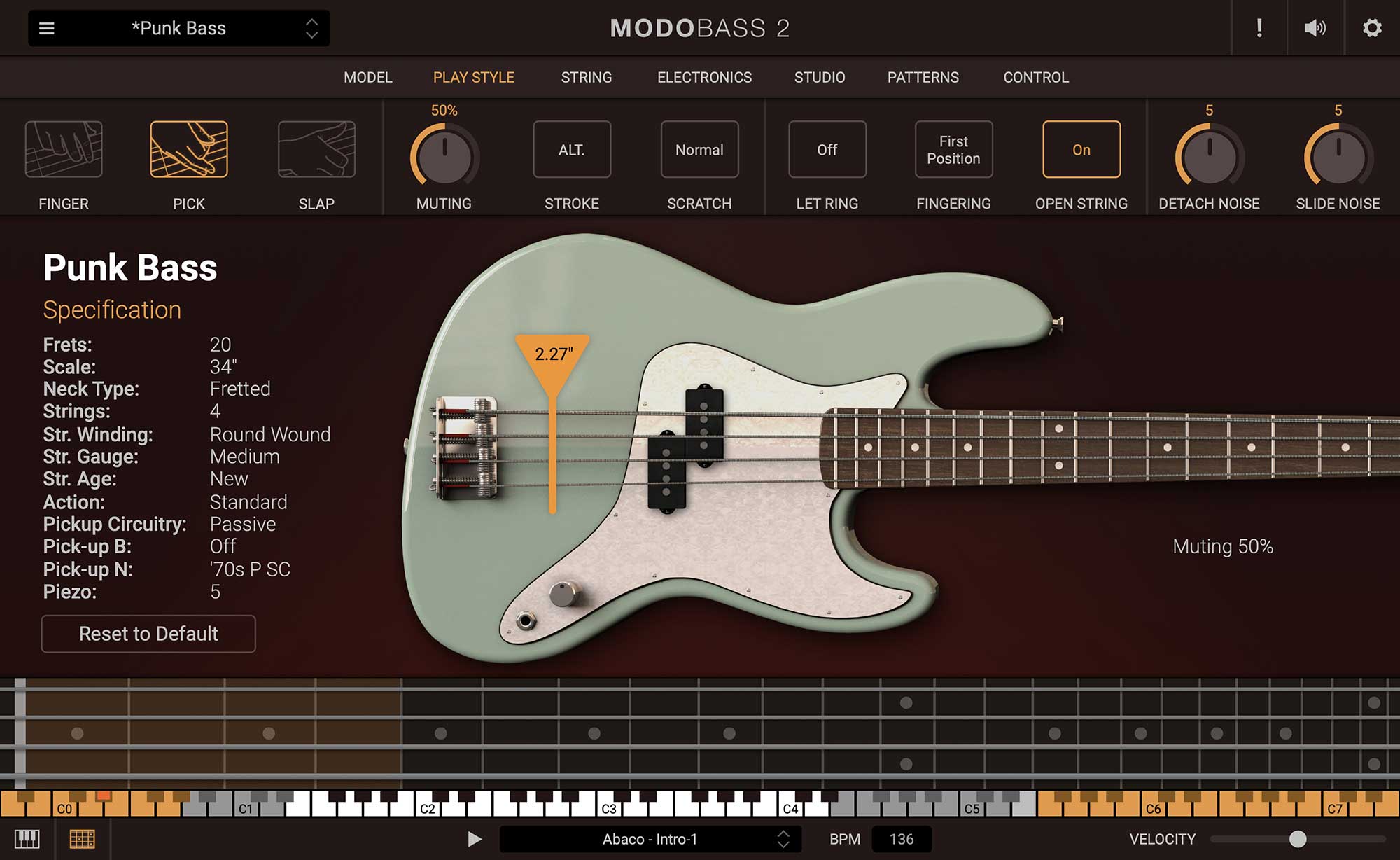
MODO BASS lets you choose fingerstyle, slap or pick playing and apply muting to those styles. Pick mode includes thickness and alternate/downstroke behavior, while fingerstyle lets you control how the fingers interact with the string. You can also move the virtual playing hand toward the bridge or neck.
That last control is underrated. Playing closer to the bridge produces a tighter, brighter tone; moving toward the neck gives a rounder sound with more low-mid weight. Automating that position can add natural movement to a performance.
My take: choose the playing style before you start EQing. A tone that feels too soft may simply need a pick or a bridge-side playing position. A bass that feels too aggressive may need fingerstyle closer to the neck. Solve the performance first, then mix it.
How I would program a realistic MODO BASS part
The engine responds well, but your MIDI still has to behave like a bass part. I would use these rules:
- Stay within a believable range. Do not write giant jumps just because a piano roll allows them.
- Use velocity musically. Accents should follow the groove rather than every note hitting at the same level.
- Think in phrases. Slides, mutes and legato are most convincing when they support the line instead of appearing randomly.
- Leave some timing variation. A bassist locked to a grid at microscopic precision often sounds less human, not more.
- Use keyswitches and automation deliberately. MODO BASS can control vibrato, slide, mute, playing style and other behavior through MIDI.
A simple line played naturally will usually sound better than a technically complicated line with unrealistic phrasing.
The 1,500+ MIDI patterns are genuinely useful
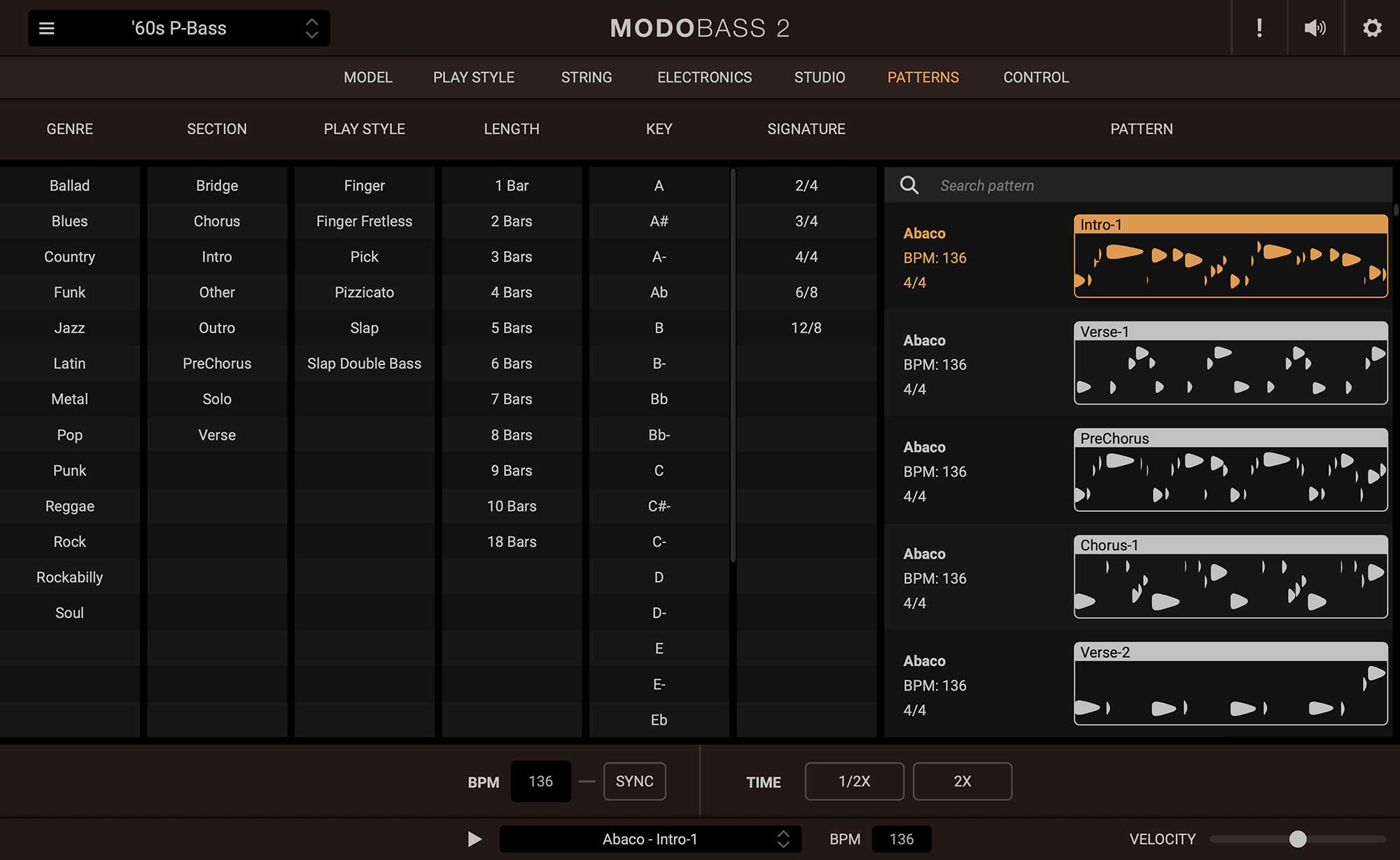
The Patterns section contains more than 1,500 MIDI grooves and lets you filter by genre, song section, length, time signature and other criteria. You can audition a pattern in the plugin and drag it straight into the DAW.
My take: I would use the patterns as arrangement starters rather than final answers. Find something with the right pocket, drag it into the project and edit the notes around your chords and vocal rhythm. The value is getting from a blank MIDI region to a believable bass concept quickly.
Patterns are also useful for learning what makes bass MIDI feel natural. Look at where the rests, shorter notes and accents occur, then apply those ideas to your own parts.
Fretless bass is more than an extra preset
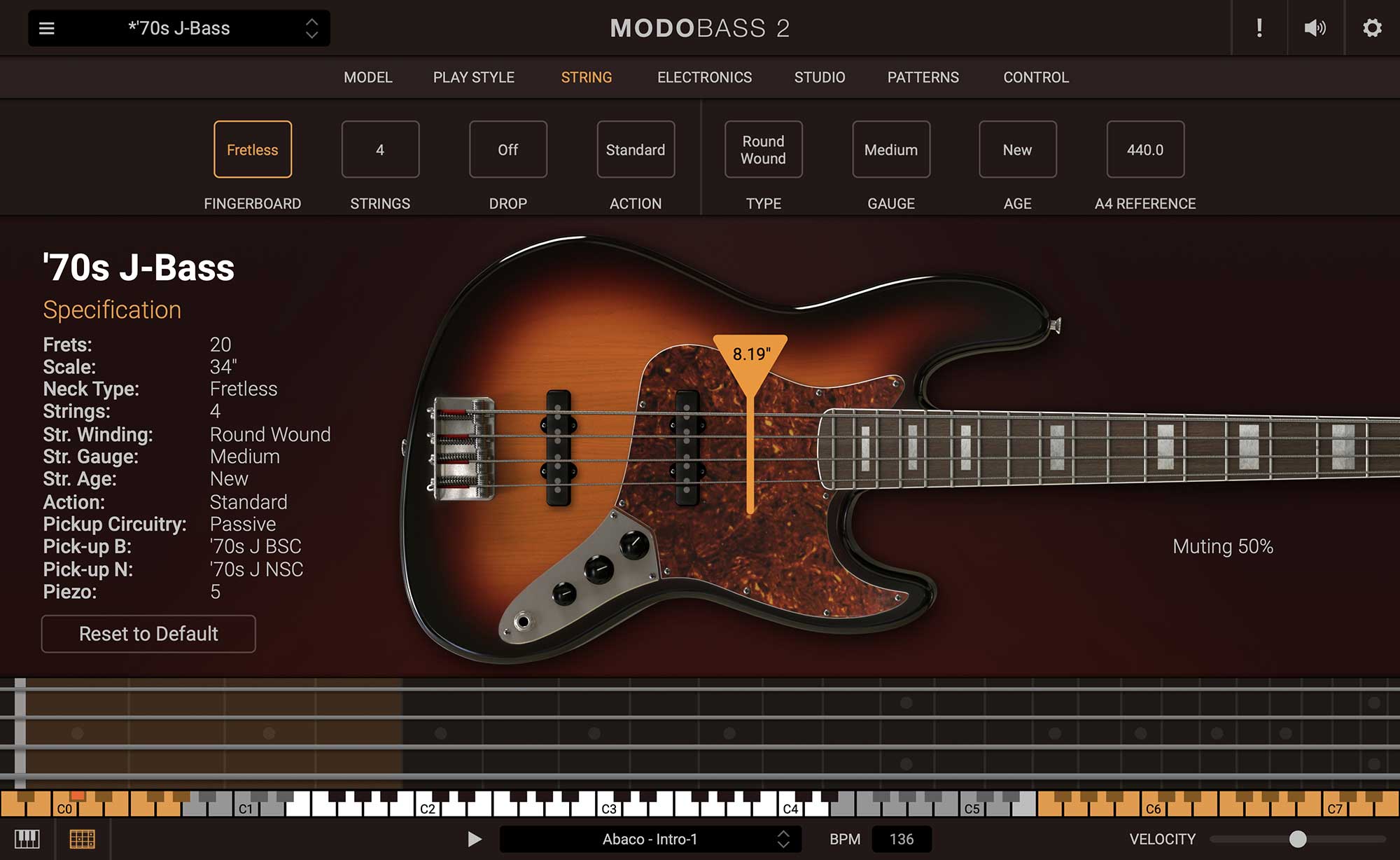
Version 2 added dedicated Fretless Jazz and Fretless Bass Man models, and the full version can convert standard basses to fretless behavior. That gives you more than a different tone; slides, vibrato and transitions become a bigger part of the performance.
I would use fretless when the bass needs to be expressive rather than simply supportive: fusion, soul, ambient music, cinematic parts or melodic passages where pitch movement is audible.
The two upright basses widen the plugin considerably
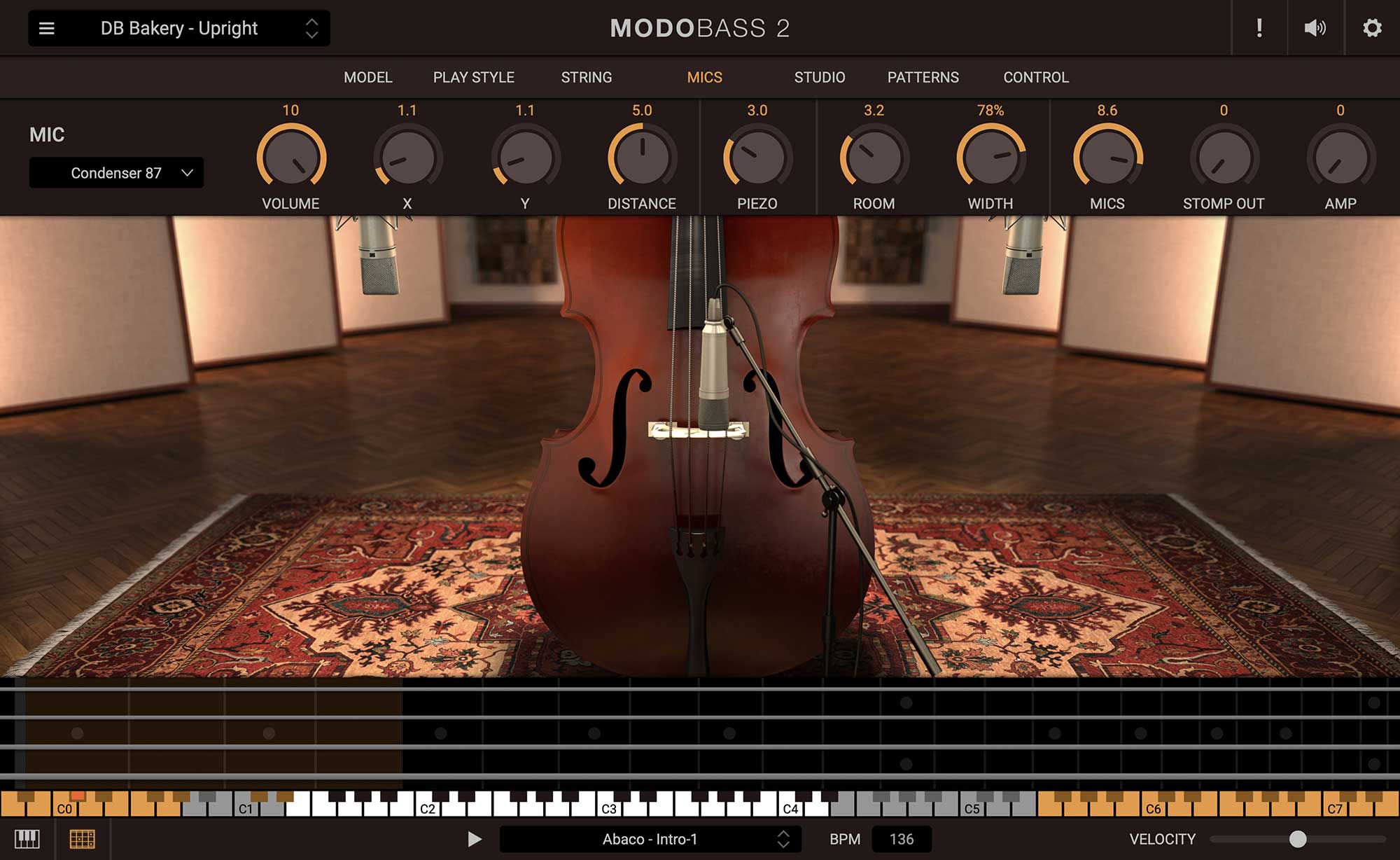
MODO BASS 2 includes a Studio Upright aimed at jazz-style double bass and a Rockabilly model for more percussive upright playing. Their dedicated studio view lets you work with microphone position, piezo signal and stereo room ambience.
This matters because an upright bass is not simply an electric bass with darker EQ. The transient, body resonance and room contribution are part of the sound. Having dedicated upright models makes the full version much more useful for jazz, acoustic arrangements and soundtrack work.
Amps and effects: enough to finish a bass tone
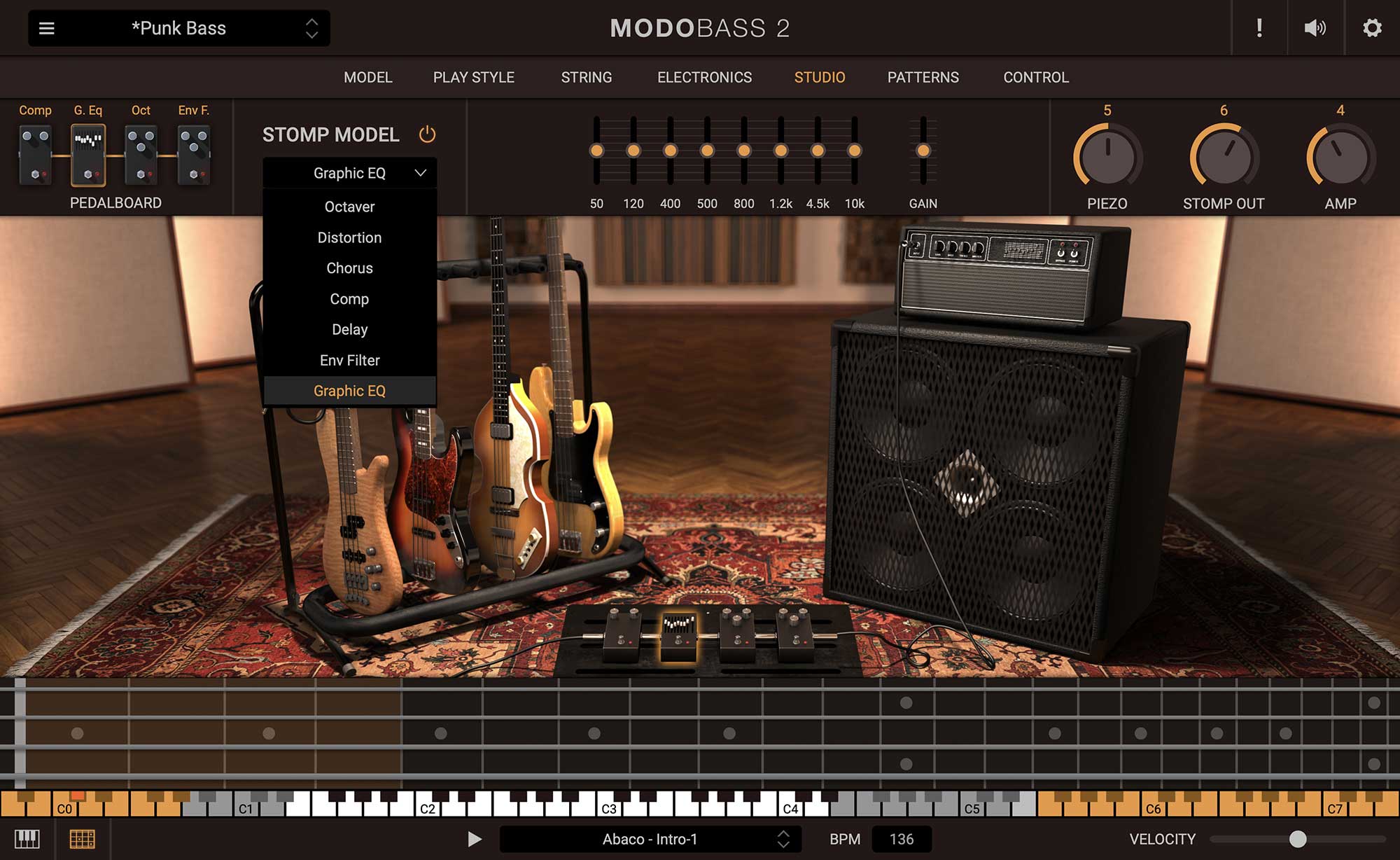
The effects section includes Octaver, Distortion, Chorus, Compressor, Delay, Envelope Filter and Graphic EQ, with four stomp slots. You also get a tube-style 1x15 setup and a solid-state 4x10 bass amp.
That is enough for most writing and demo work. If the song already uses a favorite bass amp plugin, you can bypass MODO's amp and effects and process the modeled DI signal elsewhere.
My take: I would get the instrument and performance right inside MODO BASS, then decide whether the final mix needs an external chain. A poor bass choice cannot be fixed by stacking more processors.
MODO BASS 2 CS vs full version
| Version | What you get | Who it is for |
|---|---|---|
| MODO BASS 2 CS | Free; one '60s P-Bass, fewer patterns, no fretless conversion or pattern import | Anyone who wants to test the engine before paying |
| MODO BASS 2 SE | Four bass models with the full core feature set | Producers who only need a small electric-bass collection |
| MODO BASS 2 Full | All 22 models including fretless and upright basses | Producers who want the full tonal range |
I would normally tell a new buyer to start with the free CS version. It includes the '60s P-Bass and is enough to judge whether you like the physical-modeling workflow. The current sale changes the calculation, though: at $29.99 for the full package, paying for all 22 models is much easier to justify.
MODO BASS 2 price: the current $29.99 sale changes the verdict
On October 6, 2026, Plugin Boutique lists MODO BASS 2 at $29.99 instead of $199.99, an 85% discount. IK Multimedia is running the same promotion and states that the sale ends October 7, 2026.
At $199.99, I would recommend testing CS first and comparing it with whichever sampled bass instrument you already own. At $29.99, the equation is different. You get 22 models, uprights, fretless options, the pattern library and the full physical-modeling engine for less than many single sampled bass instruments.
MODO BASS 2 vs a sampled bass plugin
| Decision | MODO BASS 2 | Sampled bass instrument |
|---|---|---|
| Sound generation | Calculated in real time | Recorded real instrument samples |
| Instrument customization | Very deep: strings, pickups, scale, action, electronics and more | Usually limited to what was recorded or scripted |
| Recorded character | Created by the model and processing | Can capture a specific real instrument, player and signal chain beautifully |
| Disk footprint | Relatively small | Can be significantly larger |
| Best reason to choose | You want one flexible engine that can become many basses | You want the exact character of a particular sampled instrument |
I would not choose one technology on principle. Choose the result and workflow. If one deeply sampled Precision Bass already sounds perfect in your music, you may not need 22 modeled instruments. If you constantly want to change setup and performance details, MODO BASS has a clear advantage.
If you're deciding between a deeply editable modeled bass and a songwriting-focused sampled instrument, read our MODO BASS 2 vs EZbass comparison.
Free alternative: Ample Bass P Lite
If you do not want to spend anything, Ample Bass P Lite is still one of the strongest free alternatives. It uses a sampled Precision-style bass, includes common articulations and now has a much deeper MIDI composition system. It is narrower than MODO BASS 2, but “narrower” is fine when you only need one good electric bass sound.
My take: download Ample Bass P Lite if you want to hear the difference between a good sample-based bass and MODO's physical modeling without spending money. Then keep the workflow you actually prefer.
MODO BASS 2 pros and cons
| Pros | Cons |
|---|---|
| 22 bass models in one instrument | Deep controls can be unnecessary if you only need one simple bass tone |
| Extensive physical customization after the MIDI is written | Realism still depends heavily on realistic MIDI programming |
| Electric, fretless and upright basses | Some producers may prefer the fixed character of a premium sampled instrument |
| 1,500+ MIDI patterns for fast songwriting | Regular $199.99 price is a bigger commitment than the current sale |
| Small footprint relative to large sample libraries | The interface has a lot of pages and parameters compared with simpler bass plugins |
System requirements and plugin formats
MODO BASS 2 runs as a 64-bit standalone instrument and as AU, VST2, VST3 or AAX on supported Mac systems, and VST2, VST3 or AAX on Windows. IK currently lists macOS 10.13 or later and Windows 10 or later, with 4 GB RAM minimum and 8 GB suggested. Apple M1 is supported natively.
Those published requirements are fairly modest, but your real test should be the free CS version. Load it in the DAW and project size you actually use, rather than judging performance in an empty session.
Who should buy MODO BASS 2?
I would buy MODO BASS 2 if you frequently need believable played bass parts but do not have a bassist available. It is particularly useful for pop, rock, funk, soul, metal, singer-songwriter work and soundtrack production where the bass behaves like an instrument rather than a sub layer.
I would also choose it when I want several types of bass without installing multiple large sample libraries. The jump from electric to fretless to upright inside one product is genuinely convenient.
I would skip it if nearly every bassline in my music is an 808, synth bass or extremely simple root-note layer. In that case, the performance modeling is solving a problem I do not have.
For more choices, see our best bass guitar VST plugins guide.
Final verdict: is MODO BASS 2 worth it?
At $29.99: absolutely, for almost any producer who uses realistic bass guitar sounds. The current discount is unusually deep, and the full package covers far more ground than the price suggests.
At the regular $199.99 price, my answer is more conditional. MODO BASS 2 remains a powerful and flexible instrument, but you should first test MODO BASS CS and compare it with your existing sampled options. The value comes from editability and range, not from physical modeling being inherently “better” than sampling.
The strongest reason to own it is simple: one MIDI performance can become a vintage P-style bass, a modern five-string, a fretless instrument or an upright without starting again. For producers who regularly need those options, that flexibility saves real time.
Frequently asked questions about MODO BASS 2
How many basses are included in MODO BASS 2?
The full version includes 22 models: electric, fretless and upright basses. MODO BASS 2 CS includes one model, while SE includes four.
Does MODO BASS 2 use samples?
The bass instruments themselves are generated through real-time physical/modal modeling rather than traditional multisampling. That is what enables the deep changes to strings, pickups, setup and playing behavior.
Is MODO BASS 2 free?
The full version is paid, but MODO BASS 2 CS is free and includes the '60s P-Bass with a reduced pattern set.
How much is MODO BASS 2?
On October 6, 2026, Plugin Boutique and IK Multimedia list the full version at $29.99, down from $199.99. IK states that this promotion ends October 7, 2026.
Does MODO BASS 2 include upright bass?
Yes. The full version includes Studio Upright and Rockabilly upright models with dedicated microphone, piezo and room controls.
Can MODO BASS 2 do fretless bass?
Yes. The full version includes dedicated fretless models and lets you make standard basses fretless. The free CS edition does not include that conversion feature.
Can I use MODO BASS 2 without a DAW?
Yes. IK provides a standalone 64-bit application as well as supported plugin formats.
Research notes and official references
This review combines documented product features with editorial judgments about workflow and buying decisions. It does not claim a controlled hands-on benchmark. Price information was checked on October 6, 2026, and the quoted sale is time-limited.
Sources: IK Multimedia MODO BASS 2 product page, official specifications, IK's September 2026 sale announcement, MODO BASS 2 at Plugin Boutique and Ample Bass P Lite II at Plugin Boutique.
![[background image] image of recording equipment (for a musician & band)](https://cdn.prod.website-files.com/68efa70811edd8e5af30a90d/6acd43b8998701bbde84e11a_Best%20Export%20Settings%20for%20FL%20Studio.png)
![[background image] image of recording equipment (for a musician & band)](https://cdn.prod.website-files.com/68efa70811edd8e5af30a90d/6acd3f9347bd0dd62b202621_ShaperBox%203%20vs%20Infiltrator%202.png)
![[background image] image of recording equipment (for a musician & band)](https://cdn.prod.website-files.com/68efa70811edd8e5af30a90d/6acd3d99fa68785e0f58960e_Kontakt%208%20vs%20Decent%20Sampler.png)