

Looking for the best guitar VST plugins under 100 euros? Start with the part you need to write. A strumming instrument, a power-chord sequencer and a freely playable acoustic guitar can all put guitar into a track, but they solve different problems.
Our paid shortlist is AAS Strum Session for affordable accompaniment, Rob Papen PowerChord for heavy rhythmic parts and Rob Papen RG for guitar groove sequencing. We also include Ample Guitar M Lite 4 as a free acoustic alternative worth trying before spending.
These are instruments that generate guitar parts from MIDI. If you already play guitar and need to process a recording, our guitar amp plugin guide is the more relevant place to start.
Best guitar VST plugins under €100: quick comparison
| Instrument | EUR reference | USD reference | Our reason to shortlist it |
|---|---|---|---|
| AAS Strum Session | €41.60 | US$49 | Songwriting on a small budget |
| Rob Papen PowerChord | €79 | US$79 | Heavy, processed rhythm parts |
| Rob Papen RG | €79 | US$79 | Electric & acoustic groove sequencing |
| Ample Guitar M Lite 4 | Free | Free | A free acoustic starting point |
Checked on 1 November 2026. Strum Session’s EUR reference is the displayed Plugin Boutique price; RG and PowerChord use their developer-listed €79 full-license prices. USD references are published US prices, not conversions. Local tax, store pricing and promotions can change the final total. The €100 limit is per instrument. The three paid picks are complete instruments, not upgrade licenses; the Ample option is explicitly free.
Choose the playing workflow before the price
For chords and accompaniment: prioritise the strumming controls and how the instrument handles chord changes. That is where Strum Session is most relevant.
For programmed grooves: compare RG with PowerChord. The sequencer and the available guitar material are central to the purchase.
For an acoustic part you want to program yourself: try Ample Guitar M Lite first. Check its performance controls and edition limits against the part you have in mind.
Our selection is based on current product documentation, full-license prices and the musical jobs these tools are designed to cover. These are editorial recommendations, not claims that we have personally tested every instrument. Use the available demos and audio examples to judge the sound for your own production.
1. AAS Strum Session
€41.60 · Acoustic & electric accompaniment
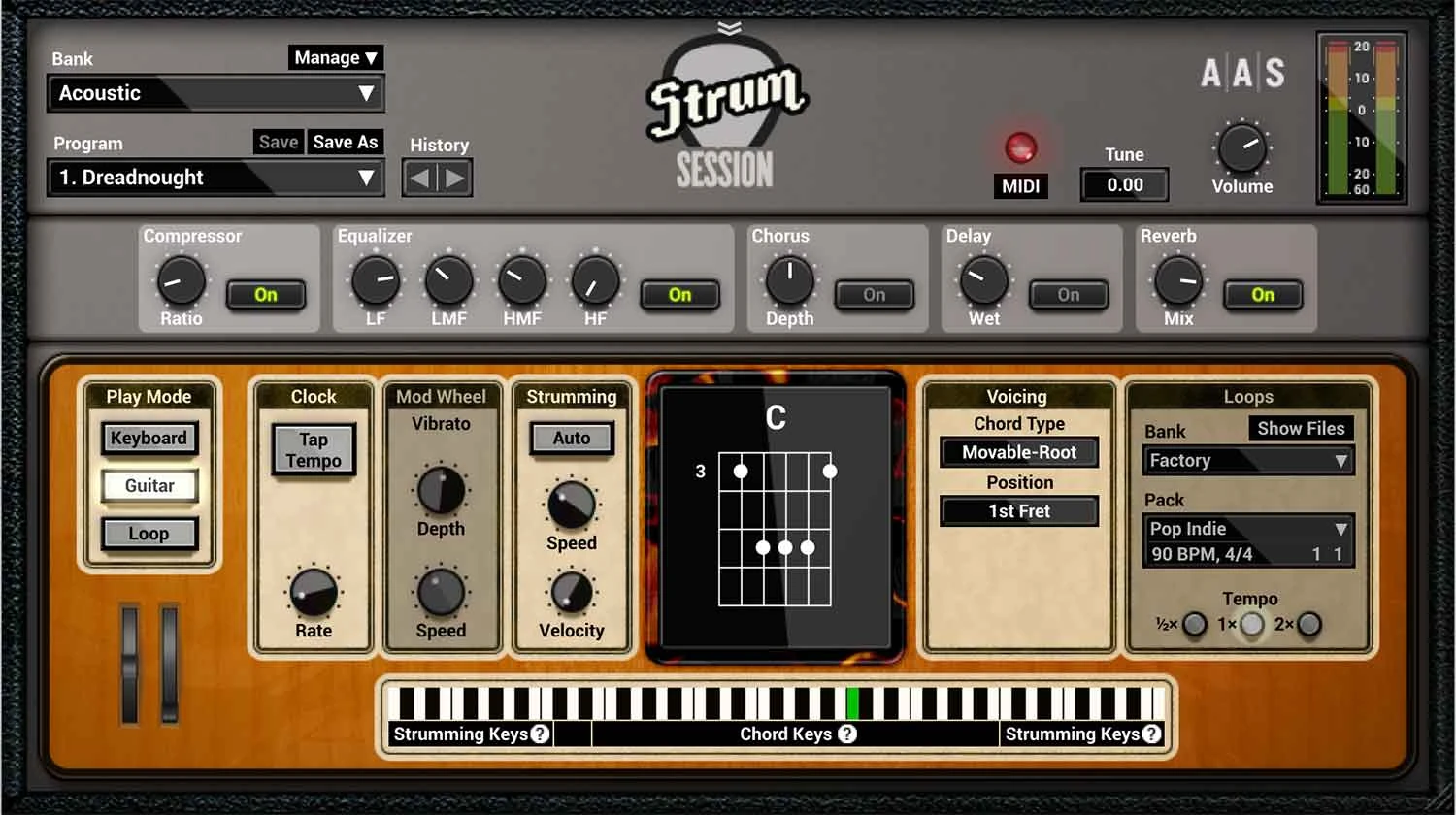
Strum Session combines physically modelled acoustic and electric guitars with chord recognition, guitar-style voicings, strumming and picking controls. It also includes MIDI patterns and effects. It is the smaller Session product, rather than the full Strum GS-2.
For a songwriter, the appeal is getting from a chord progression to an accompaniment without building each strum by hand. You can start with a pattern, then work on where the part enters, how busy it is and whether it leaves room for the vocal. That is a useful job for an instrument at this price.
The trade-off is the sound and control you personally need. Physical modelling is a different approach from a large sampled library. Listen to exposed chords and transitions in the demo, especially if the guitar will carry the song on its own.
Buy it for: affordable acoustic and electric rhythm parts from one instrument. Look elsewhere for: a specific sampled guitar, extensive instrument editing or a detailed metal lead-guitar workflow.
SoundShaper take: this is our first paid shortlist option for straightforward songwriting. Compare the regular Session license carefully with sound packs and GS-2 upgrade offers; they are different products.
2. Rob Papen PowerChord
€79 · Power-chord groove instrument
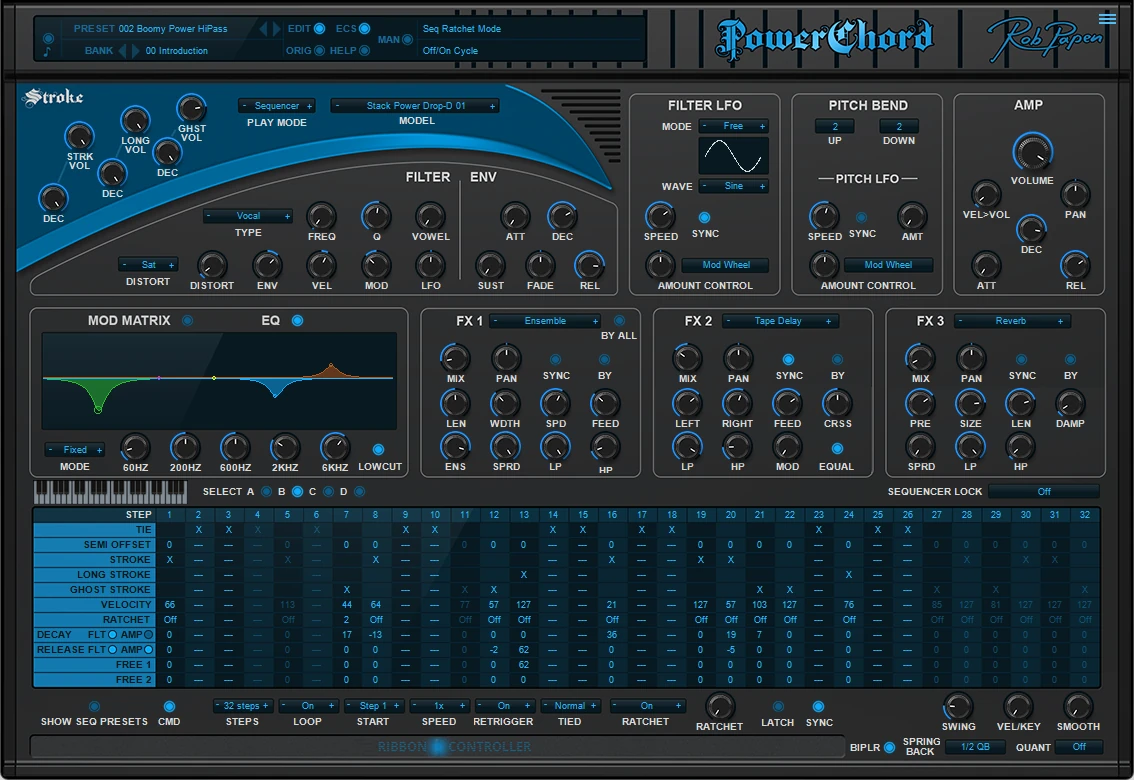
PowerChord is built around guitar grooves, with a sequencer plus manual control over strokes, long strokes and ghost strokes. Guitar models, filters and effects let you move beyond a straightforward sampled rhythm sound.
We would shortlist it when the guitar needs to function as a tight rhythmic layer: a repeating hook, an aggressive accent or a processed part that sits alongside synths and drums. Its programming approach is a reason to consider it even if perfect acoustic realism is not your main objective.
It is still important to ask what “guitar plugin” means in your project. A power-chord groove instrument is a very different purchase from a library intended for expressive solo lines. Do not buy it just because the demos sound heavy if your song actually needs detailed melodic playing.
Buy it for: power-chord patterns and creative guitar-based grooves. Look elsewhere for: nylon-string fingerpicking, exposed acoustic ballads or a replacement for every technique a lead guitarist can play.
SoundShaper take: choose this over RG when the power-chord concept itself is what you want. Demo it over your own drums and bass before deciding how much processing the part needs.
3. Rob Papen RG
€79 · Rhythm guitar groove synth
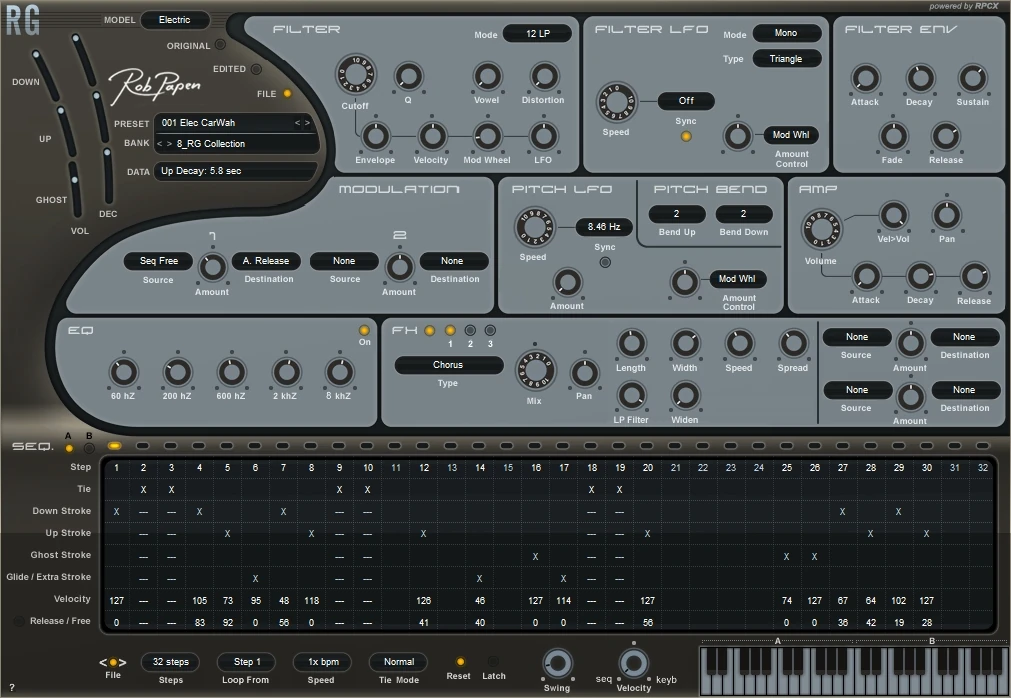
RG combines sampled guitar sound sets with a rhythm sequencer and synth-style processing. Its options include clean electric and steel-string acoustic grooves, alongside power-chord and muted material. Different keyboard ranges trigger the available chord and sequence choices.
The distinction from an ordinary playable guitar library matters. Here, we would approach the instrument by choosing a groove and adapting it to the arrangement. Filters, modulation and effects then become part of designing the rhythm, rather than simply adding an amp to a recorded guitar.
That makes RG worth considering for repeating accompaniments and guitar textures in electronic productions. Before buying, check that its chord handling covers the progression you want to use. A pattern that sounds convincing on one chord is only the beginning of a complete song part.
Buy it for: electric and acoustic rhythmic patterns with additional sound shaping. Look elsewhere for: unrestricted note-by-note guitar performances or a library whose main purpose is exposed solo playing.
SoundShaper take: RG and PowerChord are alternatives to compare, not an automatic pair to buy. Start with RG if its broader rhythm sound sets match your tracks better.
4. Ample Guitar M Lite 4
Free · Sampled acoustic guitar
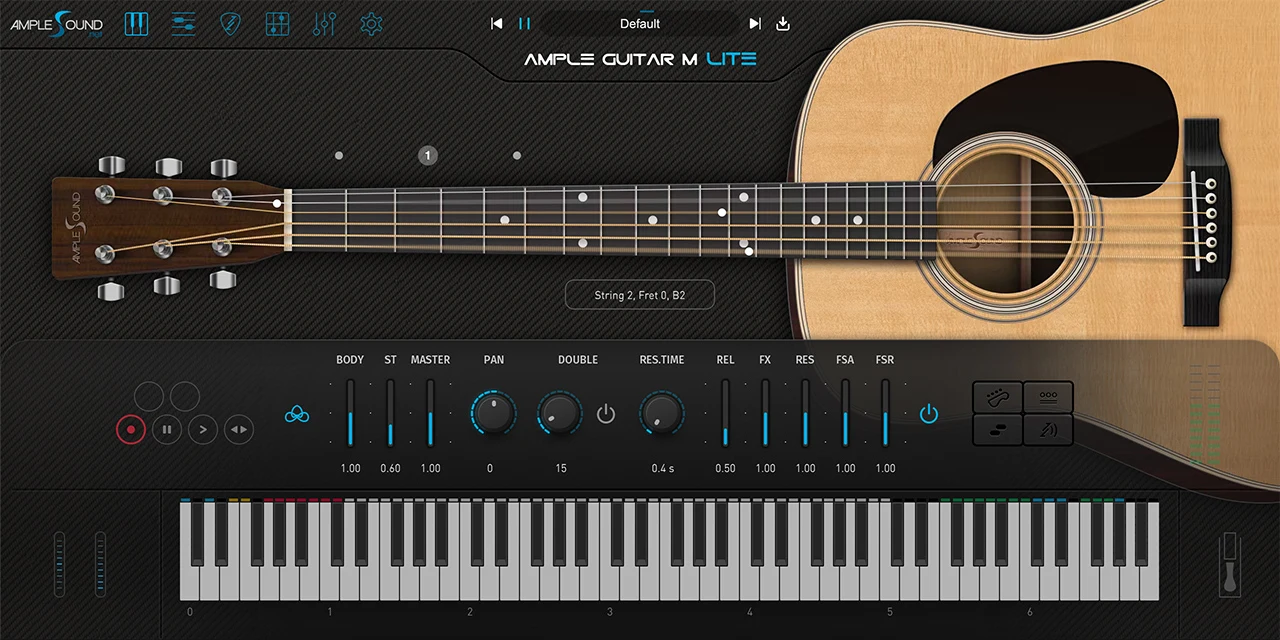
Ample Guitar M Lite is the free acoustic option on this shortlist. The current version 4 includes guitar performance tools and the Riffer editor, while retaining limits compared with the paid Ample Guitar M.
We would try it before paying for an acoustic instrument. Write a short part in the context of your track and see which limitation, if any, actually gets in the way. If it supplies the accompaniment you need, there is no reason to spend the rest of the budget immediately.
Check the comparison between the Lite and full editions on Ample Sound’s product page. Differences include the sample content, articulations and Riffer limits. A full-edition demonstration can show features that are not available in the free instrument.
Use it for: trying an acoustic guitar workflow without paying for a license. Look elsewhere for: an electric guitar sound or the full articulation and content set of the paid product.
SoundShaper take: this is our first download for someone who only needs an acoustic part. Use the developer’s download page to get the current Lite version; this is a free recommendation, not a paid deal.
SoundShaper opinion: what we would buy first
If your budget is €100, we would not treat spending all of it as the goal. The first choice is between a guitar accompaniment and a guitar performance you want to control in detail.
For a pop or singer-songwriter arrangement, we would put Strum Session on the paid shortlist and download Ample Guitar M Lite alongside it. Then write the same eight-bar accompaniment in each. Compare the time it takes to reach a usable part, the chord transitions and how the guitar sits behind the vocal. That comparison is more useful than counting presets.
For electronic or heavier productions, we would compare PowerChord and RG. We would lean toward PowerChord when a deliberately strong, repeating power-chord figure is the point of the part. RG becomes more interesting when its electric and acoustic rhythm material provides a better starting groove. Neither needs to imitate a solo guitarist to be useful in that role.
We would be more cautious if the guitar is completely exposed. A convincing pattern in a busy chorus does not prove that an instrument will deliver an intimate solo introduction. Listen to note endings, chord changes and repeated strokes with the effects turned down. Those details deserve more attention than the loudest preset.
Our practical recommendation: choose one unfinished song, decide what the guitar must contribute, and try the closest match. Buy the instrument that helps you finish that part. If the free option does the job, keep the money for the next problem you can actually identify.
What to check before buying a budget guitar instrument
Does it play your melody or trigger a prepared rhythm?
Do not assume every guitar instrument responds like a piano. Some focus on chord recognition and rhythmic patterns. Others provide more direct note and articulation control. Watch the keyboard mapping and try the exact kind of phrase you want to write.
Does the full setup stay under €100?
A cheap library can become an expensive purchase if it needs a paid sampler you do not own. The three paid instruments above run as their own plugins; they do not require a separate paid Kontakt license. For other libraries, distinguish free Kontakt Player support from a requirement for the full version of Kontakt.
Are you buying the right edition?
Strum Session and Strum GS-2 are different products. Ample Guitar M Lite and the full Ample Guitar M also differ. Check the exact license, included features and compatibility before comparing a price with a demo video. An upgrade offer may require a product you already own.
Can you make a believable part with it?
Start with a manageable chord voicing and leave space between phrases. Check whether the instrument offers strum direction, mutes or performance controls that suit your part. Random timing changes alone will not make a piano-style chord progression behave like a guitarist.
Frequently asked questions
What is the best cheap guitar VST for beginners?
For acoustic guitar, start with Ample Guitar M Lite because it is free. For a paid instrument that covers acoustic and electric accompaniment, Strum Session is our first option to compare. The better choice depends on how much of the performance you want to program yourself.
Can I use these without owning a guitar?
Yes. They generate the guitar part inside your DAW from MIDI input or their performance tools. You can use a MIDI keyboard or program the notes in your DAW. You do not need to record a physical guitar into them.
Is a guitar VST the same as an amp simulator?
No. A guitar instrument generates a performance. An amp simulator processes an incoming sound, usually a recorded guitar signal. Adding an amp effect does not turn an ordinary MIDI track into a guitar instrument.
Will the US price match the euro price?
Not necessarily. Regional prices and tax treatment vary. Compare the actual checkout amount in your region rather than assuming that a US$99 product must cost less than €100.
Final thoughts
Under €100, the strongest purchase is the instrument that matches the way you want to create guitar parts. Compare Strum Session for accompaniment, PowerChord for power-chord grooves and RG for rhythmic guitar textures. Try Ample Guitar M Lite before spending on an acoustic option.
For a broader selection beyond this budget, see our guitar VST guide. You can also explore our guides to acoustic guitar instruments and electric guitar VSTs.