
Vital changed the value equation for wavetable synths by offering its complete synthesis engine for free. That makes the Serum 2 vs Vital comparison unusual: you are not simply choosing between two competing synths, but deciding whether Serum 2 offers enough extra workflow, content and sound-design depth to justify spending $249 when Vital costs nothing.
The comparison has also changed dramatically since Serum 2 arrived. Serum is no longer primarily a wavetable synth. Xfer has added sample, multisample, granular and spectral oscillators, dual filters, expanded effect routing, an arpeggiator and a clip sequencer. Vital remains more focused around wavetable and spectral sound design, with three oscillators, drag-and-drop modulation and its distinctive spectral warping workflow.
Vital’s biggest advantage is difficult to ignore: its free Basic version includes the full synth with all features. The main limitations are the amount of factory content, with 75 presets and 25 wavetables included in the free tier. Serum 2 costs $249 and currently includes more than 626 presets and 288 wavetables, alongside its broader collection of synthesis engines.
So the real question is not whether Vital is “good for a free synth.” It is whether Serum 2 gives you enough that Vital does not. We’ll compare the two based on workflow, modulation, wavetable editing, synthesis possibilities, presets and value to find out where spending the extra money actually makes sense.
Vital is the better value for most producers who primarily want a powerful wavetable synth. The free version gives you the complete synthesis engine, so you can use its oscillators, modulation and spectral warping tools without paying to unlock core features.
Serum 2 is the stronger choice if you want a broader all-in-one synth and are willing to pay for it. Beyond wavetable synthesis, it adds sample, multisample, granular and spectral engines, making it capable of covering considerably more territory inside a single instrument.
If your main goal is wavetable sound design for the lowest possible price, choose Vital. If you want more synthesis methods, a larger included library and a broader production workflow, Serum 2 is easier to justify.
Vital makes this comparison unusually difficult for Serum 2 because the free Basic version includes the complete synthesis engine. You can use its wavetable oscillators, spectral warping, modulation system and wavetable editor without paying to unlock the core synth.
Serum 2 costs $249 outright, but you do not necessarily have to pay the full amount upfront. Through Splice, you can try Serum 2 free for 3 days and then use Rent-to-Own for $9.99 per month for 25 months. There are no additional interest charges, and once all payments are completed, you own the plugin permanently.
That makes the price difference less intimidating, but Serum 2 still needs to offer enough extra functionality to justify paying for it. Its advantage is breadth: alongside wavetable synthesis, Serum 2 adds sample, multisample, granular and spectral engines, plus a larger factory library and a broader production workflow.
If your main goal is wavetable synthesis, Vital remains extremely difficult to beat because the full synth costs nothing. Serum 2 becomes easier to justify when you want those additional synthesis engines, regularly use presets or prefer having more sound-design possibilities inside a single instrument.
Both Serum 2 and Vital are designed around highly visual sound design, so neither feels particularly difficult to understand. Oscillators, filters and modulation are shown directly in the interface, and both make it easy to see what is happening to a patch while you edit it.
Vital is especially fast when you are building a straightforward wavetable patch. Its interface is compact, modulation uses a simple drag-and-drop system, and you can preview modulation before committing to a connection. That makes experimenting with envelopes, LFOs and other modulation sources very immediate.
Serum 2 keeps the familiar visual workflow of the original Serum but now has considerably more going on under the surface. Wavetable, multisample, sample, granular and spectral synthesis all sit inside the same instrument, with additional routing and mixer options when a patch becomes more complex.
That extra flexibility means Serum 2 can take you further without leaving the plugin, but it also introduces more choices. If you simply want to open a synth and start shaping a wavetable sound, Vital can feel slightly more immediate. Serum 2 becomes more useful when the patch starts combining different synthesis methods.
This is one of the closest parts of the comparison because both Serum 2 and Vital have excellent wavetable tools.
Vital lets you create wavetables from scratch inside its built-in editor, convert your own samples into wavetables and apply spectral warping directly to the oscillator. Its pitch-splice and vocode conversion options make it especially easy to turn existing audio into new wavetable material, while the spectral tools can reshape the harmonic content far beyond basic wavetable position scanning.
Serum 2 also has a dedicated wavetable editor with extensive waveform manipulation tools. You can import or create your own wavetables, edit individual frames and convert samples into wavetables using its frequency-estimation process. Once converted, those sounds can use Serum’s normal wavetable processing and modulation options.
The difference is more about character than capability. Vital stands out for spectral manipulation and experimentation, while Serum 2 gives you a very mature wavetable workflow that now sits inside a much broader synth.
If wavetable design is your main priority, there is no obvious reason to dismiss Vital simply because it is free.
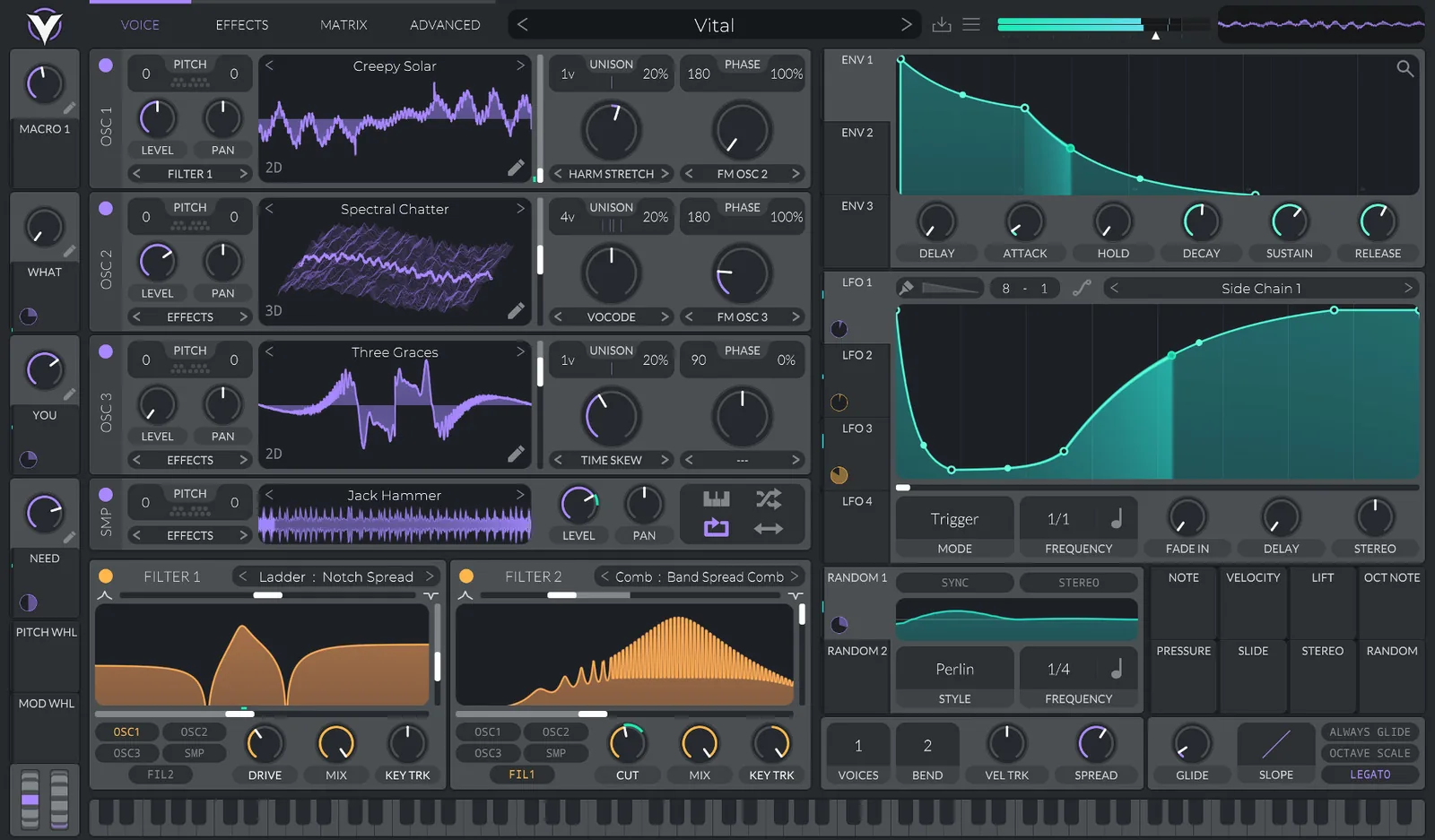
Both synths are excellent for modulation, and this is one area where the difference is more about workflow than raw capability.
Vital makes modulation extremely immediate. Sources can be dragged directly onto parameters, modulation amounts remain visually connected to the controls, and you can even modulate the amount of another modulation. That makes complex movement surprisingly easy to build without spending much time inside a traditional modulation matrix.
Serum 2 also uses drag-and-drop modulation, but its system goes deeper once you start building more involved patches. Modulation can be assigned directly from source to destination, edited through the matrix, shaped with custom curves and combined with auxiliary modulation sources. Serum 2 also lets modulation sources affect individual LFO points, which opens up more detailed control over how modulation itself evolves.
Vital feels slightly faster when you want to create movement and immediately see what is happening. Serum 2 becomes more powerful when you want to organize and refine a larger modulation network across a complex patch.
This is the point where Serum 2 starts to justify its higher price. Vital is an excellent wavetable synth, but Serum 2 has grown into a much broader instrument.
Vital is centered around three wavetable oscillators plus a sample source, with spectral warping, custom wavetable creation, audio-rate modulation and flexible routing. That gives it a huge range for electronic sound design, especially when you want to reshape harmonics or build movement-heavy patches.
Serum 2 adds several synthesis methods that go beyond that core wavetable approach. Its additional engines let you work with samples, multisamples, granular material and spectral processing inside the same synth. It also expands the production workflow with tools such as sequencing and more flexible routing, so you can build patches that would require a more specialized setup in Vital.
That matters most when you stop thinking of Serum 2 as simply a better wavetable synth. If all you need is wavetable synthesis, Vital is already difficult to beat. Serum 2 becomes more compelling when you actually want to combine different synthesis methods inside one instrument.
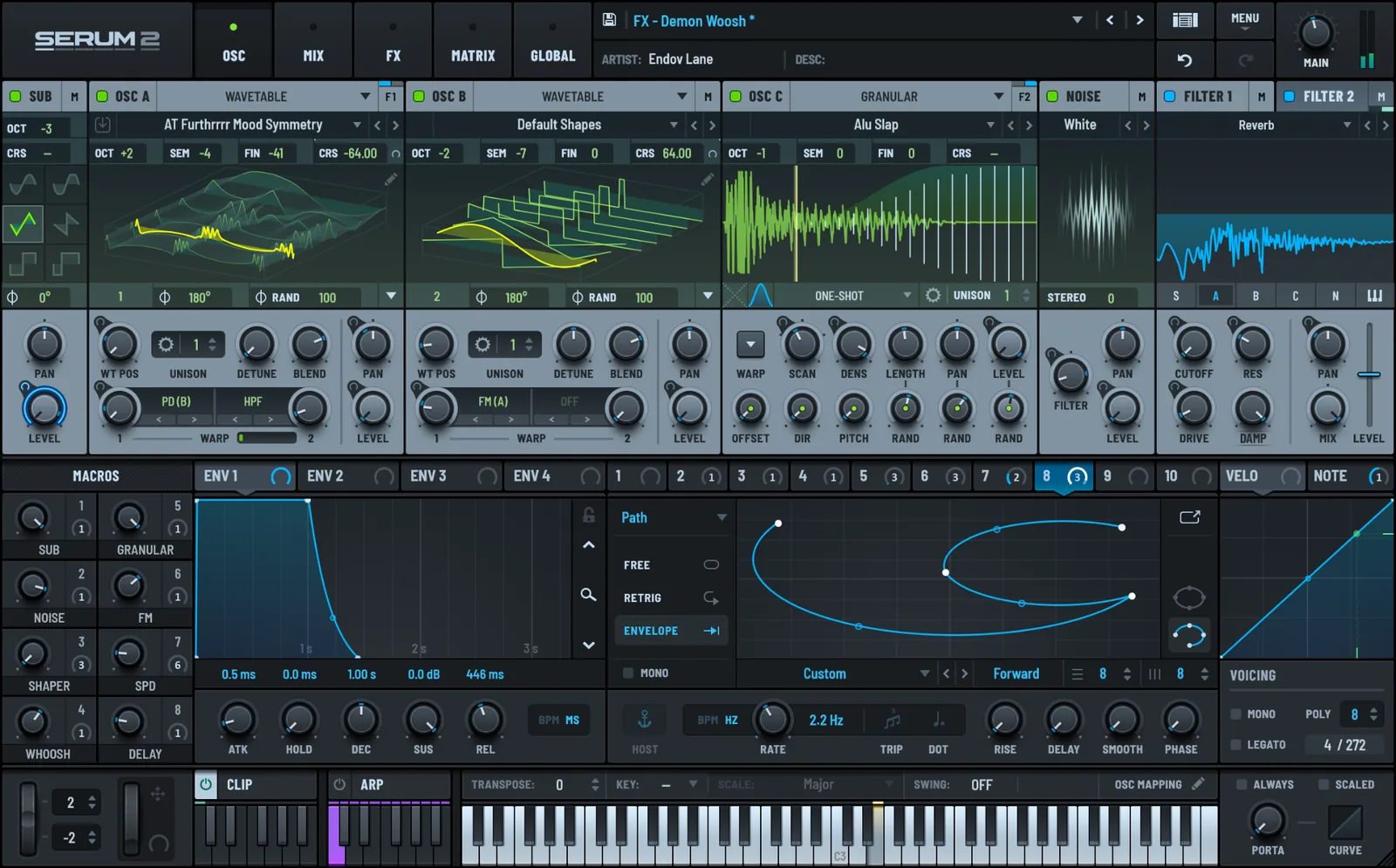
Serum 2 has the stronger preset ecosystem, both in what is included and in the amount of third-party content built around it.
Xfer includes more than 626 presets and 288 wavetables with Serum 2, and the updated preset browser lets you preview sounds before loading them. That matters because Serum has also become one of the most widely supported synths for commercial preset packs, tutorials and sound-design content.
Vital takes a different approach. The free Basic version includes 75 presets and 25 wavetables, while Vital Plus increases that to 250 presets and 70 wavetables, and Pro includes more than 400 presets and 150 wavetables. Importantly, those paid tiers do not unlock a more capable synth—the full feature set is already available in the free version.
That makes Vital unusually generous if you prefer designing sounds yourself. You are not paying to unlock synthesis features; you are mainly paying for more factory content and extras.
Serum 2 makes more sense if you regularly start from presets, buy genre-specific sound banks or want access to a much larger established ecosystem of third-party content.
CPU usage depends heavily on how each patch is built, so there is no meaningful universal winner between Serum 2 and Vital.
Vital can be very efficient with straightforward wavetable patches, but high unison counts, oversampling, complex modulation and heavy effects can increase CPU use quickly. The same applies to Serum 2, especially when combining several oscillator engines, granular processing, multiple effects and high polyphony.
Serum 2 also gives you more ways to build complex hybrid patches inside one instrument, which means its CPU usage can vary considerably depending on how many engines and processing stages are active. Vital is more focused, but that does not automatically make every Vital patch lighter.
For both synths, reducing unison, polyphony, oversampling and unnecessary effects usually has a bigger impact than choosing one plugin over the other.
No clear winner for CPU performance. Both can run efficiently, and both can become demanding when a patch gets complex.
The biggest reason to choose Serum 2 over Vital is not that it sounds automatically better. It is that Serum 2 gives you more ways to build a sound inside one instrument.
Serum 2 makes the most sense if you:
Vital is harder to beat if your needs are simpler. Its free version already gives you the full synthesis engine, making it an excellent choice for producers who mainly work with wavetables, basses, leads, pads and heavily modulated electronic sounds.
Choose Vital if you:
For most producers who only need wavetable synthesis, Vital is enough.
Serum 2 becomes worth paying for when you will actually use the extra engines, larger ecosystem and broader workflow—not simply because it is the more expensive synth.
Vital makes this comparison much closer than the price difference suggests. Its free version gives you the complete synthesis engine, and for producers mainly interested in wavetable synthesis, modulation and electronic sound design, there is surprisingly little reason to spend money before finding an actual limitation.
Serum 2 wins when you look beyond wavetable synthesis. Its additional sample, multisample, granular and spectral engines make it a broader instrument, while its larger preset ecosystem and expanded workflow give you more room to stay inside one synth as your patches become more complex.
That means the best choice depends less on which synth is “better” and more on what you actually need.
Choose Vital if you want an extremely capable wavetable synth without spending anything.
Choose Serum 2 if you want a more complete all-in-one sound-design environment and will actually use the extra synthesis engines and ecosystem.
For most beginners, start with Vital. If you eventually reach the point where its more focused architecture feels limiting, Serum 2 becomes much easier to justify—especially since you can try it free first and use Rent-to-Own instead of paying $249 upfront.

![[team] image of team member (for a mobile gaming)](https://cdn.prod.website-files.com/68efa70811edd8e5af30a90d/690abaa8987a07a672c4cd2c_channels4_profile.jpg)
![[background image] image of recording equipment (for a musician & band)](https://cdn.prod.website-files.com/68efa70811edd8e5af30a90d/6aa35b3b03d3771388765f76_Main%20Image.png)
![[background image] image of recording equipment (for a musician & band)](https://cdn.prod.website-files.com/68efa70811edd8e5af30a90d/6aa35785b8608362620d46e3_Main%20Image.png)
![[background image] image of recording equipment (for a musician & band)](https://cdn.prod.website-files.com/68efa70811edd8e5af30a90d/6aa351f638777f809800a4ff_Main%20Image.png)