Serum 2 and Nexus 5 can both cover a huge range of modern production sounds, but they are built around very different priorities. Serum 2 puts sound design first, while Nexus 5 is designed to get polished sounds into a track as quickly as possible.
That difference is smaller than it used to be. Serum 2 has expanded far beyond traditional wavetable synthesis with wavetable, multisample, sample, granular and spectral oscillators. Nexus 5 has moved in the opposite direction: what was once known mainly as a preset-focused instrument now includes eight generator types, custom sample import, wavetable support and much deeper sound editing.
The result is that neither plugin fits its old stereotype anymore. Serum 2 can now handle everything from synthetic basses and leads to granular textures and multisampled instruments. Nexus 5 can go much deeper than simply browsing presets, but its biggest strength remains the speed of starting with a polished sound and adapting it to the track.
So the real Serum 2 vs Nexus 5 decision is not which synth can technically do more. It is where you want to spend your time: building and shaping sounds yourself, or finding a strong starting point and moving quickly into the rest of the production.
In this comparison, we’ll look at workflow, sound design, presets, synthesis engines, modulation, expansions, CPU use and value to help you decide which synth makes more sense for the way you produce.
Serum 2 is the better choice if you want to build and shape sounds yourself. Its deeper modulation, flexible routing and wider synthesis toolkit make it better suited to producers who enjoy starting from an initialized patch and controlling how every part of the sound behaves.
Nexus 5 is the better choice if speed matters more than sound design depth. Its huge preset library and streamlined browsing workflow make it easier to find a polished sound quickly, tweak it and move on with the track.
If you want maximum control and deeper sound design, choose Serum 2. If you want fast access to finished sounds with less setup, choose Nexus 5.
This is where the biggest difference between Serum 2 and Nexus 5 becomes clear.
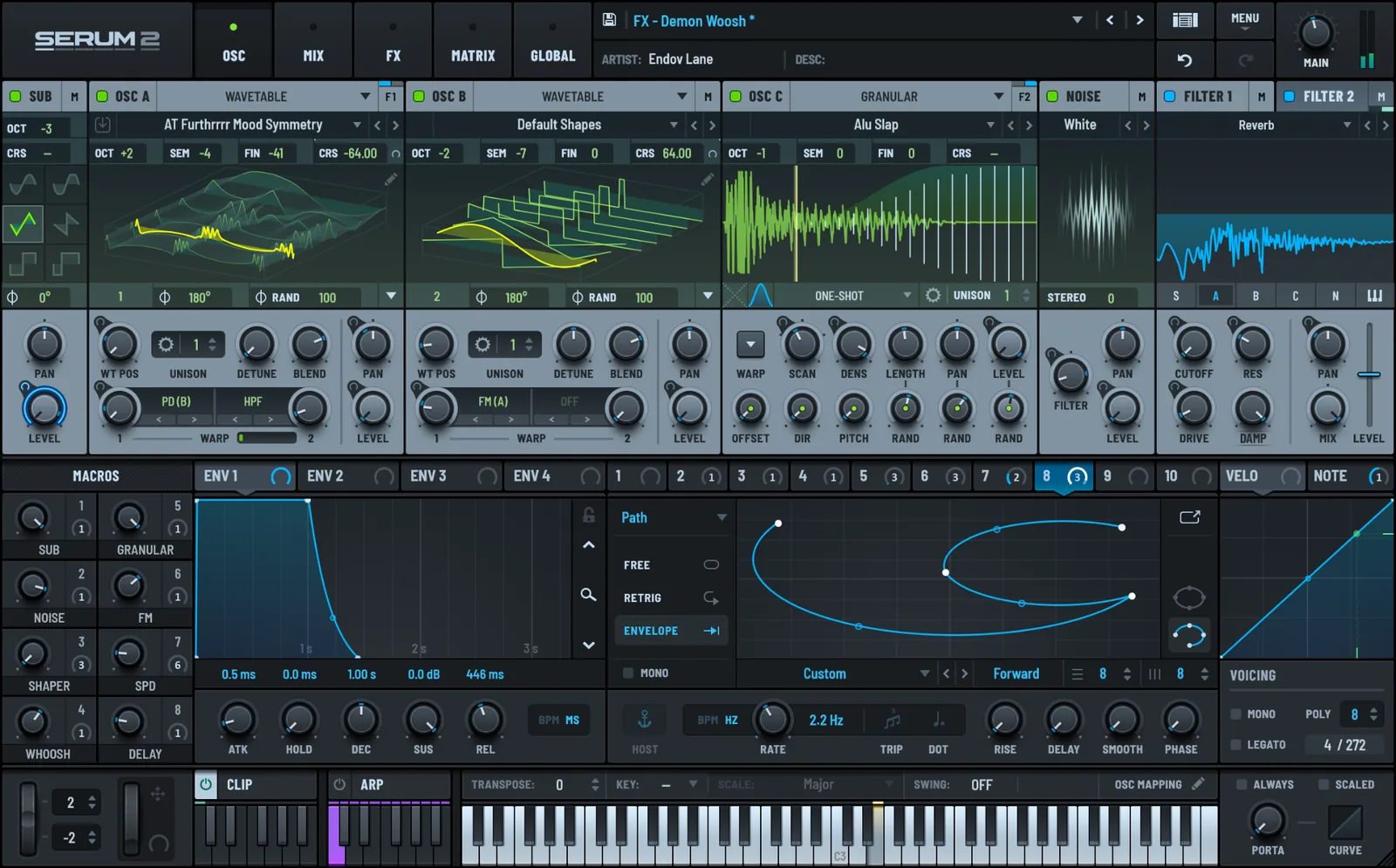
Serum 2 is built around creating sounds from the ground up. You can combine different oscillator types, shape wavetables, import samples, build modulation with envelopes and LFOs, and route those movements across almost every important parameter in the synth.
That makes Serum 2 especially strong when you already have a sound in mind and want precise control over how it develops.
Nexus 5 can now go much deeper than older versions of Nexus. You can work with multiple generator types, import your own samples and make significant changes to the structure of a preset. But the workflow still feels more focused on starting with an existing sound and modifying it rather than designing every element from zero.
For producers who enjoy detailed sound design, Serum 2 gives you the more direct and flexible environment.
If your priority is getting a usable sound into the track quickly, Nexus 5 has the advantage.
Its workflow is built around browsing a large library of polished presets, filtering by category and loading sounds that are already close to production-ready. For genres where speed matters, that can save a lot of time compared with building every patch yourself.
Serum 2 also has a strong preset ecosystem, but the workflow naturally encourages more editing and sound design. Even when starting from a preset, you are more likely to spend time adjusting oscillators, modulation and effects.
That does not make Serum 2 slow, but Nexus 5 is simply more focused on finding a strong starting point and moving on with the track.
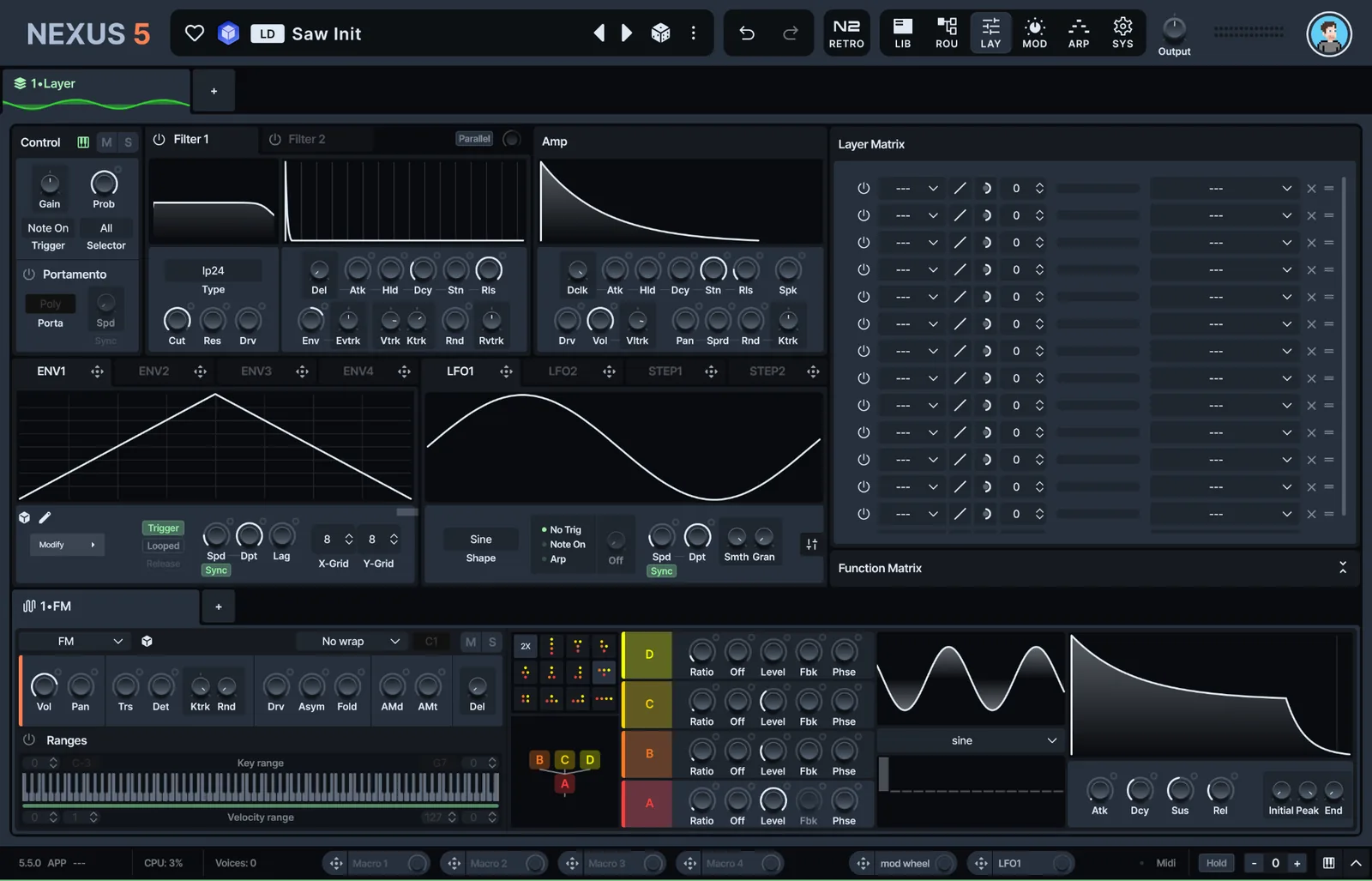
Nexus 5 is no longer just a preset browser.
Compared with earlier versions, it gives you much more control over how a sound is built. You can work with different generator types, import your own samples, adjust routing and effects, and make far more detailed changes to presets than before.
That makes Nexus 5 much more capable for producers who want to go beyond simply loading a sound and changing a few macros.
The difference is that Nexus still keeps this depth behind a workflow designed for speed. Serum 2 places the synthesis and modulation process at the center of the interface, while Nexus 5 makes it easier to ignore that complexity until you actually need it.
So although Serum 2 remains the stronger choice for dedicated sound design, Nexus 5 is far more flexible than its preset-player reputation suggests.
This is one of the strongest areas for Nexus 5.
Nexus is built around a large preset and expansion ecosystem, with sounds organized for quick browsing across different genres and instrument types. If you produce EDM, trap, hip-hop, pop or cinematic music, the main advantage is that you can usually get close to the sound you need without designing it yourself first.
Serum 2 also has a very strong preset ecosystem. Xfer has an official preset store, and there are already dedicated Serum 2 packs covering genres such as techno, drum & bass, ambient, house and bass music.
The difference is how those libraries are meant to be used. Nexus 5 treats presets as the center of the workflow, while Serum 2 presets often feel more like starting points that you can open up, study and reshape.
If you mainly want a huge selection of polished sounds ready to drop into a production, Nexus 5 is the stronger choice.
Both synths give you serious control, but Serum 2 makes modulation a much more central part of the workflow.
In Serum 2, modulation can be assigned directly to parameters and adjusted visually around the control itself. That makes it easy to see what is moving, how far it moves and how different envelopes or LFOs interact as a patch becomes more complex.
Nexus 5 has become much more capable here too. It includes assignable LFOs, macros and a modulation matrix that can route sources to parameters such as filter cutoff, oscillator pitch and effects.
The difference is mainly in emphasis. Serum 2 encourages you to build movement into the sound from the start, while Nexus 5 gives you enough modulation depth to customize and animate sounds without making it the center of every workflow.
CPU use depends heavily on the patch, so neither synth is automatically lighter in every situation.
Serum 2 can become demanding when you stack multiple oscillators, use high unison settings, granular processing, oversampling and long effect chains. Simpler patches are usually much easier to manage.
Nexus 5 often feels more predictable because many sounds are built around ready-made presets, but complex layers, effects and large expansion sounds can still increase CPU usage.
We did not run a controlled benchmark, so we would not call either synth the clear winner here. In practice, patch complexity matters more than the plugin name itself.
For most modern systems, both should be manageable as long as you keep an eye on unison, effects and unnecessary layers.
The price difference is fairly small, but the way you pay is very different.
Serum 2 costs $249 as a one-time purchase. Through Splice, you can also try it free for 3 days and then use Rent-to-Own for $9.99 per month for 25 months, which makes it much easier to spread the cost instead of paying everything upfront.
Nexus 5 Starter is currently listed at $179, reduced from $249, and includes the plugin with more than 5,400 presets. reFX also sells larger bundles and a large catalogue of paid expansions, so the total cost can rise quickly if you want to build out the library.
For pure sound-design value, Serum 2 gives you more creative depth for the money. Nexus 5 can be excellent value if your priority is getting a huge collection of polished sounds immediately, but its expansion ecosystem can make it the more expensive option over time.
Choose Serum 2 if you enjoy creating sounds from scratch and want deeper control over modulation, routing, oscillators and sound movement. It is the better fit for producers who like shaping a patch until it behaves exactly the way they want.
Serum 2 also makes more sense if you want one synth that can cover a wide range of sound-design tasks without relying heavily on expansion packs.
Choose Nexus 5 if you care more about speed than building every sound yourself. Its strength is getting polished presets into a track quickly, with enough editing tools to customize them when needed.
Nexus 5 is especially attractive if you prefer browsing through large libraries, working quickly across different genres and spending more time arranging and producing than designing individual sounds.
Serum 2 and Nexus 5 are both powerful instruments, but they are built for different types of producers.
Serum 2 is the better choice if sound design is an important part of your workflow. It gives you deeper control over synthesis, modulation and routing, making it easier to build unique sounds instead of relying mainly on presets.
Nexus 5 is the better choice if you want to work quickly. Its strength is the huge library of polished sounds that can be loaded, adjusted and dropped into a track with minimal setup.
For most producers who want one flexible synth they can keep growing with, we would choose Serum 2. Nexus 5 makes more sense if you already know that speed, presets and expansions are more important to you than creating sounds from scratch.
![[team] image of team member (for a mobile gaming)](https://cdn.prod.website-files.com/68efa70811edd8e5af30a90d/690abaa8987a07a672c4cd2c_channels4_profile.jpg)
![[background image] image of recording equipment (for a musician & band)](https://cdn.prod.website-files.com/68efa70811edd8e5af30a90d/6aa35b3b03d3771388765f76_Main%20Image.png)
![[background image] image of recording equipment (for a musician & band)](https://cdn.prod.website-files.com/68efa70811edd8e5af30a90d/6aa35785b8608362620d46e3_Main%20Image.png)
![[background image] image of recording equipment (for a musician & band)](https://cdn.prod.website-files.com/68efa70811edd8e5af30a90d/6aa351f638777f809800a4ff_Main%20Image.png)