Kontakt 8 and Nexus 5 are both huge virtual instruments, but they are built around very different ideas. Kontakt 8 is primarily a deep sampling platform with an enormous ecosystem of third-party libraries, while Nexus 5 is designed to get polished, production-ready sounds into a project as quickly as possible.
The gap between them has become smaller. Kontakt 8 now includes creative tools such as Chords, Phrases and Leap, alongside improved wavetable capabilities. Nexus 5 has moved far beyond its old reputation as a simple preset player, adding an open architecture, user sample import and eight different generator types including wavetable, granular and FM synthesis.
That means the Kontakt 8 vs Nexus 5 decision is no longer simply “sampler versus rompler.” Both can cover a wide range of sounds, but they still approach music production very differently.
Kontakt 8 makes more sense when you want access to realistic instruments, detailed sample libraries and deeper control over how sounds are built. Nexus 5 is more appealing when speed matters and you want to browse thousands of polished presets without interrupting your workflow. Kontakt 8 includes more than 900 Factory Library instruments, while the current Nexus 5 standard edition includes more than 5,300 presets.
In this comparison, we’ll look at workflow, sound libraries, sampling, synthesis, expansions, CPU performance and value to help you decide which instrument makes more sense for the way you produce.
Kontakt 8 is the better choice for producers who want realistic instruments, deep sampling and access to a huge third-party library ecosystem. It takes more time to explore, but it gives you far more control over how instruments are built, edited and expanded.
Nexus 5 is the better choice for producers who value speed and polished presets. Its workflow is built around finding a finished sound quickly and getting back to producing, making it especially strong for EDM, hip-hop, pop and other genres where fast sound selection matters.
Kontakt 8 and Nexus 5 solve many of the same problems, but they approach them from very different directions. Rather than comparing them only by counting presets or features, we focused on how each instrument fits into a real music-production workflow.
The comparison looks at how quickly you can find and shape a usable sound, the quality and variety of the included content, sampling and sound-design possibilities, expansion options and the overall learning curve. We also considered how each platform grows over time, since both Kontakt and Nexus are designed around much larger sound ecosystems than what is included with the initial purchase.
For common production tasks, the biggest question is not simply which instrument can produce more sounds. It is how much work is required to reach the result you want. Kontakt 8 offers considerably more depth when you want to work with detailed sampled instruments or customize them, while Nexus 5 puts more emphasis on browsing, loading and quickly adapting production-ready sounds.
That difference will be the basis for the sections below: speed and convenience versus depth and flexibility.
If your priority is getting from an empty project to a usable sound as quickly as possible, Nexus 5 has the advantage. Its workflow still revolves heavily around browsing and loading presets, and the Librarian lets you filter sounds by folders, expansions, categories and characteristics. Once you find something close to what you need, you can make adjustments without having to build the instrument from scratch.
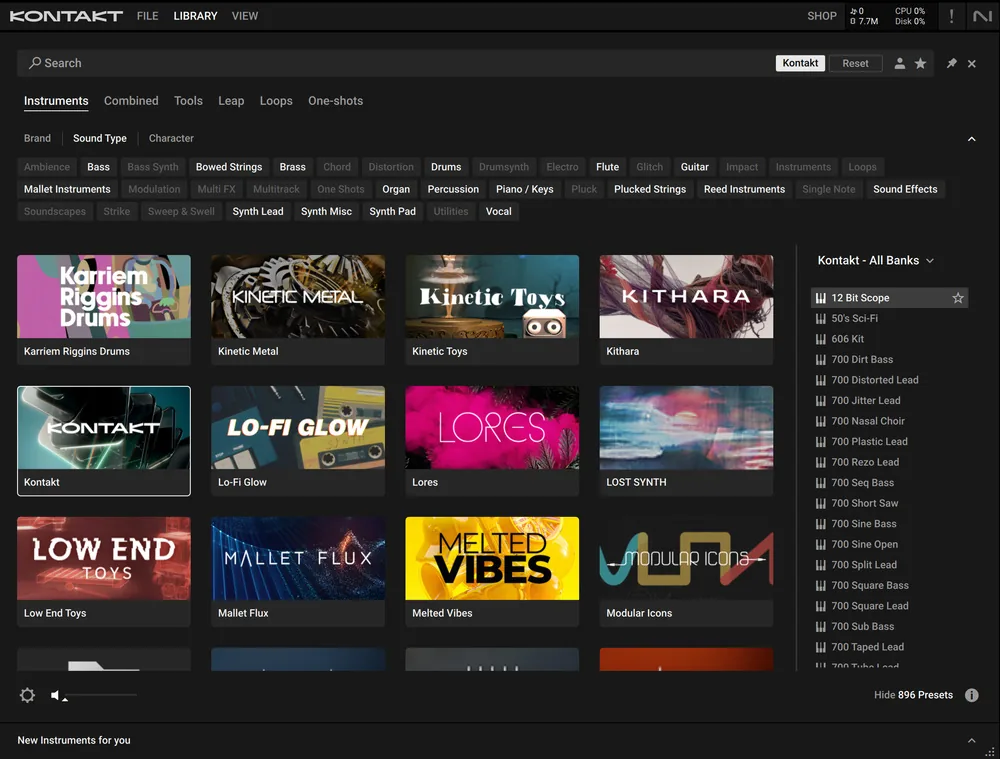
Kontakt 8 has improved its browsing experience considerably. Its Library browser separates instruments, combined presets, Tools, Leap content, loops and one-shots, which makes a large collection easier to navigate. But Kontakt is still a broader platform: depending on what you load, you may be working with anything from a simple sampled instrument to a highly detailed orchestral library with its own interface and controls.
That extra depth is useful when you need it, but it also means Kontakt can require more decisions before you reach the final sound. Nexus 5 is more consistent: open the browser, narrow down the type of sound you want, load a preset and continue producing.
This is where the difference between Kontakt 8 and Nexus 5 becomes especially clear. Both include a large amount of content, but the libraries are built for very different purposes.
Kontakt 8 comes with more than 900 instruments in its Factory Library, covering orchestral sounds, acoustic instruments, drums, choirs, synths and vintage gear. More importantly, Kontakt gives you access to thousands of additional instruments from Native Instruments and third-party developers. That ecosystem is one of its biggest advantages, especially for producers working with orchestral, cinematic, acoustic or highly specialized sampled instruments.
Nexus 5 takes a much more preset-focused approach. The Standard edition currently includes more than 5,300 factory presets, including over 1,100 introduced with Nexus 5. The library is heavily geared toward modern production styles such as EDM, house, melodic techno, hip-hop, trance and drum and bass, making it easy to find sounds that are already close to mix-ready.
The numbers are not directly comparable: one Kontakt instrument can contain an entire deeply sampled piano, orchestra section or custom sound-design engine, while a Nexus preset is typically a finished playable sound. If you want sheer preset quantity and fast browsing, Nexus 5 has the edge. If you want a broader ecosystem with detailed sampled instruments and specialist libraries, Kontakt 8 is considerably stronger.
This is where Kontakt 8 has the clearest advantage. Kontakt is built around detailed sample-based instrument creation, giving you control over mapping, velocity ranges, groups, loops, slices, envelopes, routing and effects. Its deeper instrument-building tools also include scripting and modulation, which is why so many commercial sample libraries are built specifically for Kontakt.
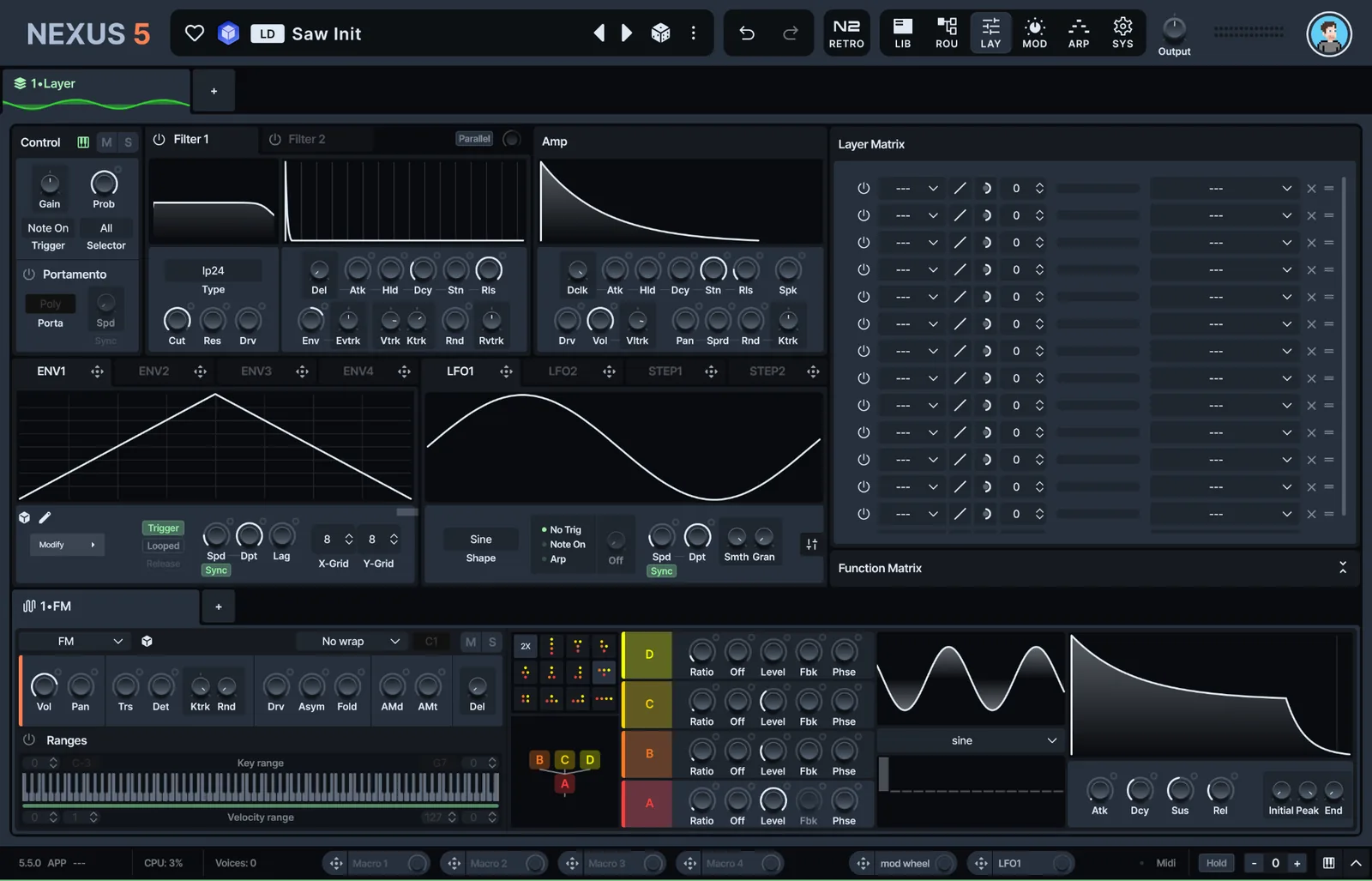
Nexus 5 is much more capable here than older versions. You can now import your own samples and use them inside several oscillator types, including Sampler, Timestretch, Retro, Cloud and Grain. It can automatically slice imported audio, detect notes, create loops and map samples across different ranges and velocities. Nexus 5 also supports importing custom wavetables, including Serum-format wavetables.
The difference is depth. Nexus 5 gives producers enough flexibility to customize presets and build considerably more original sounds than before, without losing the fast workflow Nexus is known for. Kontakt 8 goes much further when you want to construct detailed multisampled instruments or control exactly how samples behave.
Kontakt 8 is still primarily a sampling platform, but its synthesis capabilities are much stronger than the name might suggest. The updated Wavetable module adds a second Form shaper plus a modulation oscillator capable of frequency and phase modulation, while instruments such as Conflux combine sampled material with wavetable synthesis. This makes Kontakt useful for hybrid sounds that sit somewhere between traditional sampling and synthesis.
Nexus 5 takes a broader synth-style approach. It now includes eight generator types: virtual analog, sample, timestretch, wavetable, Retro, Grain, Cloud and FM. Generators can also be combined inside layers, giving Nexus considerably more sound-design flexibility than earlier versions.
The difference is in how those features are presented. Kontakt gives instrument builders and advanced users a much deeper environment for constructing custom instruments, while Nexus 5 makes its synthesis engines more immediately accessible inside the same workflow used for editing presets.
If you mainly want to create synth patches without diving into instrument development, Nexus 5 is the more straightforward option. Kontakt 8 becomes more interesting when synthesis needs to work alongside detailed sampling, scripting and custom instrument design.
This is one of the biggest long-term differences between Kontakt 8 and Nexus 5.
Kontakt has the broader ecosystem. Native Instruments describes Kontakt as a platform used by hundreds of third-party developers, with thousands of sample-based instruments available from companies such as Spitfire Audio, Audio Imperia, Slate + Ash and many smaller independent developers. The full version of Kontakt can also load unlicensed third-party libraries that are not compatible with the free Kontakt Player.
That makes Kontakt especially valuable if you expect your collection to grow over time. You can start with the included Factory Library and later add anything from orchestral sections and cinematic percussion to pianos, guitars, vocals and highly specialized instruments. Kontakt is less about buying one fixed collection and more about gaining access to an enormous library platform.
Nexus 5 also has a large expansion ecosystem, but it is more tightly centered around ready-made sounds. reFX currently offers more than 200 expansions, covering genres such as EDM, house, melodic techno, hip-hop, trance, drum and bass and newer styles. Nexus 5 also lets you create your own expansions and can load third-party expansions, so the platform is no longer limited entirely to official reFX content.
The difference comes down to what you want from that ecosystem. Nexus expansions are ideal when you want more production-ready presets in a specific genre. Kontakt libraries can go much further, with entire sampled instruments and custom interfaces that can dramatically change what Kontakt itself becomes.
CPU usage is difficult to compare directly because Kontakt 8 and Nexus 5 place very different demands on a system. Performance depends heavily on the instrument or preset you load, polyphony, effects, layering and the complexity of the patch.
Kontakt 8 can range from extremely lightweight instruments to large cinematic or orchestral libraries with multiple microphone positions, round robins, scripting and effects. In those cases, RAM usage and disk streaming can become just as important as CPU performance, especially when several large Kontakt instruments are running at the same time.
Nexus 5 is generally built around self-contained presets, but complex sounds can still use multiple layers, generators, effects and high polyphony. A simple pluck may barely affect a modern system, while a heavily layered cinematic or supersaw preset can require considerably more processing.
Because the workload changes so much from one sound to another, we would not describe either instrument as universally more CPU-efficient without running a controlled benchmark across comparable patches.
No clear winner for CPU performance. For larger Kontakt libraries, available RAM and fast storage may matter just as much as processor speed, while Nexus 5 performance depends largely on how complex the loaded preset is.
Kontakt 8 currently costs $299 for the full version, with eligible owners able to upgrade from $99. You can also buy Kontakt 8 through Plugin Boutique, where qualifying purchases currently include a free software gift at checkout, adding a little extra value compared with buying the license on its own.
The purchase gives you the full Kontakt environment and access to its huge ecosystem of Native Instruments and third-party libraries. That ecosystem is where much of Kontakt’s long-term value comes from, especially if you expect to add orchestral, cinematic, acoustic or specialist instruments over time.
Nexus 5 is more focused on giving you a large collection of production-ready sounds immediately. Its entry price can be lower depending on the current reFX offer, while larger Nexus bundles add substantially more expansions and presets.
The real difference is what you are paying for. Kontakt 8 is an instrument platform that becomes more valuable as you expand it, while Nexus 5 gives you more instant content and a faster preset-based workflow from day one.
Choose Kontakt 8 if you want an instrument that can grow far beyond the sounds included with the initial purchase. It makes the most sense for producers who work with detailed sampled instruments, cinematic libraries, orchestral sounds or custom sound design.
Kontakt 8 is the better fit if you:
Choose Nexus 5 if you want to spend less time designing sounds and more time producing. Its preset-first workflow makes it particularly useful for electronic music, beatmaking and other styles where quickly finding a polished sound matters.
Nexus 5 is the better fit if you:
Kontakt 8 and Nexus 5 are both strong instruments, but they are designed for very different producers.
Kontakt 8 is the better choice if you want depth, realistic instruments and long-term flexibility. Its biggest strength is the huge ecosystem of Kontakt libraries and the amount of control you have over sampling, instrument design and sound shaping. It takes more time to learn, but it can become the foundation of an entire production setup.
Nexus 5 is the better choice if speed matters more than deep editing. Its preset-driven workflow makes it much faster to find polished sounds and move on with a track, which is especially useful for electronic music, pop and beatmaking.
Choose Kontakt 8 if you want an expandable platform that can cover everything from orchestral instruments to complex sample-based sound design.
Choose Nexus 5 if you want thousands of ready-to-use sounds and the fastest route from opening the plugin to actually making music.

![[team] image of team member (for a mobile gaming)](https://cdn.prod.website-files.com/68efa70811edd8e5af30a90d/690abaa8987a07a672c4cd2c_channels4_profile.jpg)
![[background image] image of recording equipment (for a musician & band)](https://cdn.prod.website-files.com/68efa70811edd8e5af30a90d/6aa35b3b03d3771388765f76_Main%20Image.png)
![[background image] image of recording equipment (for a musician & band)](https://cdn.prod.website-files.com/68efa70811edd8e5af30a90d/6aa35785b8608362620d46e3_Main%20Image.png)
![[background image] image of recording equipment (for a musician & band)](https://cdn.prod.website-files.com/68efa70811edd8e5af30a90d/6aa351f638777f809800a4ff_Main%20Image.png)